

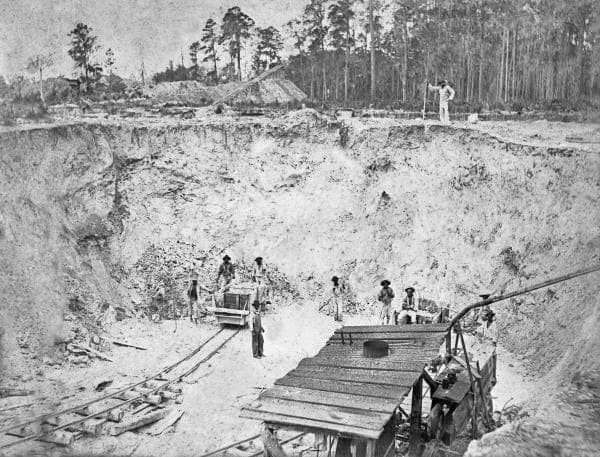
Yes, it's really called Bone Valley.
The name doesn't come from any particular darkness in the place — though the history has its share of that too. It comes from what the draglines found when they started pulling up the earth in the late 1880s: bones. The fossilized remains of creatures that had no business being in Florida, or anywhere, anymore. Four-tusked elephants called gomphotheres. Mastodons. Giant ground sloths. Prehistoric horses no bigger than a dog. Sharks whose teeth, dark and triangular, came up by the thousands in the phosphate slurry and got pocketed by mining workers who knew they were holding something strange and old.
Geologists eventually gave the deposit a formal name — the Bone Valley Formation — a shallow marine and estuarine phosphorite of Pliocene age, laid down when central Florida was the floor of a warm, shallow sea somewhere between five and twenty-three million years ago. The phosphate accumulated from the bones and waste of sea creatures, from the chemistry of ancient coastal shallows, from millions of years of slow accretion in a place that barely exists above sea level today. It underlies roughly 2,000 square miles of west-central Florida, running through Polk, Hillsborough, Hardee, and Manatee counties, sitting twenty to forty feet below the surface, waiting.1
It is, by any measure, one of the most significant mineral deposits on earth. Florida produces more phosphate than any other state, and Bone Valley is the reason. The phosphate goes into fertilizer, and fertilizer feeds the world. That's not hyperbole — it's supply chain arithmetic. Every nation with serious industrial agriculture is a phosphate consumer, and for more than a century, a meaningful share of what they've needed has come from the ground under what is now suburban Lakeland.2
The Discovery
How it started
In the winter of 1881, a U.S. Army Corps of Engineers officer named Captain Francis LeBaron was surveying the Peace River, looking for a possible canal route to Charlotte Harbor on Florida's southwest coast. What he found instead was a riverbed full of fossils and a peculiar rock pebble that tested positive for phosphate — a mineral the fertilizer industry was already hungry for.
LeBaron sent nine barrels of samples to the Smithsonian. He was excited enough about what he'd found to press Jacksonville and Philadelphia investors to "buy or bond the entire Peace River Valley."3 Nobody bit. He was ahead of his time, or ahead of the railroads, which amounts to the same thing.
By 1886 he was back, digging test pits, confirming what the first survey had suggested. And by 1889 the Peace River Phosphate Company was in business, mining the sandbars by hand with pick and shovel, loading the ore onto barges, shipping it south to Punta Gorda and from there to Europe. The age of Bone Valley had begun.
Within a few years, over two hundred companies were operating in central Florida.4 The industry grew the way boom industries do — fast, chaotic, and without much thought for what came after. Towns appeared around the mines: Bartow, Mulberry, Brewster, Fort Meade, Nichols. Narrow gauge railroads stitched the operations together, connecting mining camps to ports, bringing workers in and shipping phosphate out. The economy of Polk County, for generations to come, would be built on what was under the ground.
The Work and the Workers
The labor history that tends to get skipped over
It is worth pausing here, because the history of Bone Valley is also a labor history, and that part tends to get skipped over.
The early mines ran on cheap labor. Convict leasing — the practice of contracting out prison inmates to private industry — was documented in Polk County's phosphate operations. Debt peonage, by which workers were bound to their employers through manufactured financial obligation, appeared in the county's own historical records.5 The workforce was largely Black, drawn from communities that had few other options in a segregated Florida economy. These were the men who built the industry from the ground up, in brutal conditions, for wages that reflected neither the value of what they were extracting nor the danger of the work.
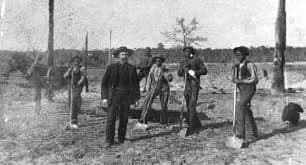
In April 1919, three thousand white and Black union members walked off the job together at phosphate mines across Polk County — Lakeland, Bartow, Mulberry, Brewster, Fort Meade, among others. It was one of the more remarkable moments in Florida labor history: an interracial strike in the Jim Crow South, at a time when the rest of the country was convulsed by postwar labor unrest. The strikers held out for months. By December, most companies had agreed to wage increases and shorter workdays.6
The effects reached Europe. Germany's Secretary of Agriculture noted in 1920 that the country had obtained only about 28 percent of the phosphoric acid fertilizer it needed — partly because Polk County miners had put down their tools.7 That detail is worth sitting with. The men working the pits outside Mulberry had enough leverage to affect the food supply of a continent. That's how much the world needed what was under Polk County.
The Machines Arrive
When the draglines came
By the 1920s, technology was displacing labor in the mines the way it displaces labor everywhere. The instrument of change was the dragline — a machine so large it evokes science fiction more than industry. Draglines are engineered to walk on pontoon-like feet across the landscape, pivoting on a central mast, swinging a bucket that holds forty-five to sixty-five cubic yards of earth at a time. At Mosaic's Four Corners Mine, nine of them work simultaneously around the clock, stripping the overburden and dredging up the phosphate matrix in an operation that looks, from a distance, like the earth is eating itself.8
The mining process strips thirty to forty feet of overburden — the clay, sand, and topsoil above the phosphate layer — and dumps it in spoil piles beside the excavation. Then the matrix beneath is dredged and slurried through miles of pipe to a washing plant, where the phosphate is separated from the sand and clay. The sand goes back to the mined area as fill. The clay — a water-saturated slime of extraordinary volume and almost no structural bearing capacity — gets pumped into settling ponds that can cover hundreds of acres, elevated sometimes sixty feet above the surrounding grade.9
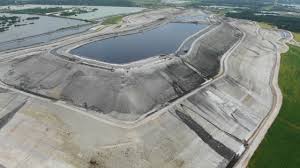
Before 1975, none of this required reclamation. You could mine a piece of Polk County, leave the pits, the spoil piles, the settling ponds, and the moonscape, and move on. Many companies did. The result, across large parts of the county, was a landscape that looked like the aftermath of something — which, in geological terms, it was.
Kissengen Spring
What the aquifer gave, and what the industry took
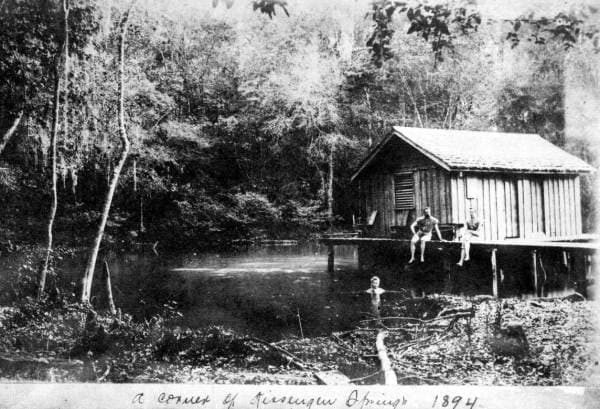
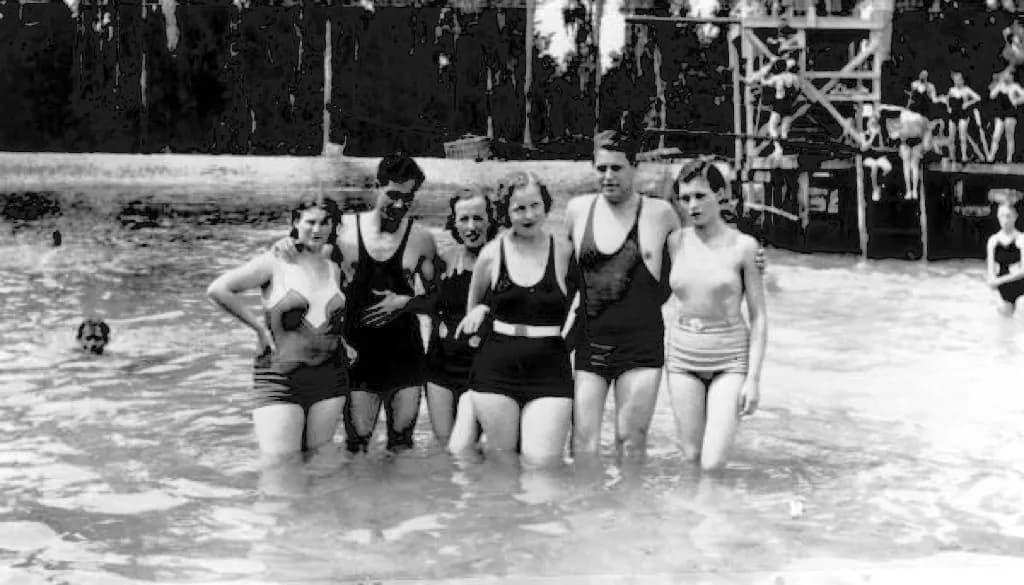
Kissengen Spring is worth pausing on — not as an indictment of the industry, but as a measure of scale. At its peak, the spring discharged twenty million gallons of crystal-clear water a day into the Peace River, rising from the Floridan Aquifer with enough pressure that the strongest swimmers reportedly couldn't reach the boil. For decades it was a genuine destination — bathhouses, a dive platform, a dance floor, political rallies in the 1930s, a rest and recuperation site for military personnel during World War II. The people of southern Polk County loved it the way people love a place that feels like it will always be there.
In February 1950 it stopped flowing. The aquifer pressure that fed it had been diminished by decades of industrial groundwater withdrawal — the phosphate industry was a primary driver, though agriculture and early development added to the draw. A 1962 sinkhole near the springhead filled the vent with clay and probably sealed the underground channels for good. There are restoration projects underway, involving Lake Hancock water levels and constructed wetlands on former phosphate settling areas, but nobody has made promises about Kissengen coming back.10
I've walked past the historical marker at Mosaic Peace River Park more times than I can count — it's marked on the trail map, easy to miss if you don't know to look for it. A while back I ducked under a fence onto some off-road jeep club's property to find the actual spring site, about a mile north of the park. There's not much left — two shallow depressions in the ground, some old stonework, the remnants of the spillway steps. I sat on those steps for a while. The sign is the thing I keep thinking about. — V.S.
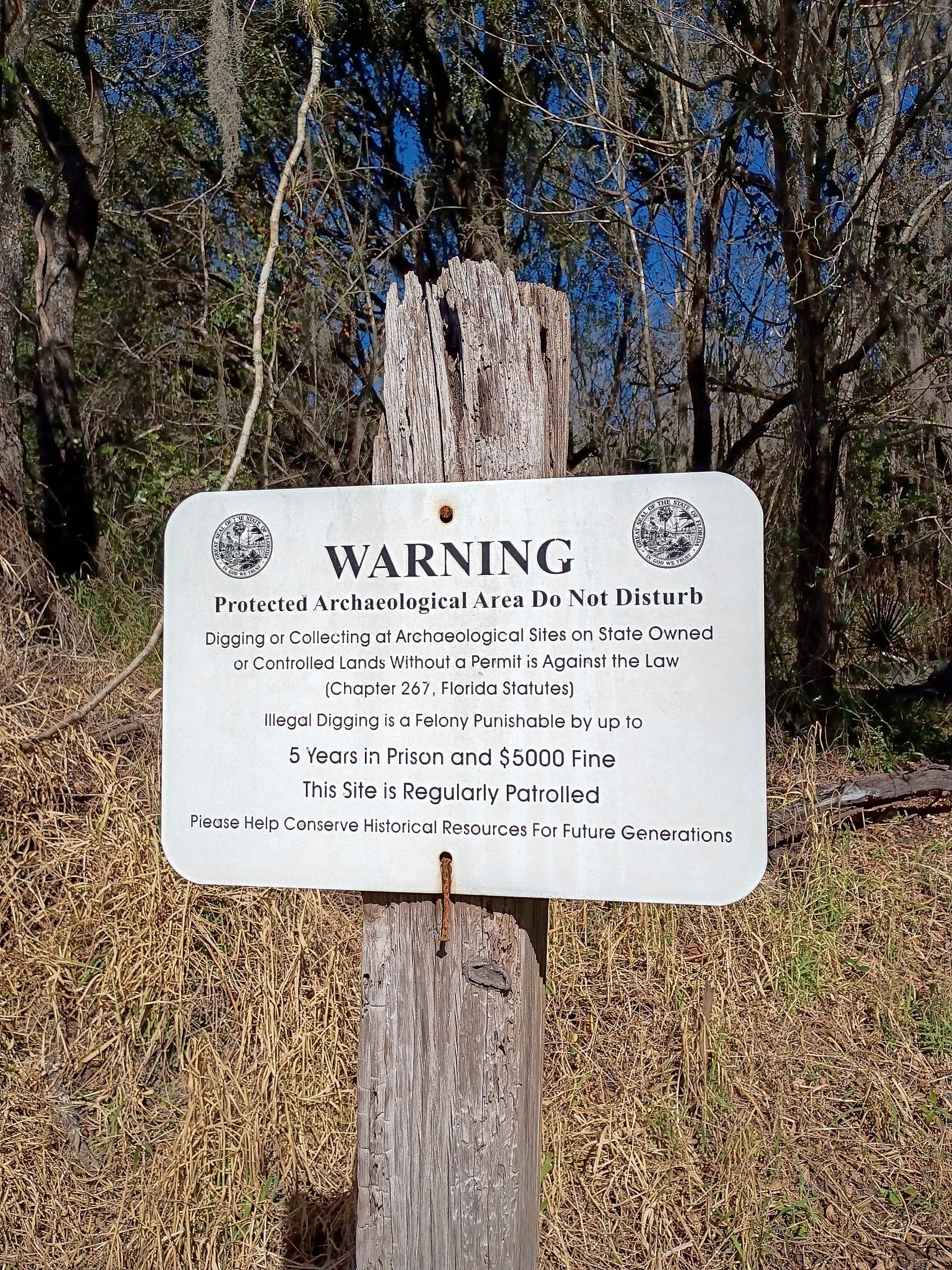
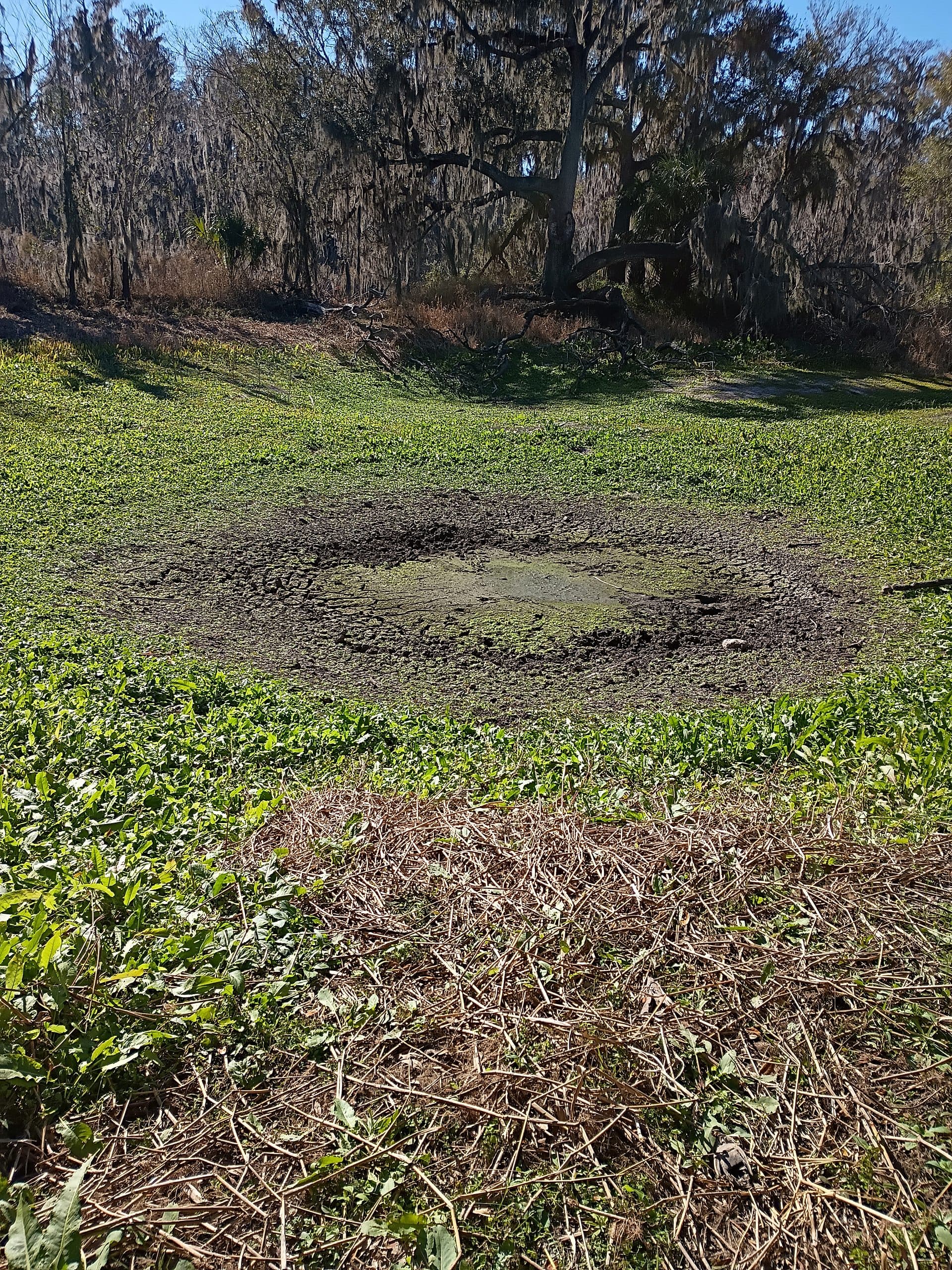
None of this is simple to assign blame for. The mines built Bartow, Fort Meade, Mulberry. They funded the railroads that connected Polk County to Tampa and the rest of Florida. They fed Europe when European agriculture was starving between the wars. They created the tax base that built the schools and the roads. The spring that's gone is the cost side of a ledger that also includes the towns you drive through and a significant portion of the world's food supply for over a century. Whether that trade was worth it is not a question with a clean answer, and it's not one this article is going to settle.
The Law Changes
1975 and reclamation
In 1975, Florida required that all newly mined phosphate lands be reclaimed — returned to what the law called "beneficial use."11 The definition was deliberately flexible: farmland, forest, wetland, recreational area, wildlife habitat, residential development. What it meant in practice varied enormously.
Some reclaimed land became parks. The Tenoroc Public Use Area, north of Lakeland, is today one of the region's most popular fishing destinations — twenty-four lakes stocked with largemouth bass, tilapia, and catfish, surrounded by pine flatwoods and cypress wetlands. The name is "Coronet" spelled backwards, a quiet acknowledgment of the Coronet Phosphate Company that mined the land from the 1950s until 1978, along with Smith-Douglass and Borden. In September 1982, Borden donated the property to the state. A sign at the entrance reads: From Mine to Yours.12
Some became golf courses. Eaglebrook, in Polk County, owes its rolling topography entirely to phosphate. Hardee County, which had virtually no natural lakes before mining, now has Hardee Lakes Park — a 1,150-acre fish management area with four large lakes that were, not long ago, phosphate pits.13
And some became neighborhoods.
Lakeland's Christina community — with its waterfront homes, mature oaks, and deed restrictions — is built on a former phosphate mine. The hills that give the neighborhood its character are spoil piles, reshaped and revegetated. The lake at its center is a reclaimed pit. Development there began in the early 1970s, before reclamation was required by law.14 The same is true of dozens of other residential properties throughout Polk County where someone is living on waterfront that was never, geologically or hydrologically, anything like a natural lake.
This is not a criticism of those properties. Many of them are genuinely beautiful. It is simply the truth of what's underneath them — and why it matters to anyone making decisions about that land.
What's Underground
What reclamation looks like below the surface
The land looks healed. That's the thing about Polk County's reclaimed phosphate terrain. Drive through Christina, through the neighborhoods around Bartow and Mulberry, through the subdivisions that ring what look like pleasant freshwater lakes, and you see lawns and docks and boats and kids swimming. You see nothing unusual.
What you don't see is the soil profile beneath the surface.
Reclaimed phosphate land is typically layered in a way that bears no resemblance to the native Florida soil that preceded it. The mining process excavated, transported, sorted, and mechanically repositioned the earthen material into post-reclamation landforms that the University of Florida's soil scientists classify as Entisols — soils with little to no profile development, essentially starting over from scratch.15 Beneath a surface layer you might find compacted overburden, then sand tailings that offer some friction but no real bearing capacity, then — in former settling pond areas — phosphatic clay slime that geotechnical engineers building the Polk Parkway described as "a special problem encountered by developers and builders in Polk County and hardly anywhere else in the world." Those slime deposits can run thirty to forty feet deep and do not consolidate under load the way natural soil does.16
For anyone building a dock, installing a seawall, or making decisions about their shoreline on a reclaimed phosphate lake, the soil conditions are different from those on a natural lake in ways that affect piling depth, wall bearing capacity, drainage behavior, and the rate at which soil migrates through or around a structure. A contractor who doesn't know what they're building on will spec a structure for conditions that don't exist at that site. It's one of the more common and least discussed problems in Polk County waterfront construction.
The Lakes
The lakes you're looking at
If you have moved to Polk County recently, or are thinking about it, there is a reasonable chance that the lake behind the house you're considering is not a natural lake. Polk County does have 554 named natural lakes — more than any other county in Florida — but it also has an unknowable number of former phosphate pits that have been filled, reshaped, and sold as waterfront property. The two categories can look identical from shore.
The distinction matters less than you might think for daily life. The bass at Tenoroc don't know or care that their lake was a phosphate pit fifty years ago. The families on Christina Lake have built real communities on ground that was strip-mined a generation before they arrived. The land recovers, in its way — the cypress comes back, the birds find it, the fish thrive.
What the distinction does matter for is construction. The soil is different. The hydrology is different. The history of what's underground is different. None of that makes a reclaimed lake a bad place to build — it makes it a place that deserves to be understood before you build.
A Place Worth Understanding
What's true about Bone Valley
Bone Valley is not a valley. Geologists named it for the fossils, not the topography — it's actually a high point in Florida's otherwise flat interior, the ancient seafloor tilted slightly by the Ocala Uplift.17 The name stuck anyway, the way names do when they capture something true about a place, even if the truth is more metaphorical than geographic.
What's true about Bone Valley is that it is one of those rare places where the deep past is genuinely close to the surface. Not in the romantic sense that historians invoke — in the literal sense that you can pick a shark tooth out of a spoil pile, that the draglines turn up mastodon molars alongside the phosphate pebble, that the soil profile in your backyard may be the rearranged remnants of a Miocene seafloor. The ancient world is underfoot here in a way that is almost nowhere else in the United States.
People move to Polk County for the lakes, the weather, the relative affordability, the absence of certain frictions that larger Florida cities have accumulated. They move here and learn, slowly, that the county has a history as layered as its soil — a history of extraction and labor and consequence and, eventually, of something that looks like recovery. The spring that may never come back. The lakes that fill the pits. The neighborhoods on the spoil piles, full of children who will grow up not knowing what's beneath the grass.
That's not tragedy. That's just what places are, if you look at them long enough.
Citations & Sources
- Altschuler, Z.S., et al. Geology and Geochemistry of the Bone Valley Formation and Its Phosphate Deposits, West Central Florida. U.S. Geological Survey, 1964.
- Scenario Journal. "One Percent: Mining Bone Valley." scenariojournal.com, 2015.
- WUFT News / The Price of Plenty. "Phosphate: Florida's Hidden Backbone." projects.wuft.org, June 2023.
- Florida Museum of Natural History / Thompson Earth Systems Institute. "Environmental History: Phosphate Mining." floridamuseum.ufl.edu.
- Fifer, Richard A. "A Case of Peonage." Polk County Historical Quarterly 33, October 2006.
- Melillo, Edward D. "A Global Environmental History of the 1919 Phosphate Strike." Yale Agrarian Studies Program.
- Ibid.
- WUFT News / The Price of Plenty. "Phosphate: Florida's Hidden Backbone." June 2023.
- Florida Department of Environmental Protection. "Phosphate Mining." floridadep.gov.
- Wikipedia. "Kissingen Springs." Citing Florida DEP and Southwest Florida Water Management District restoration documentation. See also: People for Protecting Peace River. "Kissengen Springs." protectpeaceriver.org.
- Florida Statutes, Chapter 378, Part II. Mandatory Phosphate Mine Reclamation. Florida Legislature, 1975.
- Florida Fish and Wildlife Conservation Commission. "Tenoroc Public Use Area." myfwc.com.
- Florida Trend. "What Happens to Old Mine Land?" floridatrend.com.
- Christina Lake, Florida. See also: Florida DEP Nonmandatory Land Reclamation Program.
- Mylavarapu, R., et al. "Florida Reclaimed Phosphate Mine Soils." University of Florida EDIS Publication SL370.
- Penny, Neal (Parsons Brinckerhoff), quoted in "Polk Parkway Paving Slips on Mining Slime." Superintendent's Profile.
- Bone Valley Fossil Farm. "History." bonevalleyfossilfarm.net.