Services
Not every eroding shoreline needs a seawall.
We help Central Florida waterfront owners choose the right solution for the full edge of the property — whether that means rip-rap, grading, native restoration, stabilization, or a larger structural answer.
What we help with
- →Shoreline erosion control
- →Rip-rap and armor stone
- →Grading and edge recontouring
- →Native shoreline restoration
- →Erosion control fabric and geotextiles
- →Coordination with dock or seawall work
Our approach
- →We read the whole edge condition
- →We identify the true cause of erosion
- →We recommend the simplest solution that works
- →We'll tell you when a seawall is — and isn't — needed
- →Permits handled
Not every eroding bank needs a seawall. That's worth saying plainly, because a lot of homeowners come to us expecting to hear otherwise.
On many Polk County lakes, the right fix is simpler and less expensive than a full seawall — and it works better for the site. Riprap, native vegetation, a combination approach. The goal is to stop the erosion with the right solution for what's actually happening on your shoreline, not the most expensive one that'll hold.
That said, some shorelines do need a seawall. We'll tell you which one you're looking at.
We'll be honest with you: we love talking someone out of a seawall. Not because it's less work — it usually isn't — but because the best solution for a shoreline is the one that works with what's already there rather than against it. When we can stabilize a bank with riprap and native plantings instead of concrete and sheet pile, the shoreline is better for it, the water is better for it, and your wallet is considerably better for it. We're not in the business of selling structure. We're in the business of solving the problem.
What We Do
Shoreline services in Central Florida
Riprap Installation
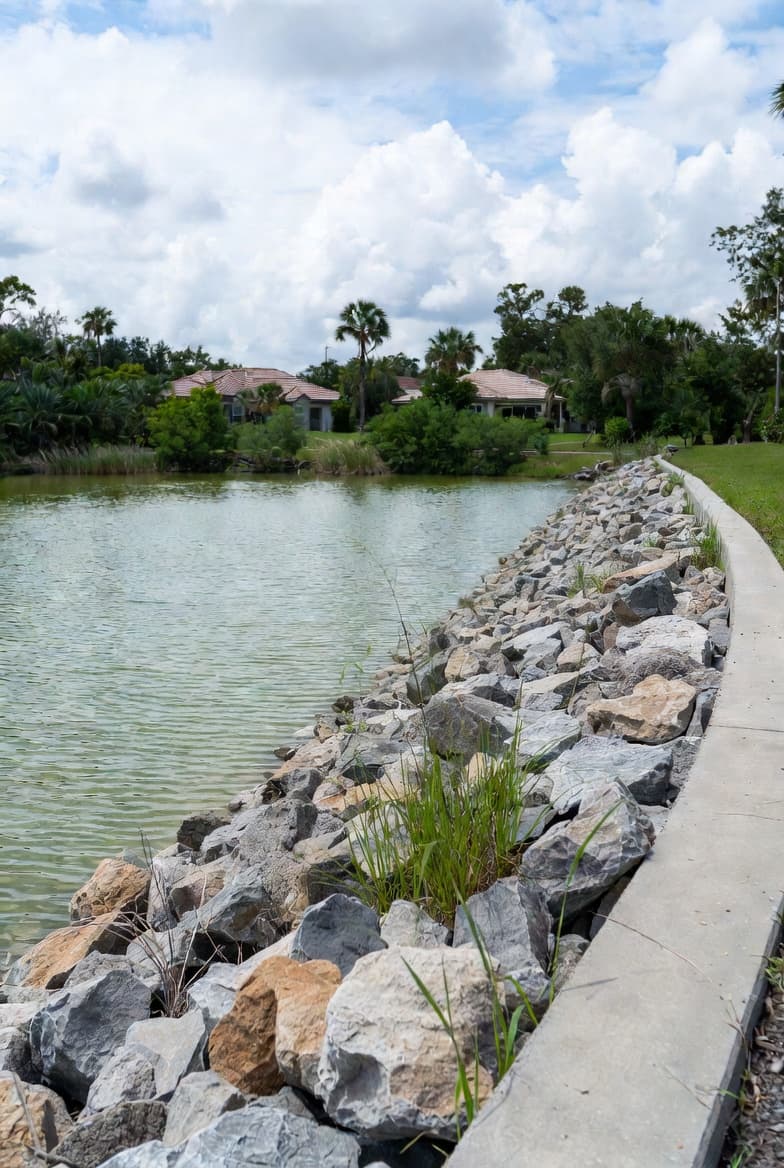
Florida limestone rock placed along the waterline to absorb wave energy and stop soil loss. The right stone size depends on wave exposure — larger rock for high-traffic lakes like Lake Eloise or Lake Juliana, smaller material for quieter shorelines. Properly installed riprap on a Polk County lake can protect a shoreline for decades with minimal maintenance.
Native Vegetation & Bio-Stabilization
Deep-rooted native Florida plants — pickerelweed, muhly grass, arrowhead — bind soil in a way turf grass can't. On shorelines with moderate erosion and manageable wave exposure, a well-installed native plant buffer can stop active erosion without any hard structure. It also improves water quality and creates habitat.
Erosion Control Fabric & Geotextiles
Heavy-duty fabric placed under rock or plantings to prevent soil from migrating while still allowing water movement. The hidden layer that keeps a riprap installation performing the way it's supposed to years later.
Shoreline Grading & Recontouring
Before you can stabilize an eroded bank, sometimes you have to reshape it. We regrade to a stable slope first, then install the appropriate protection above it.
Combination Shoreline Systems
Most effective restorations use more than one approach. Rock at the waterline to handle wave energy, coir matting on the slope above it, native plants rooted through the mat as the long-term anchor. The combination is usually better than asking one material to do every job — and often less expensive than going straight to hard structure.
Is your shoreline eroding?
Free waterfront assessment · License #SCC131154313
Materials
What we use and why
Florida Limestone Riprap
The regional standard for shoreline protection. Locally sourced, cost-effective, and sized to the wave energy at the site. Angular rock interlocks and dissipates wave energy rather than deflecting it. Properly installed, it's durable and low-maintenance for decades.
Native Deep-Root Vegetation
The most sustainable long-term solution for moderate erosion. Native species adapted to Florida lake edges build root systems that bind soil through wet and dry seasons without irrigation after establishment. Species selection matters — the right plants for the light, water depth, and soil conditions at your site.
Coir & Geotextile Fabric
Coir (coconut fiber) matting is the preferred erosion fabric for most shoreline applications. Biodegradable, it breaks down over several years as plant root systems take over — leaving no synthetic material in the lake environment. Geotextile fabric is used where longer-term separation between soil and rock is needed.
Common causes of shoreline erosion on Polk County lakes
- →Boat wake — the biggest driver on high-traffic lakes; the Chain of Lakes sees constant recreational traffic that compounds over a season
- →Storm runoff concentrating water flow along unprotected banks
- →Turf grass, which provides almost no soil-binding capacity compared to native deep-root plants
- →Florida's wet/dry cycle saturating and drying exposed soil — accelerates loss once the bank is unprotected
Shoreline restoration is almost always less expensive when there's still something left to stabilize.
Credentials
Why state certification matters for shoreline work
Shoreline work in Florida regularly crosses the ordinary high-water line — which puts it inside the regulatory jurisdiction of the Florida DEP. Homeowners who hire contractors unfamiliar with that boundary can find themselves with unpermitted work and cleanup liability.
Our license is SCC131154313 — state certified through the Florida DBPR. We're familiar with DEP's permitting requirements for shoreline work on inland freshwater lakes and manage all agency correspondence directly.
Workers' compensation applies here too. Marine and shoreline construction carries WC class code 06006. A contractor with a landscaping or general construction policy may have a gap in coverage for waterline work.
Before hiring any shoreline contractor, ask:
- →Are you Florida state certified, and what's your license number?
- →Does your workers' comp cover marine and shoreline work under class code 06006?
- →Who handles permits and agency coordination?
- →Have you worked on Polk County freshwater lakes specifically?
- →What are you recommending, and why — not just what?
Is your shoreline eroding?
Free waterfront assessment · License #SCC131154313
Service Area
Areas we serve
Lakeland
Lake Hollingsworth · Lake Bonny · Lake Morton
Winter Haven / Chain of Lakes
Lake Eloise · Lake Shipp · Lake Howard · Lake Cannon · Lake Roy · Lake Lula
Auburndale
Lake Ariana · Lake Juliana · Lake Lena · Lake Van
And throughout: Polk City · Lake Alfred · Haines City · Eagle Lake · Lake Wales · Davenport
FAQ
Common questions
What causes shoreline erosion on Florida lakes?+
Boat wake is the primary driver on high-traffic lakes. Storm runoff, turf grass with shallow roots, and Florida's wet/dry seasonal cycles all contribute. On the Chain of Lakes, where recreational traffic runs most of the year, wake erosion on unprotected banks is constant.
Riprap or seawall — how do I know which one I need?+
Riprap is typically the right answer for moderate erosion on banks without significant vertical drop and without severe wave exposure. A seawall becomes the right call when you need vertical retention — when the bank is already steep, when property or structures are close to the water, or when wave energy is too strong for soft solutions to hold. We make that call after seeing the site, not before.
How fast can I lose property to shoreline erosion?+
It varies by lake and exposure. On a quiet lake with sandy soil, a few inches a year. On a high-traffic lake with an unprotected bank, a foot or more per year during an active storm season isn't unusual. The compounding problem is that erosion accelerates once vegetation is gone and the soil is exposed.
Do I need a permit for shoreline restoration in Polk County?+
It depends on scope and location. Some native vegetation planting qualifies for a DEP exemption. Riprap typically requires a Polk County local permit and may require DEP review. We assess the permit requirements as part of the site evaluation.
Can native plants actually stop erosion?+
On moderate slopes with manageable wave exposure, yes — especially when paired with proper grading and erosion control fabric. Native plants are usually part of a broader strategy rather than a standalone fix for severe erosion. On high-traffic lakes, the plant buffer handles the upper bank while rock handles the waterline.
How does riprap compare to a seawall in cost?+
Riprap and vegetation solutions are typically far less expensive than a full seawall. The gap can be significant. We provide written estimates after the site visit so you can compare real options for your property.
Get a free waterfront assessment
If your shoreline is eroding — or you're not sure whether it is — we'll come take a look at no charge.
We got a call after one shoreline project — a customer laughing, wanting to tell us what happened when a friend of theirs, a fisherman, came by for dinner and saw the bank for the first time. He didn't know anyone lived there. He thought it was a nature preserve. That's what a restored shoreline looks like when it's done right.
(863) 934-6218State Certified Marine Contractor · License #SCC131154313 · Fully insured · Polk County & surrounding areas