

April 28, 2026
Lake Hunter, Lakeland: The Afternoon the Gator Wouldn't Let Go
On a June afternoon in 2016, Lakeland police arrived at Lake Hunter to find a nine-foot alligator spinning in the shallows with a man's body still in its mouth
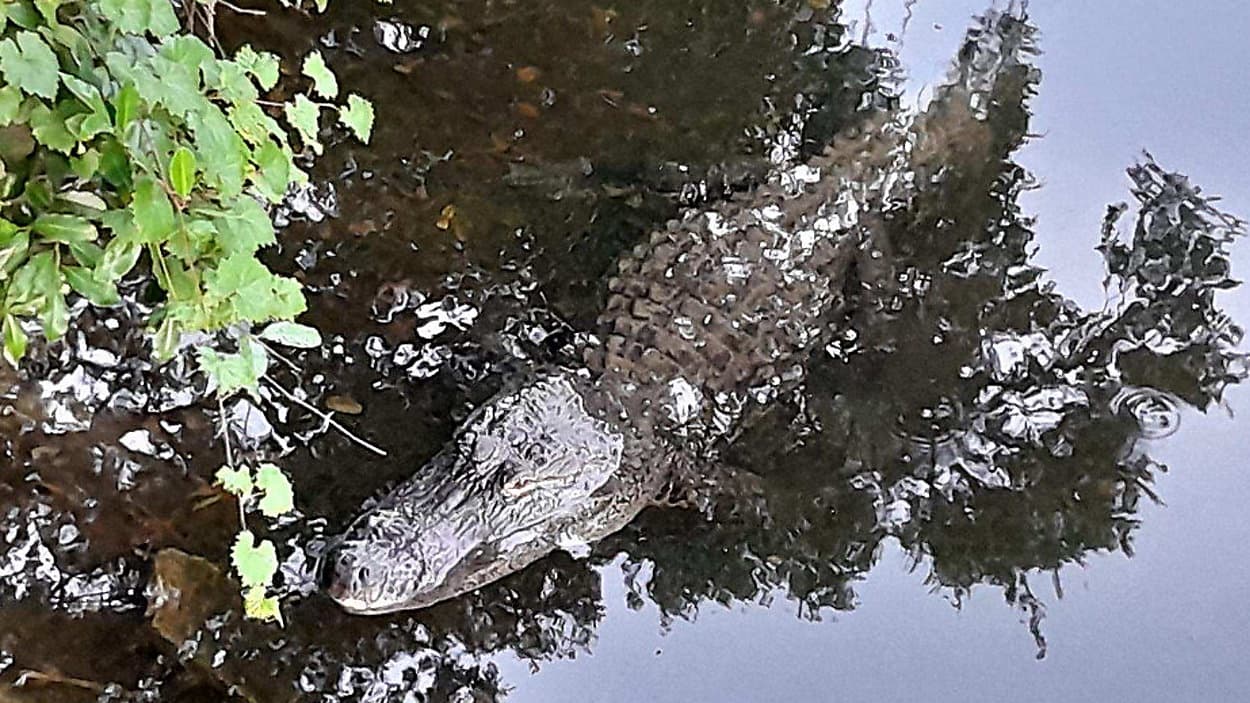
The call came in to the Lakeland Police Department around 1:40 p.m. on a Tuesday in June 2016. Someone had seen something near the corner of Lake Hunter Drive and Cresap Street, on the southwestern edge of the lake, and what the officers found when they got there is the kind of scene that doesn't quite belong to a city lake ringed by bungalows and a public park. A nine-foot alligator was in the water with the body of a man in its mouth, and it was spinning. The gator eventually released the body and swam off. Police recovered the man, later identified as 72-year-old Richard Taylor.
What made the story stranger is what came next. Officers had actually been called out the day before — Monday — after someone reported seeing a body in Lake Hunter with an alligator circling it. They'd searched and found nothing. By Tuesday afternoon, the body had reappeared, and the gator was still there. A Florida Fish and Wildlife Conservation Commission official told Sgt. Gary Gross of the LPD that alligators sometimes cache food and return to it, which might explain the gap. "All the rain may have dislodged it," Gross said. The 9-foot animal was captured and killed.
Most people who walk the path around Lake Hunter today don't know any of this happened. The lake sits inside the city — 91 acres, shallow, ringed by old neighborhoods and the Lake Hunter Terrace Historic District, which was added to the National Register in 2002. There's a park. People fish from the bank. The lake connects, through Lakeland's tangle of urban water, into the broader Mirror–Morton system that gives the city its downtown character. It is, by every visible measure, a tame lake. A neighborhood lake. The kind of place where a heron in the shallows is the most dramatic thing you'll see in a year.
But Lake Hunter is also genuinely wild in a way urban Florida lakes tend to be — shallow, warm, vegetated at the edges, and well within the home range of large gators that have lived there long before the bungalows went up. The 2016 incident is a reminder that "city lake" in Central Florida is a category the alligators never agreed to. Lake Hunter is on the FDEP's verified impaired surface water list for nutrients — total nitrogen, phosphorus, and chlorophyll-A all running above state standards — which is what you'd expect for a shallow basin sitting inside a century of urban runoff. Those same conditions, the warm shallow margins and dense bankside cover, are exactly what makes it good gator habitat.
The lake made news again in November 2025, when residents started noticing dead American shad floating in the shallows. FWC investigated; the working theory pointed to a cold snap, a kill triggered by temperature shock in a fish species that runs thin in this part of its range. Two news cycles, almost a decade apart, both about Lake Hunter, both about something the lake produced that nobody expected to see from a city sidewalk.
The 2016 case never became a true-crime story. There was no foul play established, no headline arc, no dramatic resolution beyond the recovery itself and the destruction of the animal. Taylor's death entered a state-maintained list of fatal Florida alligator encounters and stayed there, one line among many. The lake went back to being what it had been the morning before — a shallow, tea-colored basin in the middle of Lakeland with a paved walking path and people fishing off the docks at the park.
That's really the thing about Lake Hunter. It looks settled. It looks like the city won the negotiation a long time ago. The historic district on its eastern shoulder, the bungalow rooflines, the curated park benches — all of it suggests a lake that has been domesticated into a backdrop. But the water itself never agreed to that arrangement. A 9-foot alligator had been living in it, hunting in it, caching in it, the entire time. The June 2016 afternoon is the one day that fact pushed itself onto the police blotter and into the paper.
Most days, you can stand on the bank and not think about any of it. The lake doesn't advertise its history. But Lake Hunter has had a Tuesday afternoon that most lakes haven't, and the shallow margins that made the scene possible are still right there, doing what they've always done.
Presented by

Own waterfront in Lakeland?
Lake history is interesting. Shoreline conditions are practical. Horizon Marine builds docks, seawalls, and shoreline protection on Lakeland's lakes — and gives a straight answer on what your property actually needs.
Lake Osceola, Winter Park: The Boat Tour That Outlasted Everything Else in Orlando
The narrow canals between Winter Park's lakes were dug for Gilded Age homeowners — and in 1938 they became the route for an attraction that has run longer than anything else in greater Orlando
Read →
Lake Down, Windermere: The One Public Door Into the Butler Chain
The only public boat ramp on the entire Butler Chain of Lakes sits on Lake Down — and it almost didn't stay there
Read →
Lake Harris, Tavares: The Day the College Record Fell
In January 2022, two brothers fishing a college tournament on Lake Harris brought a five-bass limit to the scales that weighed more than any single-day catch in the history of the Bassmaster College Series
Read →
Moon Lake, New Port Richey: The Four Miles of Roses in the Pine Flats
In the 1930s a Clearwater hotel man ringed a Pasco County lake with 35,000 rose bushes and four miles of blooms, and drew Rex Beach and a Vanderbilt to a dude ranch in the pine flats
Read →
Building on Lake Hunter or another Lakeland lake?
Free waterfront assessment · License #SCC131154313