

April 25, 2026
Lake Lulu, Winter Haven: The Park That Gave the Chain Away
Before Winter Haven had a public park on its chain of lakes, it had to build one — and the lake they chose was Lulu
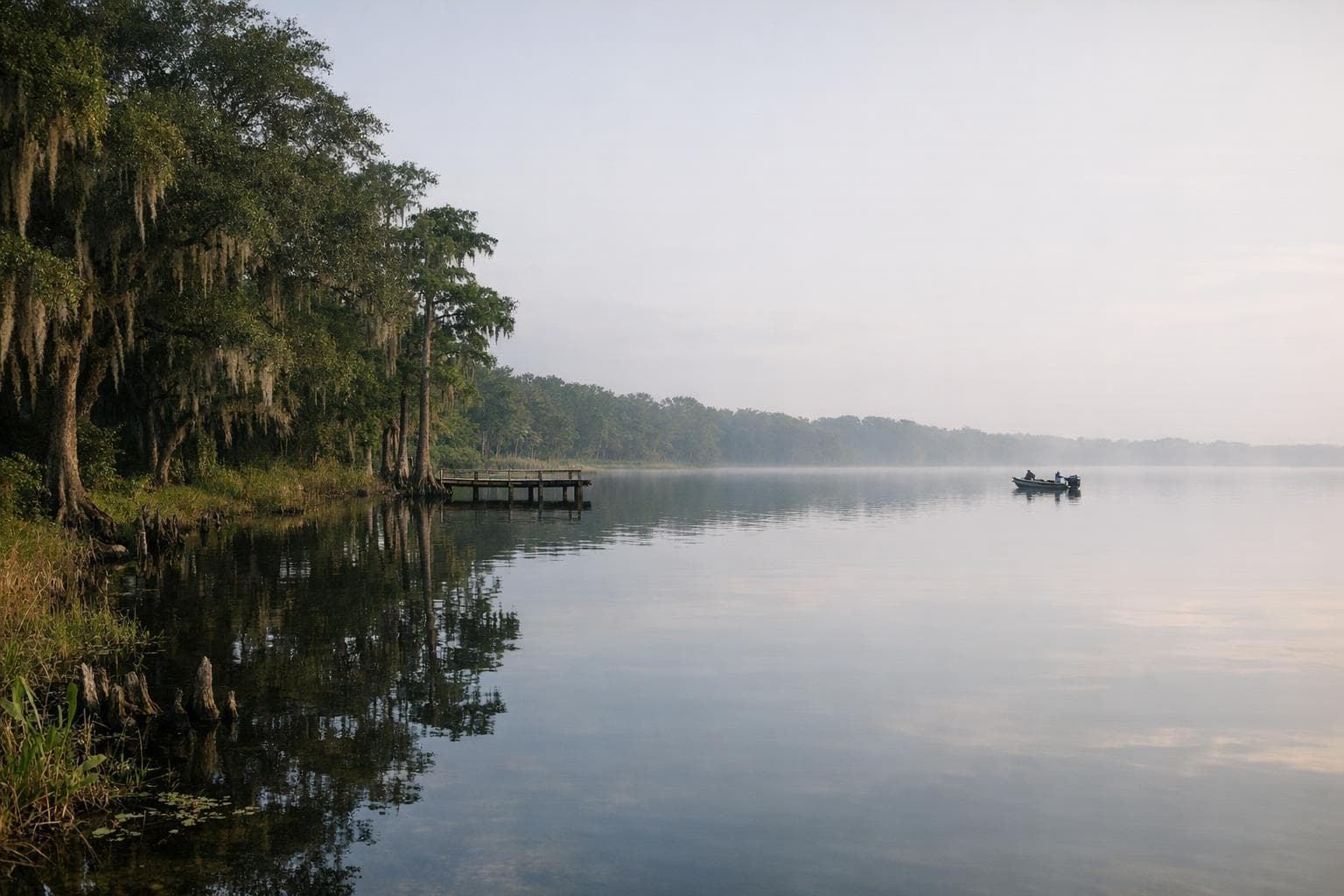
For a town defined by its lakes — more than fifty of them, depending on who's counting and how wet the year has been — Winter Haven was surprisingly slow to give the public a proper place to enjoy them. Through the first half of the twentieth century, the lakes were for citrus growers who backed up to them, for the families whose names got attached to the shorelines early, and eventually for Dick Pope, who turned Lake Eloise into a stage set for water-ski spectacles at Cypress Gardens. The chain was famous, but the fame belonged to private interests. If you were a resident without lakefront property, your relationship with the water was mostly a matter of driving past it.
That changed in 1966, on Lake Lulu. That's when the city built Chain of Lakes Park — not on Eloise, not on Howard, not on one of the northern chain lakes that had been drawing attention since the canals were first dug in 1915, but on this quieter, irregularly shaped lake at the southern end of the system. The choice was deliberate. Lulu sat at the seam between the southern chain and the rest of Winter Haven's waterways, connected by the same canal system that had been knitting the lakes together for decades. It was accessible without being overdeveloped. It had room. And it gave Winter Haven something it had never really had: a front door to its own defining feature.
It's easy to underestimate what that meant. The Chain of Lakes canals — started in 1915, the product of civic ambition and a whole lot of dredging — had created one of the most unusual navigable freshwater systems in Florida. You could put a boat in at one lake and, through a series of narrow, hand-dug canals, wind your way through a half-dozen others without ever touching a trailer. But the system was built for drainage and flood control, and later for the convenience of lakefront property owners. Public access was an afterthought. Chain of Lakes Park on Lulu was the city's belated acknowledgment that this interconnected water — the thing that made Winter Haven different from every other small Florida city — ought to belong to everyone, at least in one place.
The lake itself is an unusual shape, which is part of what makes it interesting from the water. Wikipedia describes it as a "somewhat irregular oval," which is generous. Lulu comes to a point at its east and west ends, so it's more like a lens or an eye — wide in the middle, tapering to narrow tips where canals and shoreline close in. It covers somewhere around 280 to 315 acres depending on the source and the water level, which in Polk County can shift meaningfully between wet season and dry. The north and northeast shore is lined with private residences, the way most Winter Haven lakes are, but the southern and western edges — that's where the park lives, where the public got its foothold.
The name itself is one of those Polk County mysteries that the record doesn't fully resolve. The research seeds suggest it was named for a settler family, which would fit the pattern. Many of Winter Haven's lakes carry the names of the families who homesteaded near them in the 1880s and 1890s — the Eycleshimers, the Jacksons, the Sykes, and others who arrived before the town was even incorporated in 1911. But the specific Lulu — whether it was a surname, a given name, a daughter or a wife — doesn't surface clearly in the available record. It's a common enough story in Florida place-naming: someone's name gets pinned to a lake, and within two generations, nobody remembers whose it was or why. The name outlasts the memory.
What Lulu became, though, is worth knowing. It became the lake where Winter Haven finally turned outward. Chain of Lakes Park grew into the civic gathering spot — the place for fishing from shore, for launching a boat into the southern chain, for sitting by water that your tax dollars entitled you to sit by. It's not glamorous in the way Cypress Gardens was glamorous. It's not a spectacle. It's a park on a lake in a town full of lakes, and the remarkable thing about it is simply that it took until 1966 for Winter Haven to build one.
The southern chain, where Lulu sits, has always been the quieter sibling to the northern chain. The northern lakes got the spring training camps — the Boston Red Sox, and later the Cleveland Indians. They got more of the tourism traffic, more of the development pressure. The southern chain got anglers chasing largemouth bass in the two-to-five-pound range, got crappie fishermen working the edges in the cooler months, got the kind of use that doesn't generate headlines. Lulu fits that character. It's not the lake you visit to be impressed. It's the lake you visit to understand what the chain actually is when nobody's performing for a camera.
If you're on the water and you idle through the canal connecting Lulu to Lake Shipp to the north, you're tracing the route those original 1915 canals made possible — the same route that turned a scattering of separate lakes into a single navigable system. That system is the real story of Winter Haven, and Lake Lulu is where the city finally decided to let everybody in on it.
Presented by

Own waterfront in Winter Haven?
Lake history is interesting. Shoreline conditions are practical. Horizon Marine builds docks, seawalls, and shoreline protection on Winter Haven's lakes — and gives a straight answer on what your property actually needs.
Lake Pierce, Lake Wales: The Five-Day Haul From Net to Railroad
Before it was a fish camp, the north shore of Lake Pierce was a commercial netting operation that hauled its catch out over log roads on a five-day round trip to the railroad — back when the lake was called Cat Fish Lake.
Read →
Lake Tracy, Haines City: The Ditch That Got Its Own Government
A drainage ditch that begins at the north end of Lake Tracy has had its own unit of Florida government since 1929, and it still assesses $50 an acre to keep the channel open
Read →
Lake Jessie, Winter Haven: The 180-Acre Lake Where the World Learns to Land on Water
About 500 pilots a year earn their seaplane rating on a 180-acre lake beside the Winter Haven airport — more, by one industry count, than every other seaplane school in the United States combined
Read →
Lake Griffin, Leesburg: The Drawdown That Brought the Bass Back
In the mid-1980s, biologists drained part of Lake Griffin on purpose — and the bass came back so hard the creel surveys still mark those years as the high water line
Read →
Building on Lake Lulu or another Winter Haven lake?
Free waterfront assessment · License #SCC131154313