

May 3, 2026
Spook Hill, 1950
The hill that rolls cars uphill seems to have been invented in stages, and most of the people who did the inventing never left a name.
Barney's Tavern opened in Lake Wales in the 1930s and appears in the Florida Memory collection as a going concern through the 1950s. At some point the tavern printed and handed out a pamphlet of local legends. One copy survives in the State Archives, dated 1956.
It introduced Captain Gimme Sarsaparilla, a pirate who in the year 1511 retired from the sea to Lake Wales to pursue a quiet life of whale fishing in the inland lakes. His trusted lieutenant, Teniente Vanilla, was buried at the foot of a small hill on North Wales Drive. The captain himself went to Davy Jones' locker at the bottom of North Lake Wales.
The pamphlet was not presented as fiction.
The hill already had its name by then. The earliest documented use of Spook Hill is 1950. Who wrote it down first is not recorded.
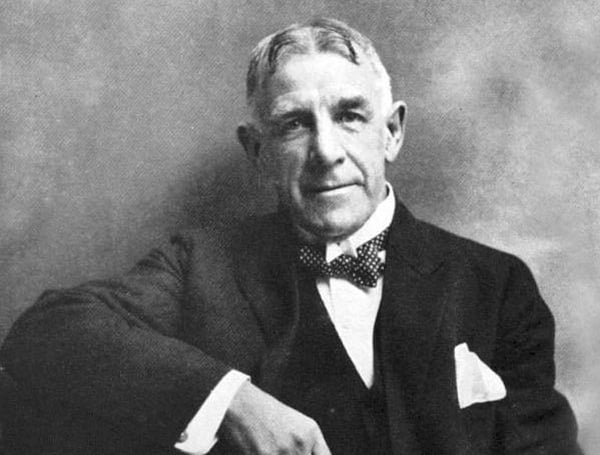
A quarter mile away stands the tower Edward Bok built. Bok, Dutch-born, spent thirty years editing the Ladies' Home Journal and was sixty-four when he retired. In 1922 he bought land on Iron Mountain, the limestone ridge in Polk County that rises 295 feet above sea level in a state that mostly lies flat to the water. He hired Frederick Law Olmsted Jr. to design the grounds and commissioned a Gothic tower of coquina stone and pink marble with a 60-bell carillon that could be heard for miles across the orange groves. President Calvin Coolidge came to dedicate it on February 1, 1929.
Who Barney was — his full name, where he came from, how seriously he meant any of it — the record does not say. A National Park Service historian reviewing the site decades later described Spook Hill as an example of a community building a tourist attraction from scratch, and wrote that the legend grew more elaborate over time.
The other legend sounds older. It holds that a Native American chief named Cufcowellax fought a great bull alligator that had been raiding his village near the lake. Both died. A small lake formed where they fell, and the tribe called it Lake Ticowa. The chief's spirit, or the gator's, or both, is said to still move things on the hill.
Cufcowellax appears on the sign at Spook Hill and in no historical record the National Park Service could verify. No confirmed village. No confirmed battle. No confirmed Lake Ticowa. The legend appears to date from sometime in the twentieth century, and the record does not establish whether it came before or after the pirate story.
A third account has a fisherman, unnamed, watching his parked car begin to roll uphill in the 1930s with the engine off. He is said to have shouted something about spooks and fainted. Locals, the story goes, called the place Spook Hill after that.
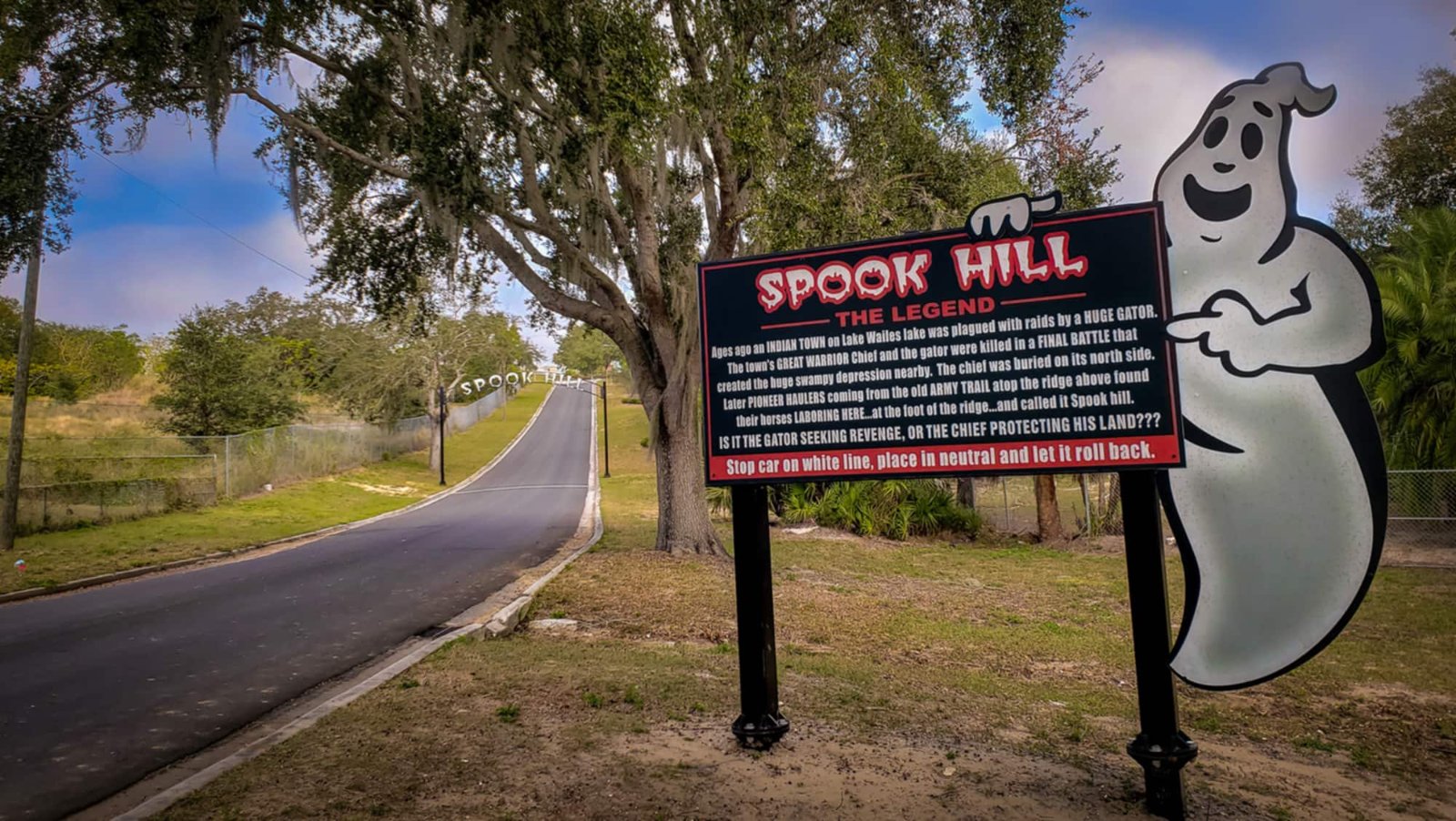
The hill is on North Wales Drive, between Burns Avenue and Spook Hill Elementary School. Drivers pull to the marked line, shift into neutral, and the car rolls — uphill, or what looks like uphill.
Spook Hill is a gravity hill. The surrounding ridge hides the true horizon, and without a reliable reference point the eye reads a descent as a climb. The land slopes down. The car rolls downhill, as cars do.
In April 2019, the National Register of Historic Places added Spook Hill to its rolls.
Presented by

Central Florida is built at the edge of land and water.
Horizon Marine works where that history meets today's lakefront properties — docks, seawalls, shoreline protection, and permitted marine construction across Polk County and surrounding areas. License #SCC131154313.
About Horizon Marine →Orlando Can Keep Walt Disney. We've Got George Jenkins.
George Jenkins arrived in Florida at seventeen with nine dollars and built something Lakeland still lives inside. The story of Publix, told from the city that never let him leave.
Read →
The Night the Lake Came Over the Levee
The night before the storm came ashore, weather officials told Florida it would not hit
Read →
He Learned to Swim at Nine Months Old
The canals that made Winter Haven famous were dug to haul citrus fruit, and the company that built them went bankrupt in two years
Read →
The Town That Kept Its Oranges
Christmas Day 1894 was one of Florida's most beautiful days, and four days later the citrus industry was gone
Read →
Planning waterfront work in Lake Wales?
Free waterfront assessment · License #SCC131154313