

May 1, 2026
Lake Cannon, Winter Haven: The Bloom That May Have Been a Florida First
In the spring of 2001, four people riding jet skis across Lake Cannon picked up rashes that may have made Florida history — and not the kind anyone wanted
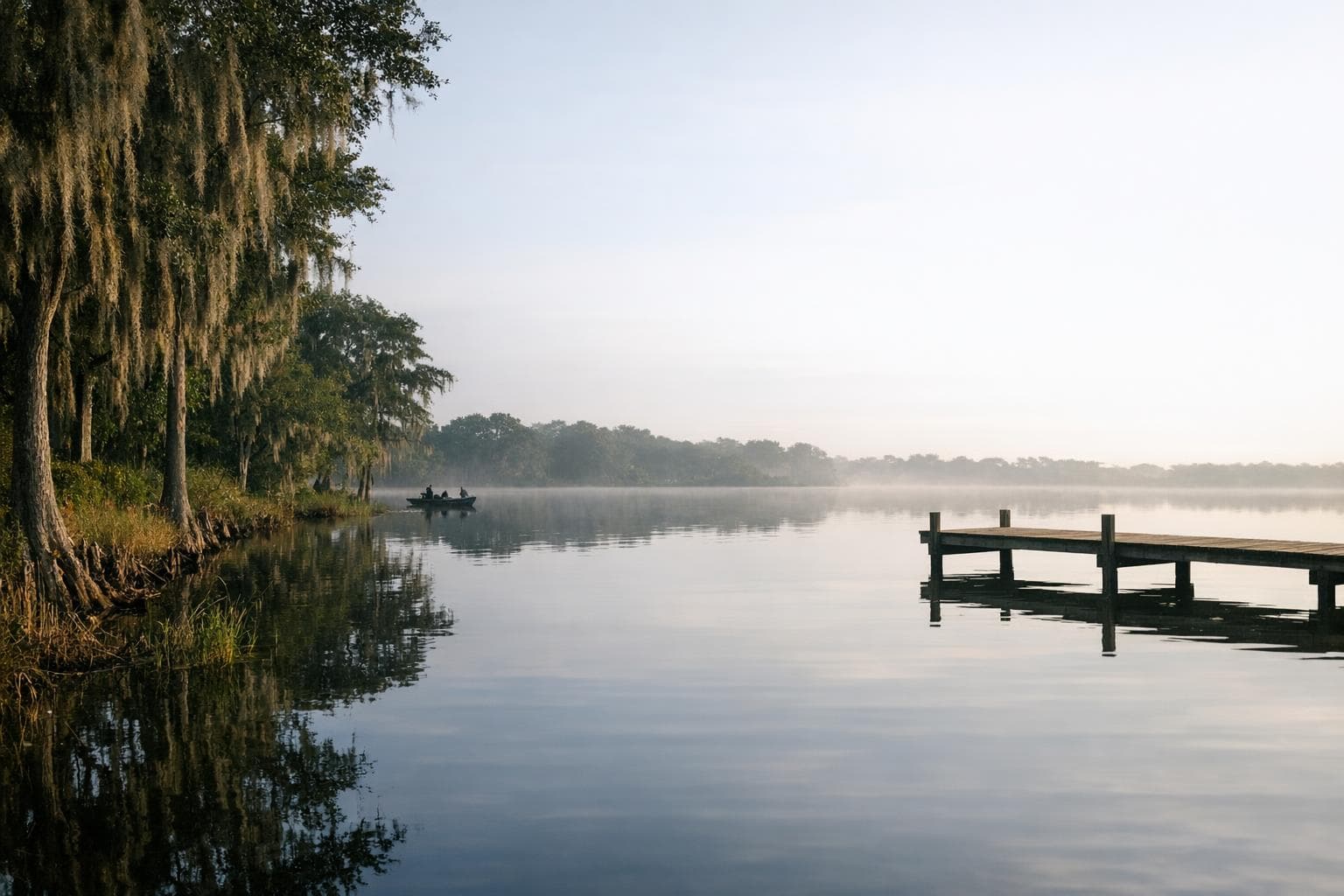
The jet skis went through it fast, like they do across a stretch of Lake Cannon thick with the kind of greenish scum that Floridians had been seeing on lakes for years and mostly ignoring. By the time the riders got home in May of 2001, something was wrong. Rashes. One of them bad enough for an emergency room.
What Polk County's lakes manager said next put Lake Cannon, briefly, into the medical literature of the state. The bloom was mostly Microcystis and Cylindrospermopsis — two cyanobacteria with a quiet rap sheet in scientific journals but almost none in the lived experience of Florida boaters. Joe King, who managed the county's lakes at the time, told the Orlando Sentinel that the four riders may have been Florida's first documented victims of freshwater toxic algae.
May have been. That's the careful phrasing, and it matters. Toxic blooms had certainly happened in Florida lakes before. What was new was somebody connecting the dots — a bloom, four people, a hospital, two species named — and putting it on the record. Lake Cannon, 332 acres on the northern part of Winter Haven's Chain of Lakes, became the place where that connection got made.
The species themselves are worth knowing if you spend time on Polk County water. Microcystis produces microcystin, a liver toxin that has killed dogs that drank from blooming shorelines. Cylindrospermopsis — now usually called Raphidiopsis raciborskii — is a tropical species that pushed into Florida lakes through the late twentieth century and now turns up routinely in summer monitoring. It produces cylindrospermopsin, which has been linked in laboratory studies to nerve and liver damage. In 2001, a lot of this was still new science. The idea that you could get sick from skimming across a Florida lake on a Sunday afternoon was, for most people, not really an idea at all.
Why Lake Cannon? Part of the answer is the chain itself. Cannon sits in the northern group, connected by canal to its neighbors, with residential shoreline running most of its perimeter and citrus-era ridge land draining toward it from the surrounding slopes. Decades of that drainage — fertilizer, septic, stormwater off paved subdivisions built where groves used to be — fed the lake the nitrogen and phosphorus that cyanobacteria turn into summer blooms. Heat does the rest. By May the water is warm enough, long enough, that a calm week can stack a bloom up against a downwind shore in a green mat thick enough to see from a dock.
That's the bloom the jet skis cut through.
Nothing about the incident shut Lake Cannon down. The boat ramp on Lake Cannon Drive stayed open. The bass kept biting around deep structure; the bluegill and shellcracker still came in steady through summer, the way local fishing reports note year after year. What changed was elsewhere — in monitoring programs, in health department awareness, in the slow professional shift toward treating cyanobacteria not as a nuisance but as a public health question. The City of Winter Haven now publishes annual health metrics on its lakes. Aquatic vegetation gets tracked across thirty-nine waterbodies. The 2001 bloom on Cannon wasn't the cause of all that, but it was an early data point that gave the work a face — four people, a rash, an ER, two Latin names in a newspaper.
If you're on Lake Cannon in late spring or summer and you see a slick of bright green or blue-green pulled tight against the lee shore — the kind that looks like spilled paint rather than floating plants — that's the same family of organisms. Most days it's harmless. Some days it isn't. The lesson of May 2001 wasn't that Lake Cannon is dangerous. It was that the green stuff on Florida lakes is not always just green stuff, and that someone, somewhere, has to be the first case before anyone takes the second one seriously.
Cannon was that lake. Most people who fish it, ski behind a boat on it, or live along its shoreline have never heard the story. It sits in the record anyway — a quiet first, on a residential lake in the northern chain, the year four riders learned something about Florida water that the rest of the state would spend the next two decades catching up to.
Presented by

Own waterfront in Winter Haven?
Lake history is interesting. Shoreline conditions are practical. Horizon Marine builds docks, seawalls, and shoreline protection on Winter Haven's lakes — and gives a straight answer on what your property actually needs.
Lake Marion, Haines City: The Island House Built in the Shape of a Celtic Cross
In 1887 an Irish carpenter who had come south for his lungs started cutting cypress on a 23-acre island in Lake Marion, and built a house in the shape of a Celtic cross — his family has held the island ever since
Read →
Lake Conine, Winter Haven: The Wetland That Took Fifteen Years to Come Back
The 32 acres of wetland along Lake Conine's south shore spent 15 years and $3.7 million becoming a nature park — the slow, unglamorous work of turning drained ground back into a filter for the water
Read →
Hardee Lakes, Bowling Green: The Lake That Stayed Closed Until the Fish Grew
Lake 3 at Hardee Lakes Park was stocked with sunshine bass in 2001 and then kept shut to anglers while they grew, and when it finally opened one Saturday morning in October 2005 all eight spots were already taken
Read →
Moon Lake, New Port Richey: The Foot and a Half That Doubles the Lake
Between 38.2 and 39.6 feet, Moon Lake grows from about 105 acres to 193 — the extra water standing in a 95-acre cypress swamp that a raised road cut off from the lake, and that now sets the lake's legal minimum level
Read →
Building on Lake Cannon or another Winter Haven lake?
Free waterfront assessment · License #SCC131154313