September 15, 2026
Little Lake Harris, Howey-in-the-Hills: The Summer Nobody Could Get Off the Dock
In August 2018 hydrilla filled Little Lake Harris so thickly that people couldn't get a boat away from their own docks, and by November the state was treating 2,700 acres of a 2,744-acre lake
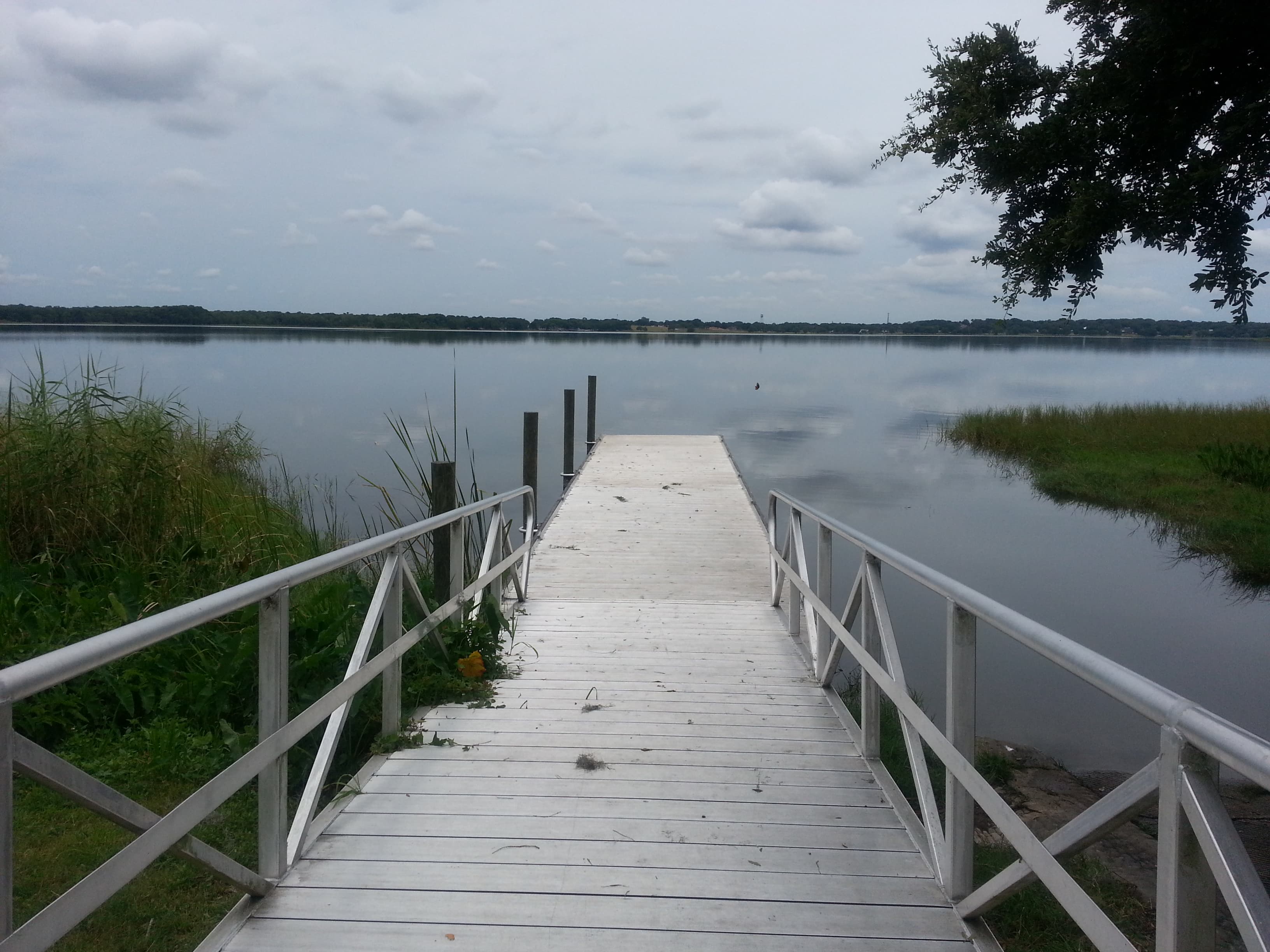
In August 2018, people living on Little Lake Harris could not get a boat away from their own docks. The Howey-in-the-Hills side of the water had filled with hydrilla — a submersed plant with a long stalk and clusters of leaves that reach the surface and mat there — and Mayor Chris Sears said it looked to be halfway out into the lake. The worst of it ran along North Lakeshore Boulevard, a couple of blocks from the historic Howey mansion, in a town of about 1,200 people roughly 40 miles northwest of downtown Orlando.
The town council meeting on Aug. 13 had to be moved out of the tiny town hall to Lake Hills School on South Lakeshore Boulevard because so many people wanted in. About 75 showed up. Roddy Tate, 65, told the room the hydrilla was so thick "you can almost walk across it." Sears, mayor since 2008, said he had not seen it this bad in the 25 years he had lived in Howey, and that residents who had been there fifty years told him the same.
The infestation traces to September 2017. Nathalie Visscher, an invasive plant management biologist with the Florida Fish and Wildlife Conservation Commission, told the meeting the hydrilla had been spread by the high winds of Hurricane Irma. Mike Perry, executive director of the Lake County Water Authority, later described a second consequence of the storm: the extra water moving through the system made aquatic herbicides ineffective during a prime treatment season, and in that delay the hydrilla went unchecked. Spectrum News 13 reported that as water levels rose after Irma, canals along the Lake Harris chain were opened and water from neighboring waterways allowed the plant to spread. In the warm months hydrilla can grow up to a foot a day.
FWC officials came to the meeting with a plan. The agency would treat 640 acres on Little Lake Harris, 475 acres on adjoining Lake Harris and 470 acres on Lake Eustis, at a total cost of about $1 million, concentrated where people and businesses had docks. Some in the room argued for a mechanical harvester instead of chemicals. Robbie Lovestrand, another FWC official, said harvesting would cost more and reach only a fraction of what herbicide could treat. Visscher also noted that treating in August was not ideal, because high water temperatures raise the risk of a fish kill, which made the choice of herbicide matter.
The work started the following week. An airboat applied herbicide through a trailing hose across the sections of shoreline with docks, a job expected to take about a week, with the plant dying back in roughly two more.
That first pass covered less than a quarter of the lake. On Nov. 13, 2018, FWC announced it would conduct aquatic plant control on 2,700 acres of Little Lake Harris — the entire lake, by the Lake County Water Atlas measure, is 2,744 acres. There were no restrictions on fishing or swimming during the treatment, and a 14-day restriction on irrigating turf and landscape ornamentals.
By the following January the money had run out. FWC had spent everything earmarked for aquatic plant management in the 2018-19 fiscal year, and then some, with six months still to go. The Harris Chain had the most expensive hydrilla problem in Florida: of the $10 million FWC spent statewide on hydrilla control the previous year, $4.3 million went to the Harris Chain, and about $3 million of that to Lake Harris alone — more than any other lake in the state. Perry told the Harris Chain of Lakes Restoration Council that hydrilla was the water authority's number one issue, and warned that a $3 million problem could become a $10 million one.
The following spring a state and local partnership put up nearly $2.2 million for the chain — $1.5 million from the Lake County Water Authority, $675,000 from FWC, with Lake County government supplying the crews. Treatment began on Lake Dora, then moved to Lake Eustis, Lake Yale, and the western and eastern sides of Lake Harris.
Little Lake Harris was left off that list. Perry told county commissioners that spring that the lake where the whole thing started would not be treated this time around, because so much effort had gone into it the year before.
Sources
Every factual claim in this story was checked against the page it came from before the story was saved. These are those pages. Our standards are on the masthead.
- Hydrilla growth in Little Lake Harris causing worry in Howey-in-the-Hills — 'It is bad,' mayor says (Orlando Sentinel, Aug. 13, 2018)
- FWC to spend $1M to treat hydrilla on 3 Lake County lakes — 'This stuff is so thick you can walk across it' (Orlando Sentinel, Aug. 14, 2018)
- FWC to treat Little Lake Harris hydrilla after complaints from Howey-in-the-Hills residents (Orlando Sentinel, Aug. 24, 2018)
- FWC conducts aquatic plant control on Little Lake Harris (Florida Fish and Wildlife Conservation Commission bulletin, Nov. 13, 2018)
- Little Lake Harris | Lake Details — Lake County Water Atlas
- Irma 1 year later: Invasive plant wreaks havoc on Lake County community (Spectrum News, Sept. 12, 2018)
- Growing like weeds: Funding evaporating to control hydrilla problem in the Harris Chain (Daily Commercial, Jan. 19, 2019)
- Nearly $2.2 million earmarked to fight hydrilla in Harris Chain of Lakes (Orlando Sentinel, May 1, 2019)
Presented by

Own waterfront in Leesburg?
Lake history is interesting. Shoreline conditions are practical. Horizon Marine builds docks, seawalls, and shoreline protection on Leesburg's lakes — and gives a straight answer on what your property actually needs.
Lake Marion, Haines City: The Island House Built in the Shape of a Celtic Cross
In 1887 an Irish carpenter who had come south for his lungs started cutting cypress on a 23-acre island in Lake Marion, and built a house in the shape of a Celtic cross — his family has held the island ever since
Read →
Hardee Lakes, Bowling Green: The Lake That Stayed Closed Until the Fish Grew
Lake 3 at Hardee Lakes Park was stocked with sunshine bass in 2001 and then kept shut to anglers while they grew, and when it finally opened one Saturday morning in October 2005 all eight spots were already taken
Read →
Lake Eva, Haines City: Sixty Years of Piped Stormwater
For roughly sixty years the centerpiece of Haines City's signature park was fed the runoff of city streets — and it took a chemical pump and a state grant to start pulling it back
Read →
Lake Denton, Avon Park: The 51-Foot Hole Where Divers Certify
A shallow-state lake that drops to 51 feet with 30 to 40 feet of visibility became one of inland Florida's go-to lakes for learning to scuba dive
Read →
Building on Little Lake Harris or another Leesburg lake?
Free waterfront assessment · License #SCC131154313