

May 5, 2026
Lake Mirror, Lakeland: The Locked Door on the Promenade
A locked gate on Lakeland's most photographed promenade hides a chamber that locals have spent nearly a century inventing stories about — alligator dens, lion pits, and a secret tunnel under the lake to the Terrace Hotel
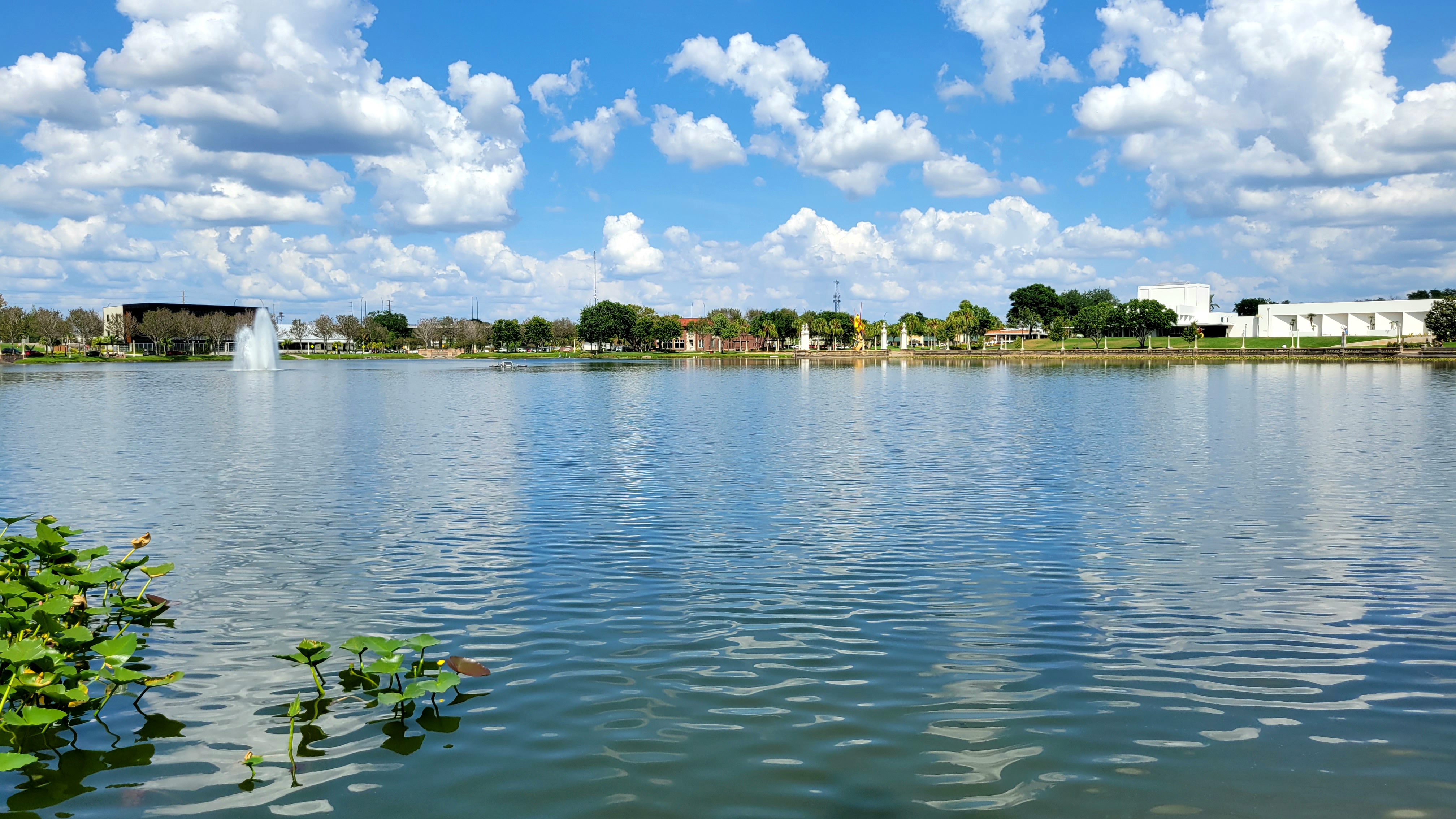
Set into the colonnade of the Frances Langford Promenade is a metal gate, locked, the space behind it dim and unmarked. It has a name. It is called a loggia, and for most of the last ninety-some years the people who walk past it have not known what is inside.
The promenade was finished in 1928, designed by Charles W. Leavitt of New York and built in two phases as the centerpiece of a downtown civic vision that wrapped Spanish-Mediterranean revival architecture around a 19-acre lake. The whole thing was added to the National Register of Historic Places on January 27, 1983. The loggia is part of that original construction — a recessed alcove behind a gate, tucked into the long arc of columns and balustrade that gives Lake Mirror its postcard.
Lakelanders filled the gap with rumor. One version held that the loggia was where Blinky the alligator lived. Another insisted city officials had once kept lions there, the better to dispose of criminals quietly. The most persistent and most charming legend was that the loggia concealed the entrance to a tunnel running under Lake Mirror to the Terrace Hotel on the opposite shore — a passage used by the wealthy and the discreet to cross the water unseen, on their way to forbidden trysts or deals best done in the dark. The Terrace opened in 1924 and hosted its share of well-known guests in the boom years.
In 2018, as part of an "Only in Polk" reader-question series, The Ledger decided to settle it. Stacy Smith, the foreman of Hollis Garden and a guide to the twice-monthly Lake Mirror history tours, brought a key. He unlocked the northern door of the loggia and let a reporter and a camera in.
There are no lions and no tunnel. The space is small and architectural, a piece of the original 1928 design that was never intended to be much more than what it is. The article catalogued the legends rather than killing them, the loggia remains gated, and people who walk by still ask.
One of those people was Veneis Little, a lifelong Lakelander and Florida Southern graduate, who told the paper she had fallen for the loggia at an event the previous year and could not stop wondering what was behind the doors. "It's my hope the heart and spirit of Lakeland lives in there," she said.
Lake Mirror is small, only nineteen acres, and shallow enough that the city now manages it with a control structure, holding water in place during drought rather than releasing it downstream. It has no boat ramp in the conventional sense; it is a non-motorized lake, ringed by the promenade, with Munn Park a block away and Hollis Garden, Barnett Children's Park and the more recent Allen Kryger Park along its edges. The Terrace sits visible on the far shore, close enough to point at.
A restoration grant in the 1980s brought the promenade back. The hotel survived the bust. The Lake Mirror Classic auto show fills the downtown streets each fall, and Hurricane Milton's floodwaters in 2024 pushed the Classic to rearrange its plans. The gate on the loggia stays locked most days.
Presented by

Own waterfront in Winter Haven?
Lake history is interesting. Shoreline conditions are practical. Horizon Marine builds docks, seawalls, and shoreline protection on Winter Haven's lakes — and gives a straight answer on what your property actually needs.
Lake Marion, Haines City: The Island House Built in the Shape of a Celtic Cross
In 1887 an Irish carpenter who had come south for his lungs started cutting cypress on a 23-acre island in Lake Marion, and built a house in the shape of a Celtic cross — his family has held the island ever since
Read →
Spring Lake, Brooksville: The Grove That Turned Into an Attraction
A hard freeze wiped out a Spring Lake citrus grower's living in the early 1960s, and rather than replant, the Boyett family turned the survivors into a roadside attraction that outlived the groves around it
Read →
Edward Medard Reservoir, Plant City: The Drawdown That Fed the Food Banks
When Hillsborough County's busiest reservoir was emptied in 2009 to rebuild its eroding bank, more than 1,300 of the stranded tilapia and catfish were filleted and sent to local food banks
Read →
Lake Denton, Avon Park: The 51-Foot Hole Where Divers Certify
A shallow-state lake that drops to 51 feet with 30 to 40 feet of visibility became one of inland Florida's go-to lakes for learning to scuba dive
Read →
Building on Lake Mirror or another Winter Haven lake?
Free waterfront assessment · License #SCC131154313