

May 8, 2026
Lake Parker, Lakeland: The Lake Lakeland Plumbed Back to Health
The story of how Lakeland's largest lake — sitting in the shadow of a power plant for most of a century — became measurably cleaner water
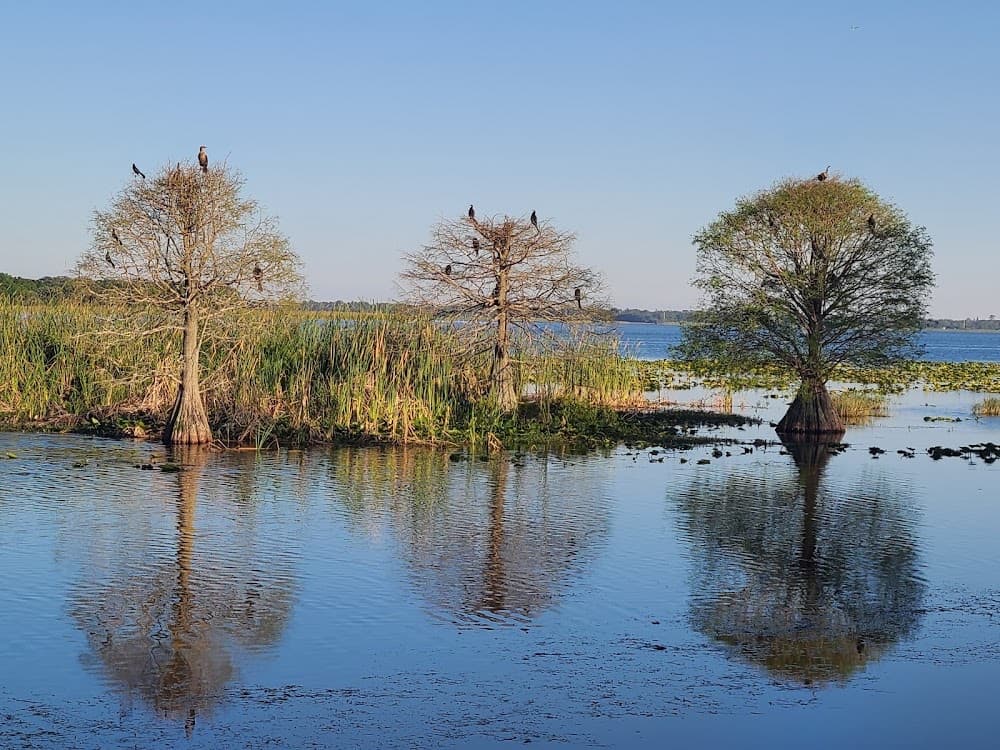
Stormwater coming off Lakeland's streets used to run more or less straight into Lake Parker. For most of the second half of the twentieth century, that was the arrangement: a little over 2,100 acres of shallow water at the north edge of town, the largest lake in Lakeland and the sixth-largest in Polk County, taking in whatever a growing city's pavement sent downhill. Nutrients accumulated. Algae followed.
The Charles Larsen Power Plant sits on the western shore. Construction began in 1947 and generation began in 1950, and for decades the plant defined the view across the water from the east side of the lake.
What changed came in pieces, over years, through the City of Lakeland and the Southwest Florida Water Management District. Engineered treatment systems were built to intercept stormwater before it reaches open lake and remove nutrients from it on the way. There is no single date on which Lake Parker turned around. There is instead a drainage network that no longer delivers untreated runoff to the lake.
The lake's hydrology got the same attention. Water leaves Parker through the Lake Parker Outlet, moving toward the Peace River system, and how much water sits in the lake and for how long has been studied against a long record. The District adopted minimum and guidance levels for Lake Parker built on lake-stage records reaching back to 1949 — nearly three-quarters of a century of measured water elevations, used to define how low the lake can be drawn and where it should sit.
A shallow Florida lake carrying that much nutrient load does not correct itself; left alone it produces more algae and fewer game fish. Lake Parker was on that path. It came off it because the city and the District kept treating runoff and managing levels, year after year, in a watershed that got larger and more paved the entire time rather than wilder.
The lake carries the name of Streaty Parker, an early settler who lived on its shores.
Lakeland has since built two large public fronts on the water. Lake Parker Park, on the eastern shore off Granada Street, covers more than 100 acres and has three vehicle entrances. Herons, anhingas, ibis and ospreys work the shallows and the shoreline trees there, and bald eagles turn up along the same edge. Bonnet Springs Park opened in 2022 on reclaimed industrial land at the lake's southwest corner, a second major public access point onto Parker and a western view that is no longer only the power plant.
Presented by

Own waterfront in Lakeland?
Lake history is interesting. Shoreline conditions are practical. Horizon Marine builds docks, seawalls, and shoreline protection on Lakeland's lakes — and gives a straight answer on what your property actually needs.
Lake Marion, Haines City: The Island House Built in the Shape of a Celtic Cross
In 1887 an Irish carpenter who had come south for his lungs started cutting cypress on a 23-acre island in Lake Marion, and built a house in the shape of a Celtic cross — his family has held the island ever since
Read →
Spring Lake, Brooksville: The Grove That Turned Into an Attraction
A hard freeze wiped out a Spring Lake citrus grower's living in the early 1960s, and rather than replant, the Boyett family turned the survivors into a roadside attraction that outlived the groves around it
Read →
Lake Tracy, Haines City: The Ditch That Got Its Own Government
A drainage ditch that begins at the north end of Lake Tracy has had its own unit of Florida government since 1929, and it still assesses $50 an acre to keep the channel open
Read →
Lake Griffin, Leesburg: The Drawdown That Brought the Bass Back
In the mid-1980s, biologists drained part of Lake Griffin on purpose — and the bass came back so hard the creel surveys still mark those years as the high water line
Read →
Building on Lake Parker or another Lakeland lake?
Free waterfront assessment · License #SCC131154313