

April 25, 2026
Lake Sears, Winter Haven: The Quiet End of the Northern Chain
Lake Sears feels quieter than the rest of Winter Haven’s chain because it sits at the edge of the canal-made world that turned separate lakes into one boating culture
Paddle into Lake Sears and the chain starts to feel different.
The big-lake rhythm softens. The through-traffic thins. The shoreline doesn’t announce itself the way some Winter Haven lakes do, with long ski runs, restaurant docks, and the easy confidence of places everybody seems to know. Lake Sears feels more like a lake you reach on purpose than one you pass through on the way to somewhere else.
That may be the best thing about it.
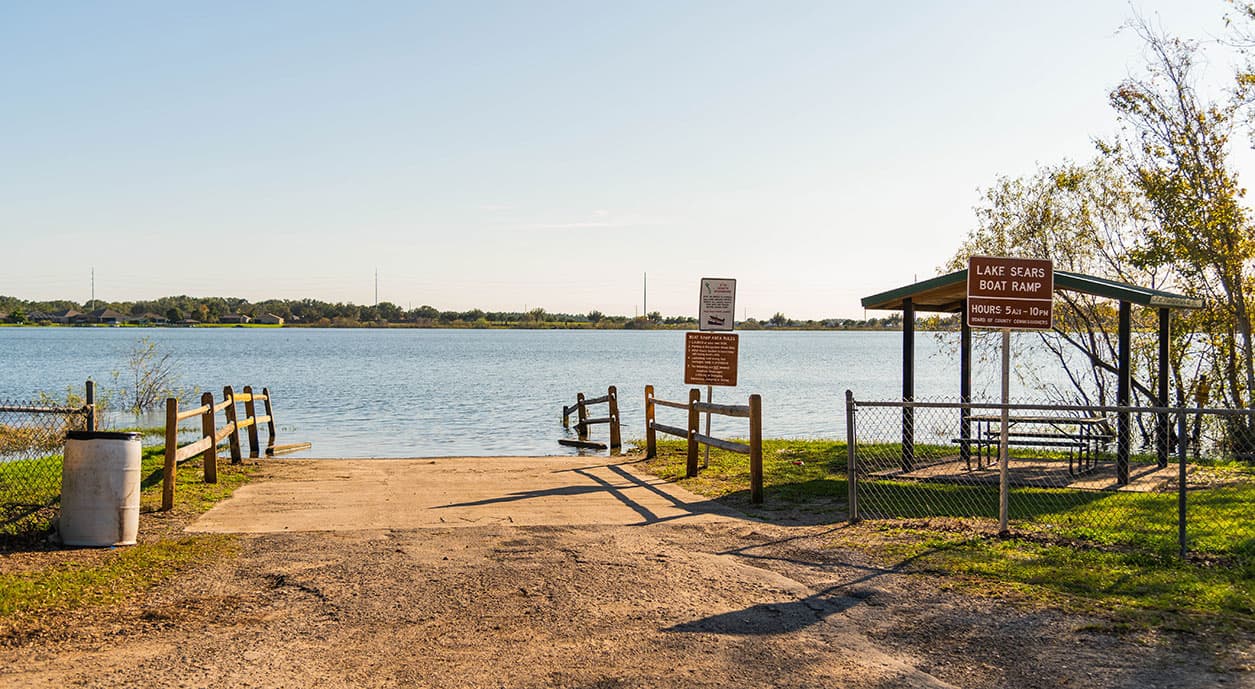
Lake Sears sits in the quieter reach of Winter Haven’s Chain of Lakes, the canal-linked system that gave the city so much of its identity. Polk County’s public access directory lists Sears as a 79-acre lake in Winter Haven, with a county-maintained paved ramp off Lake Sears Drive and canal access into the Chain. It is not a grand entrance. It is a concrete ramp, a picnic area, and water that doesn’t seem especially interested in performing for anybody. (polk.wateratlas.usf.edu)
But that plain little ramp points to the larger story. Lake Sears belongs to a chain that was not born as one continuous boating route. Winter Haven’s famous lake system became a system because people cut canals between separate lakes.
That sounds ordinary now, because the canals are so much a part of the city’s identity. You move from lake to lake and it feels inevitable, as though the water always meant to connect that way. But it didn’t. The 1998 Surface Water Improvement and Management Plan for the Winter Haven Chain of Lakes puts it plainly: “One of the most readily apparent changes attributable to man has been the interconnecting of various waterbodies in the Chain by constructing canals.” The same report says the first group to imagine the chain from “the boater’s eye view” organized as the Twenty Lakes Boat Club in 1915. (SWFWMD)
That phrase — the boater’s eye view — is the key to Lake Sears.
From a boater’s eye view, a chain is not just a collection of lakes. It is a route. It is a way to spend a whole day moving through Winter Haven without loading the boat back on the trailer. It is the thing that made the city’s lake culture feel bigger than any one shoreline. The canals turned separate basins into a shared experience.
They also changed the lakes.
The SWIM Plan, written decades after the canal system became part of local life, has a line that lands harder than most government reports: “From today’s environmental perspective the construction of canals would probably not be permitted.” The report goes on to say that the canals affect water quality by distributing impacts throughout the Chain, even as their construction historically fostered the area’s economic and recreational development. (SWFWMD)
That is not the kind of quote you usually hear at a boat ramp. But it is the kind that makes the whole chain look different.
The canals gave Winter Haven a boating identity. They also made the lakes responsible for one another in a way they had not been before. What happens in one part of the system can travel. Water, weeds, nutrients, boat traffic, and consequences do not always stay politely inside the lake where they started. A chain is a convenience, but it is also a connection.
Lake Sears sits inside that story, but it does not feel like the center of it. That is why it works as a quiet counterpoint to the better-known lakes. The middle lakes carry the weight of the chain’s public image — the big views, the familiar routes, the places where people gather and show off the whole idea of lake life. Sears feels more like an edge. It is connected, but not crowded by the mythology.
There is something honest about that.
A lake at the edge of the boating map has a different personality. It does not need to be famous to matter. It shows you the chain’s quieter consequence: not the postcard version, but the fact that Winter Haven’s lakes became what they are through choices people made more than a century ago. Some choices opened routes. Some brought recreation and growth. Some created water-quality problems that later generations had to manage. All of that is part of the same canal-cut story.
That is why Lake Sears is more interesting than it first appears. It is not just a small public-access lake in Polk County. It is a reminder that the Chain of Lakes is both natural and made, both beloved and engineered. Its quietness is not separate from the chain’s fame. It is one of the shapes that fame takes when you get away from the center.
So if you launch at Lake Sears and wonder why it feels different, that may be the answer. You are still in Winter Haven’s lake country, still part of the canal-linked system that made the city known. But you are near the softer edge of it, where the chain stops feeling like a spectacle and starts feeling like water again.
Presented by

Own waterfront in Winter Haven?
Lake history is interesting. Shoreline conditions are practical. Horizon Marine builds docks, seawalls, and shoreline protection on Winter Haven's lakes — and gives a straight answer on what your property actually needs.
Lake Harris, Tavares: The Day the College Record Fell
In January 2022, two brothers fishing a college tournament on Lake Harris brought a five-bass limit to the scales that weighed more than any single-day catch in the history of the Bassmaster College Series
Read →
Crystal Lake, Winter Haven: The Lake the Name Hides
A 36-acre circular lake on the south side of Winter Haven shares its name with six other Crystal Lakes in Polk County — and the research turns up almost nothing about this particular one
Read →
Hardee Lakes, Bowling Green: The County That Had No Lakes Until a Mine Made Four
Every one of Hardee County's four lakes was dug by a phosphate dragline in the 1990s — the county had no natural lakes at all until a worked-out mine was handed back as water
Read →
Lake Silver, Winter Haven: When the Ferris Wheel Turned Above the Shore
For a few weeks each winter in the 1940s and '50s, a double Ferris wheel turned above the shoreline and the lake sat at the center of a national broadcast
Read →
Building on Lake Sears or another Winter Haven lake?
Free waterfront assessment · License #SCC131154313