

April 25, 2026
Lake Tibet, Windermere: The Shoreline That Didn’t Become Houses
On Lake Tibet, one of the most coveted stretches of waterfront in Orange County nearly became a neighborhood — instead it became a preserve
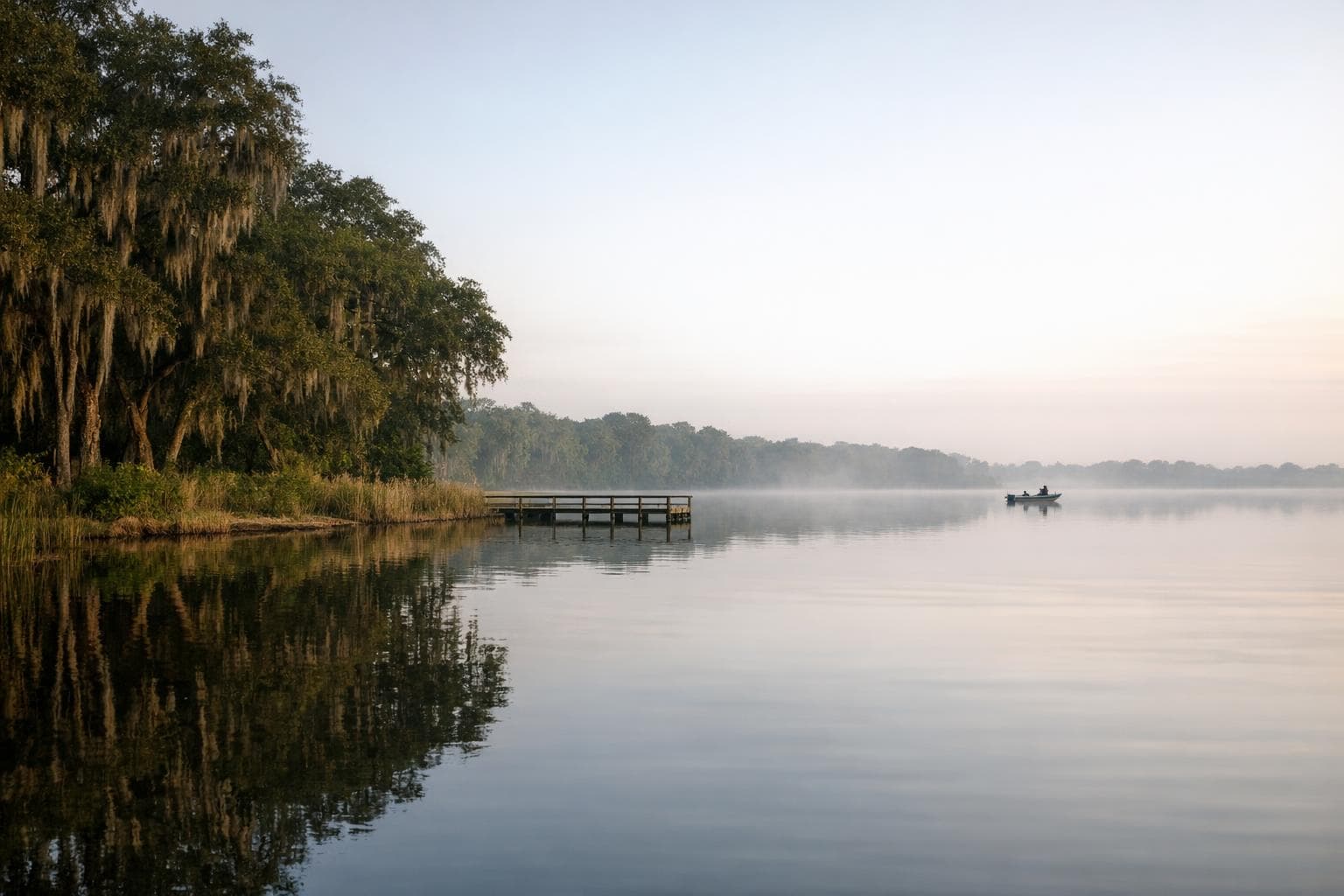
The thing to know about Lake Tibet is not where the name came from. It is what did not happen on its southwest shore.
The Butler Chain of Lakes — thirteen interconnected waters stretching through Windermere and southwest Orange County — has long been among the most coveted freshwater real estate in Central Florida. Clear water, connected navigation, more than 5,000 acres of surface water and 32 navigable canals. In 1985, it became the first lake system in Florida to receive the Outstanding Florida Waters designation, recognized for water quality and wildlife habitat at a time when much of the surrounding land was converting to something else.
That something else is the story.
The South Florida Water Management District’s land assessment for Tibet-Butler Preserve is specific: the property was acquired under the Save Our Rivers program to protect a locally significant wetland resource. Before that purchase, the flatwoods and scrub on Lake Tibet’s southwest shore were slated for residential development. On a lake chain where every acre of waterfront eventually finds a buyer and a dock, this piece didn’t go that direction. The 438 acres that are now trails, wetlands, and wildlife habitat were once headed toward streets, roofs, seawalls, and lawns. The Save Our Rivers program intervened — state money, a formal acquisition, a decision that the wetlands were worth more intact than developed — and the chain ended up with a shore that still has roots in it.
What’s there now is not one landscape but several folded into each other. Dry, sandy scrub gives way to pine flatwoods, which shift into cypress and bay swamp, which open out to lakeshore wetland at the water’s edge. Nearly 300 acres of the preserve are classified as wetlands. The Vera Carter Environmental Center runs programs on the property; the site is part of the Great Florida Birding and Wildlife Trail. It is, by any measure, a working piece of natural Florida — the kind that gets harder to find on a lake chain this developed and this desirable.
None of that is accidental, and none of it is just about scenery. Lakes don’t end at the waterline. What happens in the land around them — how runoff moves, how soil absorbs, how vegetation holds and filters — works its way into the water. A protected shoreline buffers the lake from what’s happening on the land beside it. On a connected chain where water flows south toward Reedy Creek, the Kissimmee River, Lake Okeechobee, and eventually the Everglades, that matters beyond Lake Tibet itself. The Outstanding Florida Waters designation wasn’t ceremonial. It was recognition of a system that still functioned the way it was supposed to, and the preserve is part of why that continues to be true.
The preserve sits quietly beside a lake most people associate with the other kind of waterfront story — Isleworth, Bay Hill, addresses that show up in listings with prices that make ordinary waterfront look affordable. That context is part of what makes the preserve’s existence notable. This is not a lake that ran out of demand. It is a lake where one piece of shore had a different outcome, and that outcome required a deliberate choice to stop what would have otherwise continued.
Most people who visit Lake Tibet arrive by water or through a gate. The preserve is one of the few places on the Butler Chain where you can walk to the water’s edge without either. No docks, no boat slips, no neighbors. Just the lake and the trees that have been standing here long enough to remember what was almost built on this ground.
Presented by

Own waterfront in Windermere?
Lake history is interesting. Shoreline conditions are practical. Horizon Marine builds docks, seawalls, and shoreline protection on Windermere's lakes — and gives a straight answer on what your property actually needs.
Lake Pierce, Lake Wales: The Five-Day Haul From Net to Railroad
Before it was a fish camp, the north shore of Lake Pierce was a commercial netting operation that hauled its catch out over log roads on a five-day round trip to the railroad — back when the lake was called Cat Fish Lake.
Read →
Lake Bonny, Lakeland: The Nine Inches That Kept the Pumps Off
When Hurricane Milton pushed Lake Bonny into east Lakeland's neighborhoods in October 2024, the city couldn't legally start pumping until the water had already reached people's homes
Read →
Lake Griffin, Leesburg: The Drawdown That Brought the Bass Back
In the mid-1980s, biologists drained part of Lake Griffin on purpose — and the bass came back so hard the creel surveys still mark those years as the high water line
Read →
Hardee Lakes, Bowling Green: The Lake That Stayed Closed Until the Fish Grew
Lake 3 at Hardee Lakes Park was stocked with sunshine bass in 2001 and then kept shut to anglers while they grew, and when it finally opened one Saturday morning in October 2005 all eight spots were already taken
Read →
Building on Lake Tibet or another Windermere lake?
Free waterfront assessment · License #SCC131154313