
November 3, 2026
The Towers That Broadcast Gulf to Ocean
The chief engineer who built WGTO told a reporter in August 1955 that the GTO stood for Gulf to Ocean, or else Gainesville to Okeechobee; the license left Polk County in 1989 or 1990 depending on which account you read, and a Lake Alfred road still carries the call letters
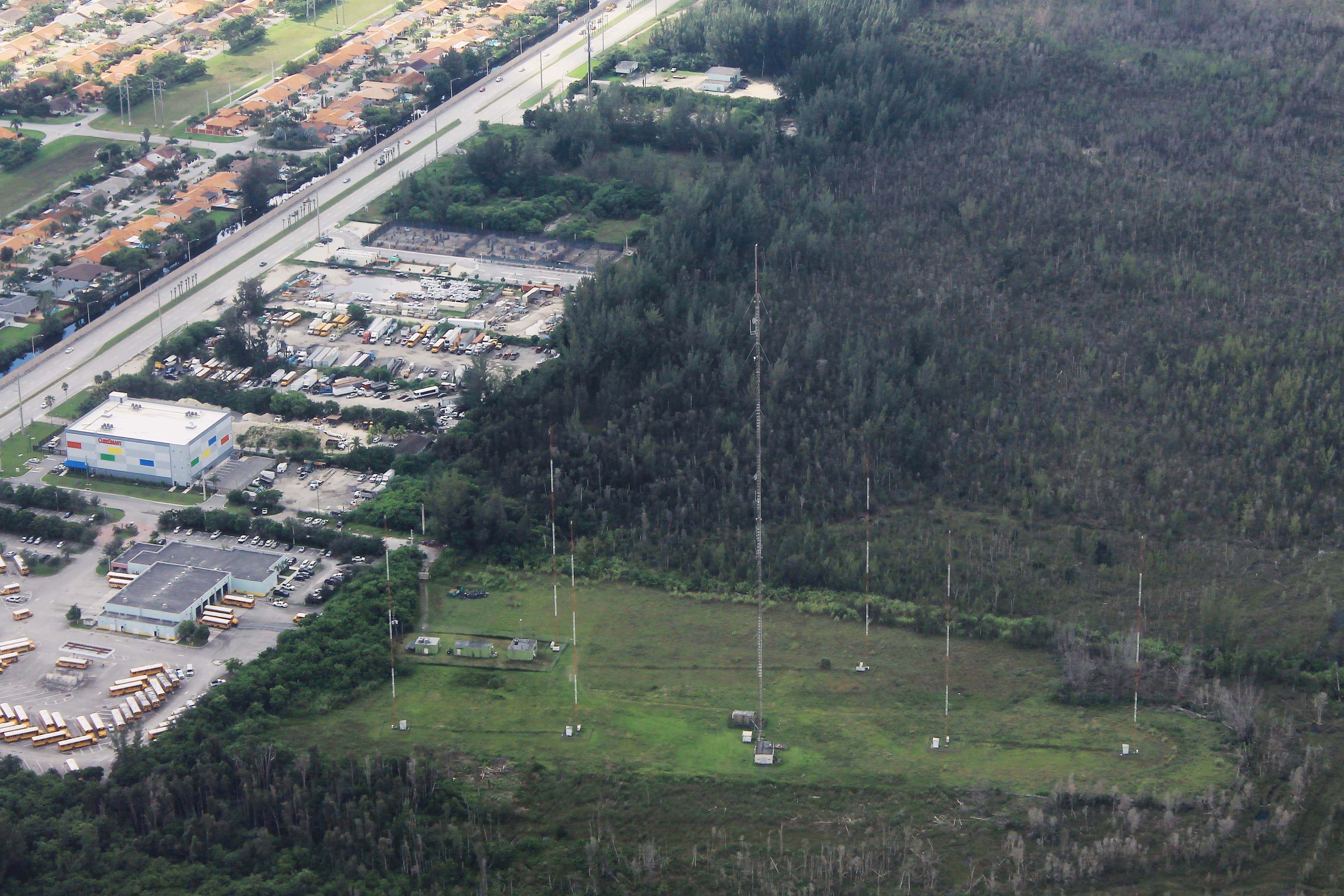
In early August 1955, N. J. Zehr, chief engineer of station KWK in St. Louis, was in Polk County supervising construction of a radio station that still had no firm opening date. He told the Orlando Sentinel that the transmitter towers and equipment houses stood approximately six and one-half miles from Haines City, near Lake Alfred, connected to the studio at the Palm Crest by two telephone leased wires. Then he explained the call letters. The W marked a station east of the Mississippi River. The letters GTO, Zehr said, could be interpreted as "Gulf to Ocean," or as "Gainesville to Okeechobee," which would be the station's most effective range.
The Orlando Sentinel reported on December 21, 1954 that Robert T. Convey, president of KWK, Inc., had announced Federal Communications Commission approval of an application for a Haines City station that had sat on file for two years. Ground for the transmitter building and broadcasting towers was leased from J. C. Cox Jr. of Lake Alfred. The station would operate daytime hours only, with 10,000 watts on 540 kilocycles, a wave-band not available for use in the United States until 1952 and not printed on the dial of many radio receivers. Listeners were told to turn the dial all the way to the left.
WGTO went on the air for the first time at 6:30 a.m. on September 9, 1955, after advertisements in 43 daily and weekly newspapers across the 26 Central Florida counties it expected to reach. Which hotel housed the studios is not settled: the Tampa Tribune of September 3, 1955 placed the dedicatory program in the Pine Crest Hotel, while The Ledger and the station's own published history name the Palm Crest Hotel, a building that later became Landmark Baptist College.
Dick Pope, the founder of Cypress Gardens, offered to build new studios for the station on the attraction's property and lease them for $1 per year in return for free advertising. The Ledger put the exchange at a radio plug for the Gardens twice every hour. In 1958 the station moved from Haines City to Cypress Gardens, the city of license changed with it, and the daytime power went from 10,000 watts to 50,000. WGTO promoted itself as the most powerful station in the nation.
Who owned it by then is disputed. The Florida broadcast database compiled by the Jacksonville Broadcasters Association dates the acquisition by KSTP, Inc., later Hubbard Broadcasting, to May 1, 1958. Broadcasting magazine reported on July 23, 1962 that Stanley E. Hubbard, president and 62 percent owner, had changed the corporate name of the group's licensees to Hubbard Broadcasting Inc., and that the stations formerly licensed to KSTP Inc. included WGTO Cypress Gardens, with no change in ownership involved. The station's own history, published by its present owner, says instead that KWK sold to Hubbard Broadcasting in 1964, repeats a rumor that Hubbard won the license in a card game, and notes that other sources say he paid $150,000.
The station's own rate card, Bulletin No. 5, was built around the 33 counties it claimed. Farm product sales in those counties came to $762,234,040, which the card turned into 88.8 percent of the total gross farm income, under the heading Florida's No. 1 Agri-Station. Weekdays opened with the George Prescott program, sign-on until 10:00 a.m., with the Agriculture Bulletin Board at 7:05 read by farm director Jim Corbett. At 5:05 each evening came "Information Citrus," fed direct from Florida Citrus Mutual in Lakeland, which the card called the only daily program of this type in Florida.
The half hour at 12:30 was "Welcome to Florida," on which Prescott interviewed tourists and celebrities visiting Cypress Gardens from all over the world while an Aquamaid handed out product samples. Prescott was the air name of George Ogburn, and he opened by identifying the station as WGTO, 540 AM, broadcasting from Cypress Gardens.
RCA Broadcast News, in February 1957, wrote that the coverage on 540 kc encompassed Gainesville, Daytona Beach, Orlando, Lakeland, Tampa, Clearwater and St. Petersburg, extending from Gainesville to Okeechobee and from Gulf to Ocean. The Ledger, in 2006, put the reach farther south: Gainesville in the north to Miami in the south, west to the Gulf of Mexico and east to the Atlantic.
In January 1977, after 22 years of pop music, WGTO flipped to country as "Great Country Music 54" and quadrupled its ratings in the first year. The Tampa Tribune reported on April 4, 1979 that WGTO had quietly begun broadcasting 24 hours daily the previous Friday, the first AM station in Polk County to be granted a 24-hour license. Station manager Dick Bennick, who hosted Saturday afternoon horror movies as Dr. Paul Bearer, said they received the information by telegram and did it that Friday. Calls came in from as far away as Vero Beach.
Radio & Records logged the end of the Hubbard era in its issue of July 18, 1986: WGTO, Cypress Gardens, price $1,535,000, buyer Cypress Broadcasting Limited with Mike Bader and Cordell Overgaard as general partners, seller WGTO AM, Inc., a wholly owned subsidiary of Hubbard Broadcasting. Power ran 50 kw days and 1 kw nights. Gospel programming followed the sale. Dr. Harry M. Lowell acquired the station in May 1988, and Florida Media took it in 1989.
The city of license moved from Cypress Gardens to Pine Hills, new studios were built in Ocoee, and the transmitter with its six towers went to a site the station's history places about ten miles west of Disney World; Scott Fybush, who toured the array, puts that Orlando-area site about 15 miles due west of Disney World. The station's own history dates the change of license and the move to 1989, while The Ledger wrote that WGTO was the voice of Cypress Gardens and Central Florida from 1958 to 1990, when the station moved to Orlando. The FCC's call sign history for the license records WWZN granted on January 26, 1995.
The 1955 site stayed on the ground leased from J. C. Cox Jr. Fybush reported from satellite imagery that the transmitter building still stood near Gum Lake, on a road named WGTO Tower Road. On June 5, 2023, the Lake Alfred City Commission approved the final plat for a 73.33-acre subdivision east of County Road 557, south of the intersection with WGTO Tower Road.
Sources
Every factual claim in this story was checked against the page it came from before the story was saved. These are those pages. Our standards are on the masthead.
- cflradio.net - WGTO-AM 540 Haines City (station file with transcribed Orlando Sentinel, Tampa Times and Tampa Tribune clippings and RCA Broadcast News, February 1957)
- iHeartMedia/NewsRadio WFLA Orlando, 'The History of NewsRadio WFLA - Orlando' (Happy 65th Birthday AM 540!), August 31, 2020
- The Ledger, 'Airwaves promoted Gardens,' February 5, 2006
- Jacksonville Broadcasters Association, Florida Broadcast Database, AM Radio 1923-2015
- Broadcasting, July 23, 1962, p. 53 (World Radio History)
- WGTO rate card, 'The Basic Buy,' Bulletin No. 5 (World Radio History station promotional literature archive)
- Radio & Records, Issue 644, July 18, 1986 (World Radio History)
- Scott Fybush, 'Site of the Week 2/22/2013: Orlando, 2011 (part 3),' Fybush.com
- FCCdata.org (REC Networks), facility ID 51970 - call sign history
- City of Lake Alfred, agenda item: Resolution 18-25, Gum Lake Preserve Phase I and Phase II
The Brick That Left Bartow
The brick for Florida's first brick schoolhouse south of Jacksonville came out of E. C. Stuart's Bartow Brick Company in 1887, and when the school came down in 1930 the brick was hauled out of Polk County to a packing house at Lake Placid
Read →
The Lie She Told at Loughman
The sawmill camp in northeast Polk County took the woman in the shiny gray Chevrolet for a detective, so Zora Neale Hurston told them she was a bootlegger the law wanted in Miami
Read →
The Cane the Children Gave Him
A girl named Maggie Johnson handed Jacob Summerlin an engraved cane at a Bartow cornerstone laying in 1887, and the cane went missing for more than a century
Read →
The Night the Lake Came Over the Levee
The night before the storm came ashore, weather officials told Florida it would not hit
Read →