

May 8, 2026
Why Other Builders' Seawalls Fail
Hydrostatic pressure, broken braces, short-sheeting, and toe scour — the four reasons most seawalls in Central Florida don't make it.
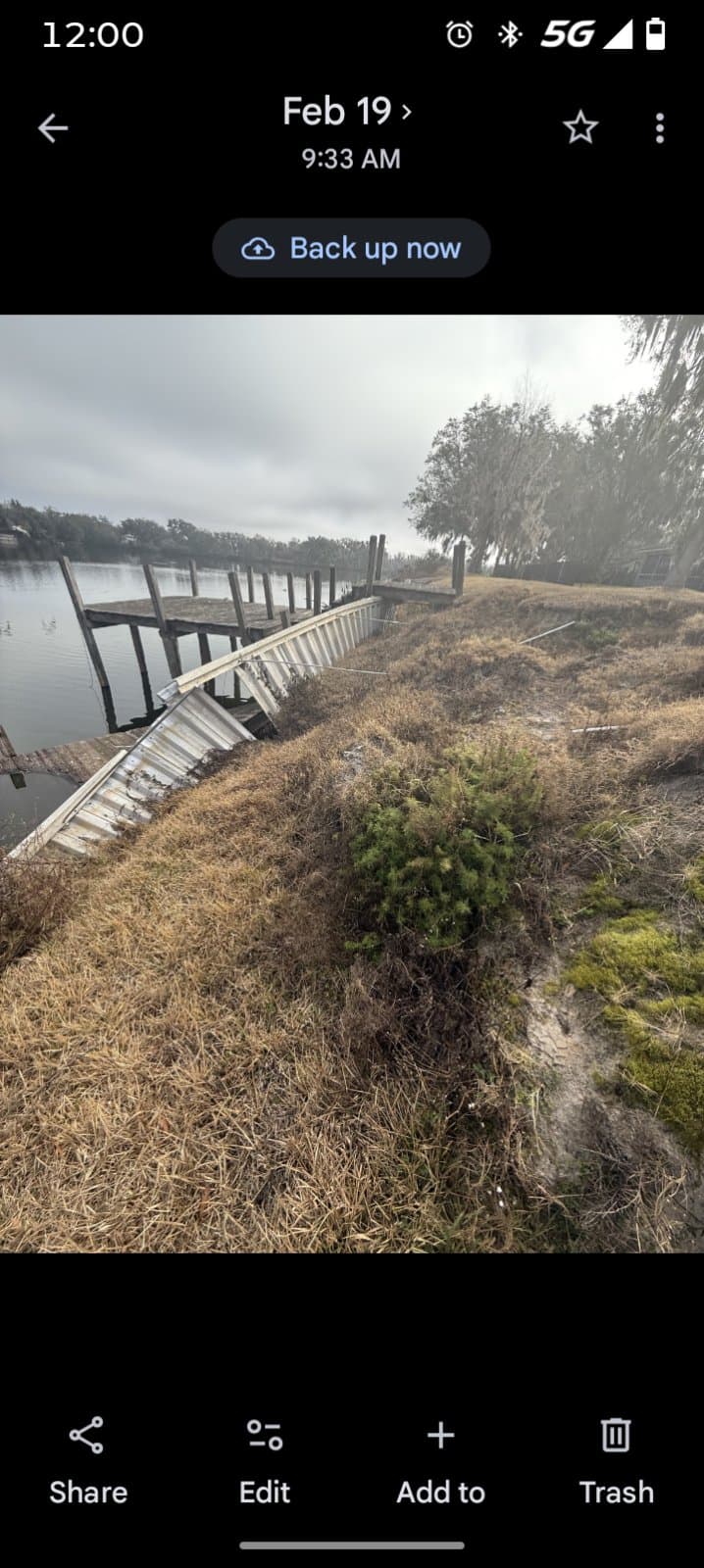
Drive any lake in Central Florida and you'll see them. Walls leaning toward the water. Hairline cracks running floor to cap. Soft spots in the yard where the soil's washed out behind. They didn't fail because seawalls fail. They failed because they were built wrong.
And almost every one traces back to the same four reasons.
1. Hydrostatic pressure
When it rains in Florida — and it rains in Florida — the soil behind a seawall gets saturated. That water has weight. A lot of it. And if it has nowhere to go, it pushes against the back of the wall with thousands of pounds of force.
Eventually, the wall tells you about it. First it bows. Then it cracks. Then it tips lakeward.
The fix isn't sexy: it's drainage. Behind a wall built right, there's a french drain — perforated pipe in coarse sand — running the full length of the wall. Water saturates the sand, finds the pipe, and exits somewhere it can't hurt anything. Pressure relieved.
A wall without one is playing roulette with the next tropical system.
2. Tieback failure
Most homeowners don't realize it, but every seawall is held up by anchors buried 8 to 12 feet behind the wall. They're called tiebacks — or deadmen — and they're the only thing keeping the wall from laying down in the lake when the soil leans on it.
Steel tiebacks rust. That's predictable.
Aluminum tiebacks have a different problem, and it's a big one. They break at the brace. The connection point where the tieback meets the wall is the failure point. It's not gradual rust — it's a structural break. One day everything's fine. The next, a section of wall is leaning ten degrees and pulling the yard with it.
It's the failure mode aluminum walls don't escape. Vinyl doesn't have it.
3. Cap washout — the shortsheeting problem
Walk a seawall and you'll sometimes see a soft spot or a small sinkhole right at the top, at the cap. That's not weathering. That's a build problem.
It's almost always shortsheeting.
Sheets need to extend high enough to fully tie into the cap. When a builder uses sheets that are too short to save material, the seam between the cap and the panel becomes a highway. Water finds it, scours soil from behind the wall, and what shows at the top is just the part that's collapsed enough to be visible.
The damage underneath is always bigger than what's visible.
You can't fix this without rebuilding. Full-height sheets, fully tied into the cap, are the only version that holds up.
4. Toe scour
Boat wakes. Wave action. A heavily-trafficked lake. Over the years, all that water moving past the wall slowly excavates the lake bottom in front of it — at the toe, where the sheets meet the lakebed.
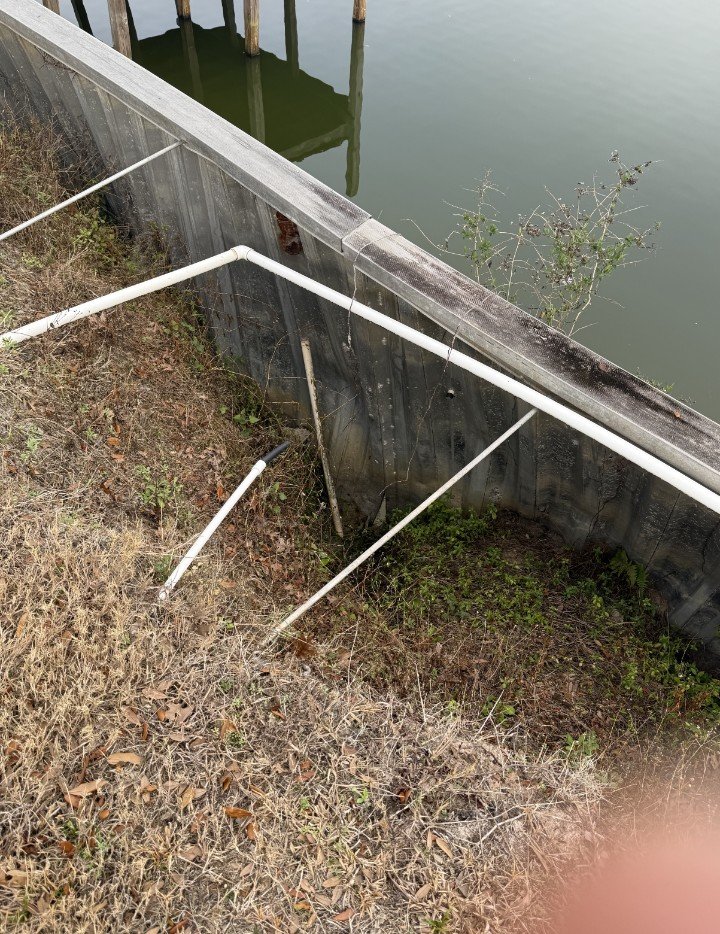
Eventually, the wall loses its footing. Not the anchor 12 feet behind it — the dirt right under it. And then the wall tips forward.
The fix is depth. Longer sheets, driven deeper. If the sheet is embedded well below the depth scour can reach, the lake can carve a foot of bottom out in front of the wall and the wall doesn't care — there's still plenty of sheet in solid ground below.
It's one of the most under-appreciated specs in seawall building. The cap, the face, the cleat — that's what people see. The thing that actually keeps a wall standing for forty years is the part nobody ever looks at.
What it comes down to
Three of those four failures are construction problems, not material problems. A vinyl wall, an aluminum wall, a concrete wall — any of them can fail any of these ways if the build cuts corners.
But on the material side: vinyl doesn't rot the way wood does. It doesn't break at the brace the way aluminum does. It doesn't crack along the rebar the way concrete does as it ages.
Built right — long sheets, deep embedment, french drain behind it, full-height tie-in at the cap — a vinyl wall outlives the house it protects.
What to look for
If there's a seawall on the property, walk it.
- Lean. Sight down the length of the wall. Is it straight? Or is there a section bowing toward the lake that wasn't there last year?
- Cracks. Hairlines aren't always serious. A vertical crack running through a panel is the wall telling you it's under load.
- Cap seams. Soft spots, sinkholes, or wet areas at the cap line. That's washout starting.
- The yard. Is grass dying in a strip behind the wall after every rain? That's water that should be in the drain, but isn't.
Caught early, any of these is a repair. Caught late, they're a rebuild.
The Build is sponsored by Horizon Marine — vinyl seawalls and docks across Central Florida. Got a wall you're worried about? Text a photo to (863) 934-6218 or email sales@horizonmarinefl.com.
Published by

Horizon Marine — Docks & Seawalls
Central Florida's dock and seawall contractor. Free waterfront assessment. License #SCC131154313.
Composite Decking Cost Explained: What You're Really Paying For on a Florida Dock
Your quote came back and composite decking stopped you cold. Here's what that number actually covers — and what to check before you sign anything.
Read →
Vinyl or Aluminum Seawall? On Central Florida Lakes, Water Chemistry Decides
Not all freshwater is the same — and on Polk County's acid-colored lakes, the wrong seawall material can fail from the inside out while still looking fine from the dock. Here's what the water chemistry data actually says.
Read →
Have a waterfront project in Central Florida?
Free waterfront assessment · License #SCC131154313