

April 16, 2026
Composite Decking Cost Explained: What You're Really Paying For on a Florida Dock
Your quote came back and composite decking stopped you cold. Here's what that number actually covers — and what to check before you sign anything.
EXCERPT: Capped composite carries twenty-five year warranties that cover material defects and not installation errors, which puts the expansion gap and the fastener system at the center of what you're buying
Composite Decking Cost Explained: What You're Really Paying For on a Florida Dock
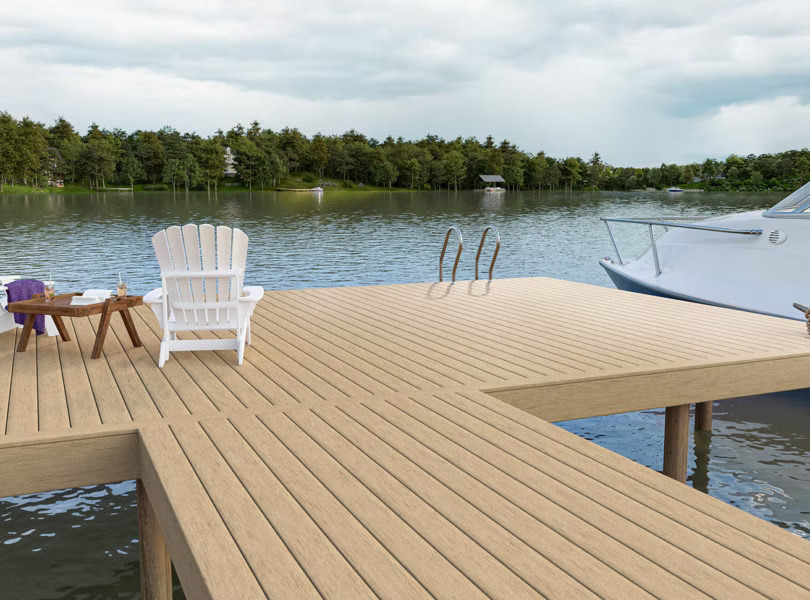 Composite decking dock with Adirondack chair and boat on calm lake, Central Florida waterfront
What the major manufacturers sell now — Trex, TimberTech, Azek, Fiberon — is capped composite: a polymer shell wrapped around a wood-plastic core. The better products carry twenty-five year warranties. Those warranties cover material defects. They do not cover installation errors, and on a dock the most common installation error is a gap that wasn't left.
Composite decking began as ground wood fiber mixed with plastic and pressed into boards. The early uncapped versions got hot enough in direct sun to blister. Twenty years of reformulation produced the capped product, which resists staining, holds its color, and handles moisture in a way wood does not.
On a Central Florida dock, that last part carries weight. The structure sits over water twelve months a year in humidity that doesn't meaningfully relent in any season. Pressure treated lumber — still a legitimate choice, still widely used in dock construction — requires periodic sealing or staining to stay ahead of that environment. Left alone it grays, checks, and eventually softens at the fastener points.
Most composite is priced and spec'd for residential decks: shade, moderate exposure, stable ground underneath. A dock has none of those. Full sun all day, heat reflected off the water, a structure that flexes with wind load and boat wake. In that environment capped composite outperforms uncapped, and lighter colors run meaningfully cooler underfoot.
Composite also moves with temperature more than wood does. The expansion gap that feels optional on a shaded patio is the whole ballgame on a south-facing dock in July, where surface temperatures reach levels uncomfortable to walk on barefoot. The manufacturer specs are written for exactly that. A contractor who installs tight to the board end has built you a claim you will lose, because the damage is an installation error and the warranty excludes it.
When you're reading a composite quote — seven thousand dollars for boards, before framing, before labor, before anything goes in the water — the board cost is the honest part of the number. What varies between marine contractors is the framing spec, the expansion gap discipline, and the fastener system.
Horizon Marine installs the Camo system on most builds: a jig that drives screws at an angle through the board edge into the joist below, leaving a clean face with no visible hardware.
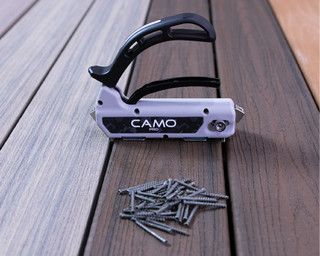 Camo hidden fastener jig and screws on composite decking, dock installation tool
On Trex, Horizon Marine uses the manufacturer's clip system, which the product is designed around.
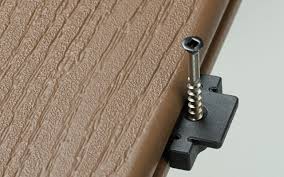 Trex hidden clip fastener system installed between composite deck boards, clean face installation
Both leave the surface clean, and both are specified for the material rather than improvised on site. Before signing a composite quote for a Florida waterfront dock, ask how the contractor fastens the field boards and what system goes on the handrail posts.
Published by

Horizon Marine — Docks & Seawalls
Central Florida's dock and seawall contractor. Free waterfront assessment. License #SCC131154313.
Have a waterfront project in Central Florida?
Free waterfront assessment · License #SCC131154313