

May 17, 2026
Lake Hamilton, Polk County: The Island Village and the President Who Came to Fish
A Seminole chief's village on Bonar's Island, and a former president casting a line from the same shoreline seventy-some years later
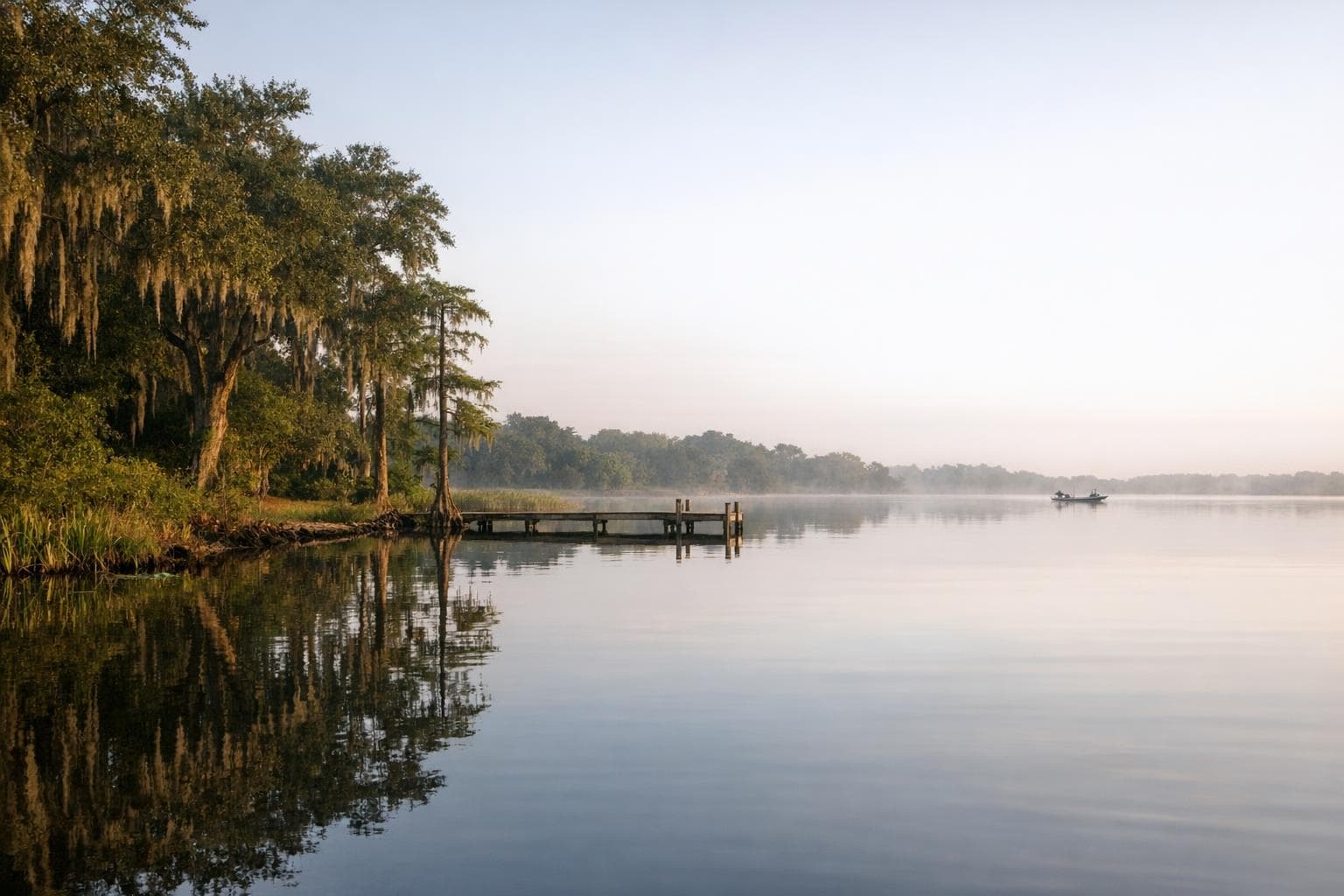
Bonar's Island sits a short way off the shore of Lake Hamilton, a hump of land most people drive past without registering. Around 1854, in the middle of the Third Seminole War, Chief Chipco brought his people there and made it home for about two years. He was a tribal leader of Muscogee Creek and Seminole heritage, and by the time he arrived on the island he was already an unusual figure — one of the first Seminole chiefs to move comfortably between the two worlds the war was trying to keep apart. He was sometimes seen walking the streets of Haines City.
That a war-era Seminole village sat on a small island in what is now a quiet north Polk lake is the kind of thing that ought to be on a roadside marker, and in fact it is. The Ponce de Leon Chapter of the Daughters of the American Revolution dedicated one in 1957, fixing the dates and the place in bronze before living memory of either could finish slipping away. The Third Seminole War was a low, scattered conflict — skirmishes, removals, hiding — and Chipco's choice to settle openly on Bonar's Island, within sight of white settlement, was its own kind of statement. He was not in the Everglades. He was here, on this lake, on this ridge.
The ridge matters to the story. Lake Hamilton sits on the Lake Wales Ridge, the spine of sand and high ground that runs down the middle of the peninsula. It is the reason the citrus groves came later — well-drained sandy soil, frost-shedding elevation, lakes deep enough to moderate the cold air on still nights. In Chipco's time it would have been longleaf pine and scrub, lakes ringed with cypress, the island a defensible bit of dry ground with water on every side. The same geography that made it a good village site made it, eventually, good grove country, and then good lakefront.
Skip forward roughly seventy-five years. In 1929, Edward Bok dedicated the Singing Tower at Mountain Lake, an event Calvin Coolidge attended as sitting president. Former president Grover Cleveland, by then long out of office and a serious recreational angler, is recorded as having fished Lake Hamilton with success — most likely during a visit tied to that same Bok Tower season of pilgrimage among the winter residents of the ridge. (Cleveland died in 1908, so any earlier ridge-country fishing trip would have predated the tower; local accounts place him on the lake, and the Bok dedication is the occasion most often cited.) Either way, the story that has come down through the town is that a U.S. president cast a line into Lake Hamilton and brought fish to the boat.
The lake earned that reputation honestly. It still has it. A Bassmaster destination piece from 2009 described Hamilton as a year-round bass fishery — spinnerbaits, jerkbaits, jigs, Texas-rigged worms, with wacky-rigged soft stickbaits producing in spring and summer. The guide quoted in that piece, Brian Albright, had pulled a 9-pound, 6-ounce largemouth out of it. Hamilton is known, he said, more for numbers than for giants. That is what a productive ridge lake looks like: shallow flats, hydrilla edges, a steady run of fish for anyone willing to work the shoreline.
The town that took the lake's name was platted in 1913, when William Hosmer built the first house and a store and the county school board put up $300 toward a schoolhouse. The groves followed the ridge south through Dundee and Lake Wales. The freezes — 1894–95, 1962, 1983, 1989 — pruned the industry hard each time, and many of the groves around Lake Hamilton never came back as groves. The recent fights at town hall over what to build on former citrus land are the long tail of those freezes; the 626-acre annexation in 2023, the development proposals delayed in early 2025 after residents pushed back on traffic and water bills, are all the same story of grove land turning into something else.
Bonar's Island is still there. It is small, wooded, and from most points on the shoreline it looks like nothing in particular — a green smudge on the water. The marker is in town. A chief lived out there with his people during a war the rest of the country was barely paying attention to, and decades later a former president fished the same water. Most of the people who own a boat on this lake have heard neither story. Both happened.
Lake Agnes, Polk City: The Shore Where Polk City Started
A Boston developer stopped to rest on the shore of Lake Agnes in the summer of 1922, and the town of Polk City grew from where he sat
Read →
Lake Rosalie, Lake Wales: The 1947 Canal That Gave the Lake a Second Way Out
Water leaves Lake Rosalie in two directions at once, and the northern route — the Zipprer Canal that kayakers now paddle — was cut through a floodplain marsh in 1947 to drain it for cattle pasture
Read →
Mountain Lake, Lake Wales: The Winter Home That Led to Bok Tower
Bok Tower sits on Iron Mountain because a Philadelphia magazine editor first bought a winter-home lot on the 92-acre private lake next door, and hired the lake colony's landscape architect
Read →
Lake Gertrude, Mount Dora: Who Controls the Water
In 2008, a Lake County commissioner said scenic Lake Gertrude should be open to outside canoes and kayaks — and the homeowners around it pushed back over who actually controls the water
Read →