

July 9, 2026
Hardee Lakes, Bowling Green: The County That Had No Lakes Until a Mine Made Four
Every one of Hardee County's four lakes was dug by a phosphate dragline in the 1990s — the county had no natural lakes at all until a worked-out mine was handed back as water
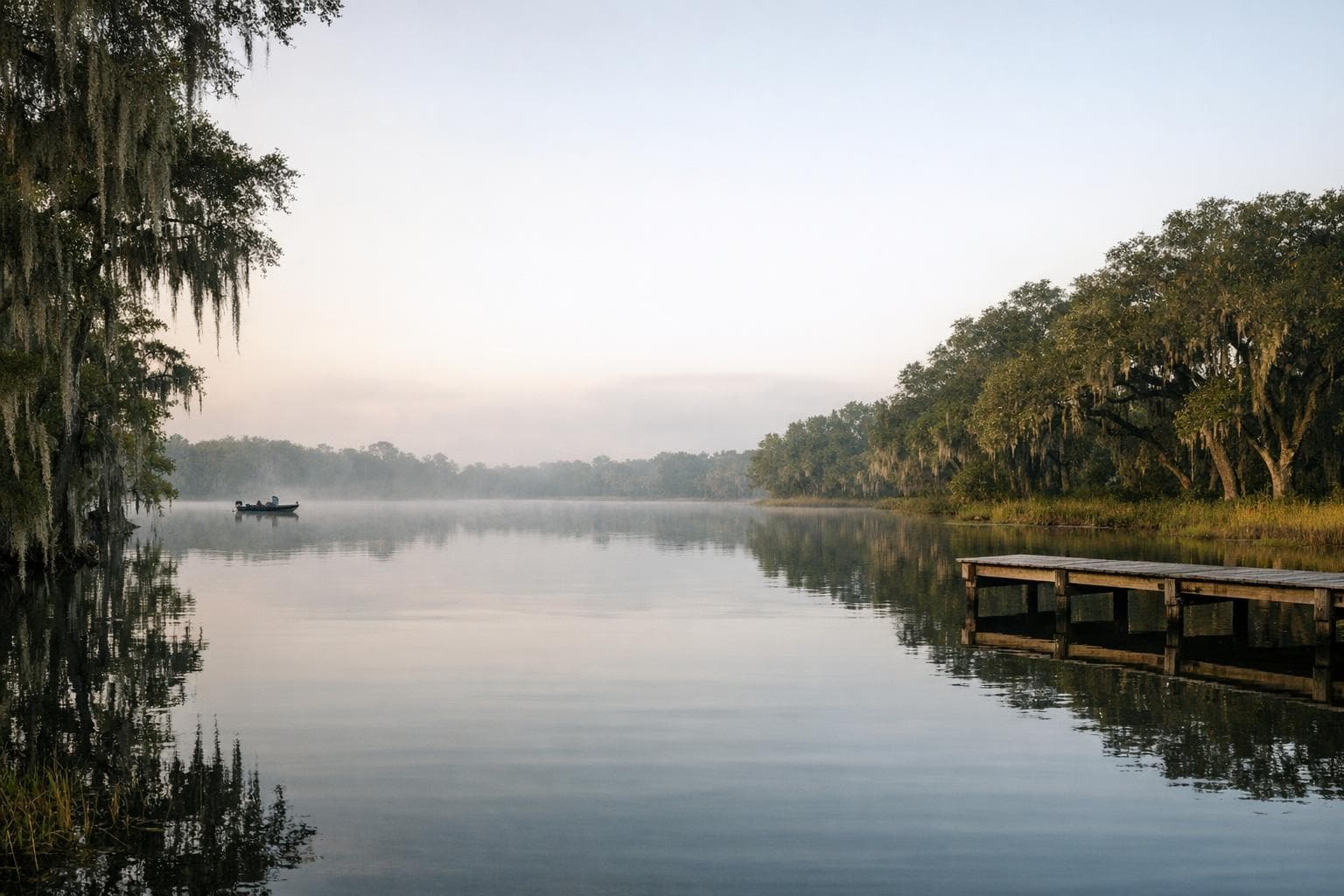
Before the 1990s, if you wanted to fish a lake in Hardee County, you left the county. There were none. The Lake Wales Ridge sinkhole lakes lie outside the county line; Hardee is drained by the Peace River, fed by creeks.
The four lakes at Hardee Lakes Park south of Bowling Green were dug by a dragline. Lake Hardee runs 120 acres, Deer Lake 110, Lake Firefly 97, and Gator Lake 47 — and every acre of them was scooped out to reach the phosphate underneath. The property was part of the Fort Meade Mine, worked by Cargill through the 1990s. When the ore was gone, what remained were the pits.
Those pits didn't get filled back in. Since 1975, Florida law has required that every acre the phosphate industry mines be reclaimed — put back to nature, agriculture, or some other productive use. Cargill's successor on the property, The Mosaic Company, did the reclamation work in partnership with the Florida Fish and Wildlife Conservation Commission, and the choice they made was to leave the excavations as open water and shape the ground around them into lakes. In 2001 the 1,260-acre tract, then held by IMC, was deeded to the Hardee County Board of County Commissioners.
The water sits in ground that used to be a working mine, bordered by the Polk County line to the north and Ollie Roberts Road to the south, close to Fort Green Springs.
FWC manages the lakes as a fish management area, the same protected-regulation status carried by Tenoroc and Saddle Creek in Lakeland and Cargill Fish Management Area near Fort Meade. The lakes were stocked and managed as a fishery from the start rather than left to fill with whatever swam in. In 2004 The Ledger ran a piece under the headline "Hardee Fishing: The Secret's Out."
The mine origin shows in the shape of the place. Reclamation lakes tend to have steep, regular banks where the dragline cut, and the four here sit as a cluster rather than a natural chain, each its own body of water inside one property. There's a campground, boat ramps, shaded tables, and a five-dollar-per-vehicle entrance.
Hardee County's older history has nothing to do with lakes. Settlement of what's now the county traces to April 1849, when the Kennedy-Darling Indian-trading post opened on what is now Paynes Creek. For the century and a half that followed, there was no lake inside the county lines.
The lakes at Hardee Lakes Park are now a stop on FWC's Florida Fishing Trail. The 2001 deed to the Hardee County Board of County Commissioners is the reason Lake Hardee, Deer Lake, Lake Firefly, and Gator Lake are public water and not a mining company's.
North Prong Alafia River, Mulberry: The 154 Snook That Started the Repair
When 1997's acid spill came down Skinned Sapling Creek into the North Prong, the first act of repair on the Alafia was a release of exactly 154 juvenile snook
Read →
Edward Medard Reservoir, Plant City: The Drawdown That Fed the Food Banks
When Hillsborough County's busiest reservoir was emptied in 2009 to rebuild its eroding bank, more than 1,300 of the stranded tilapia and catfish were filleted and sent to local food banks
Read →
Lake Davenport, Davenport: The 1942 Motion That Cut the Lake in Two
In 1942 the Minutes of Davenport record a motion to tear down the failing West Boulevard bridge and fill the channel with sand, and Lake Davenport's northeastern arm has been a separate pond ever since
Read →
Lake Whistler, Auburndale: The Dam on This Shore Belongs to the Lake Next Door
A high-hazard state dam completed in 1965 stands on 75-acre Lake Whistler's northeast shore, and the federal inventory lists its reservoir at 764 acres — Lake Arietta's number, not Whistler's
Read →