

May 20, 2026
Lake Silver, Winter Haven: When the Ferris Wheel Turned Above the Shore
For a few weeks each winter in the 1940s and '50s, a double Ferris wheel turned above the shoreline and the lake sat at the center of a national broadcast
The James E. Strates carnival company set up a double Ferris wheel and a full midway on the shore of Lake Silver for the Florida Citrus Exposition. Banquet tents, parade floats staged on side streets, radio crews running cable, and later television cameras broadcasting the whole thing to the rest of the country. For a stretch of years in the mid-twentieth century, a small residential lake on Winter Haven's northern chain was the site of the state's biggest annual celebration of the fruit that built it.
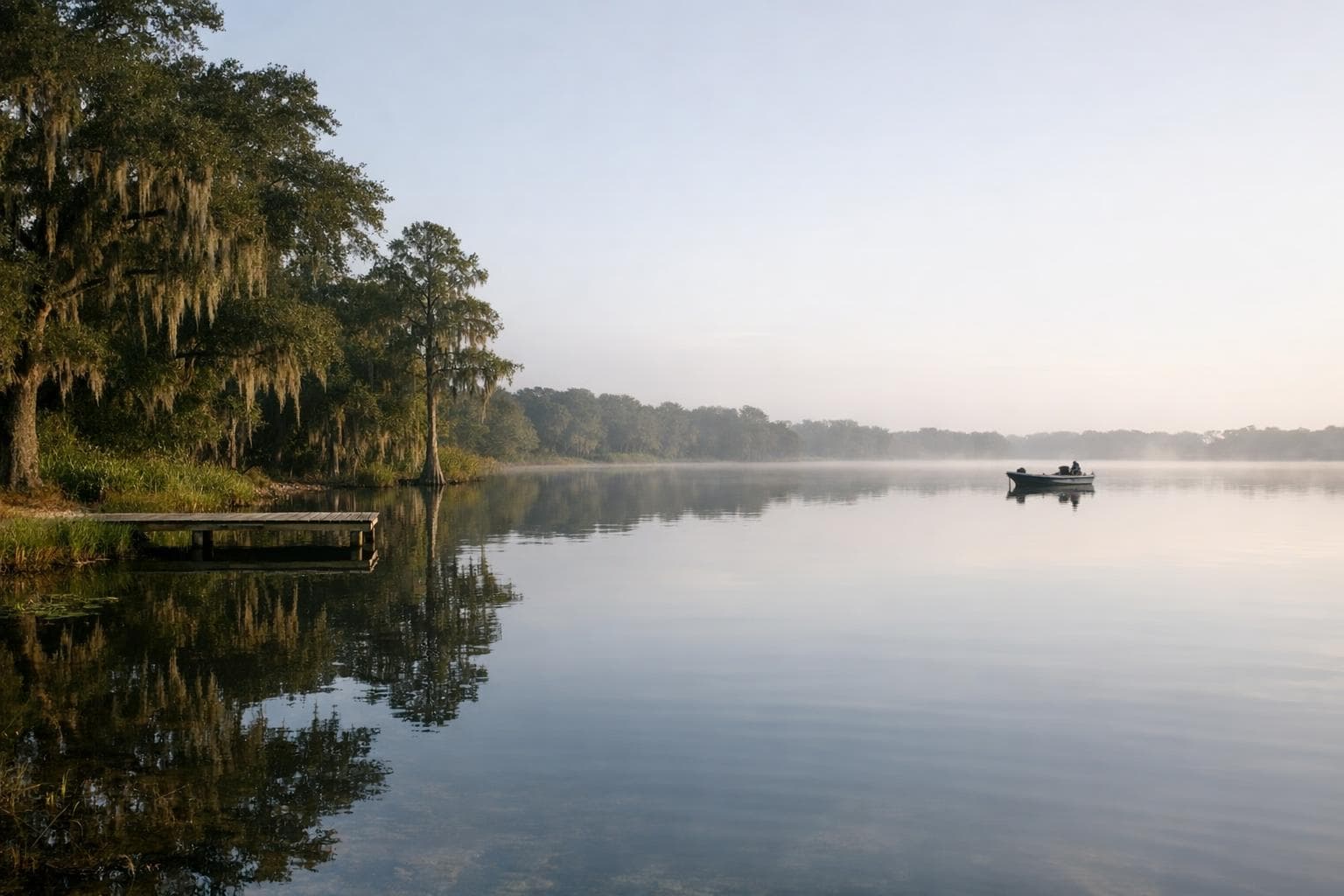
Most people who live near Lake Silver now know it as quiet water. Forty-five feet deep at its deepest point, according to the Polk Water Atlas, with a private shoreline and not much public access. There is no plaque. Nothing remains of the midway.
The Florida Citrus Exposition was Winter Haven's claim on the citrus industry. Displays of fresh fruit packed into pavilions, judged and arranged into elaborate constructions. Parades down Central Avenue. Banquets with speeches. National radio hookups, and eventually television. And on the lakefront, a traveling carnival.
The Strates company was a serious operation — one of the larger railroad-based carnival shows in the country, the kind that moved town to town by train and could put up a midway in a day. What they brought to Winter Haven included the double Ferris wheel, two wheels stacked on a single axis, taller than anything around it. Photographs from the era show crowds funneling through the 1949 entrance gate, the wheel turning behind them over Lake Silver.
The Exposition grounds sat on the lake's edge because that was the land the city had available: open ground near downtown, big enough for pavilions, rides, and parking. The water made a backdrop that read well on camera and in the souvenir photographs visitors carried home. For a few weeks each winter, a residential lake on the northern chain was the photographic shorthand for Winter Haven itself.
The Exposition faded, the way most mid-century civic festivals did. Cypress Gardens, down on Lake Eloise, grew into the region's year-round draw. The carnival stopped coming. The pavilions came down. By the time most of the current shoreline homes were built, the Exposition was held mostly in the memory of people who had been children when the Ferris wheel was lit.
Bob Griffiths, who has run the Lake Region Lakes Management District for decades, grew up near Lake Silver. The generation that watched the wheel from their backyards is the generation that remembers it; after them, the record is old photographs and a few paragraphs in the back issues of local magazines.
What's left is the lake, and a depth that surprises people who hear it for the first time. Forty-five feet is unusual in this part of Florida. Most of the chain lakes run ten to fifteen feet through the middle, shaped by dissolved limestone and shifting water tables. Lake Silver goes deeper because the karst feature beneath it goes deeper.
Lake Jessie, Winter Haven: The 180-Acre Lake Where the World Learns to Land on Water
About 500 pilots a year earn their seaplane rating on a 180-acre lake beside the Winter Haven airport — more, by one industry count, than every other seaplane school in the United States combined
Read →
Lake Marion, Haines City: The Island House Built in the Shape of a Celtic Cross
In 1887 an Irish carpenter who had come south for his lungs started cutting cypress on a 23-acre island in Lake Marion, and built a house in the shape of a Celtic cross — his family has held the island ever since
Read →
Lake Elbert, Winter Haven: The Hillside That Was Meant to Be America's Largest Modernist Neighborhood
Ten glass-walled houses opened on the grapefruit-grove crest above Lake Elbert's east shore in March 1957, and 10,000 people walked through them that first weekend — the opening installment of a modernist development that stopped at ten.
Read →
Lake Walk-in-the-Water, Lake Wales: The Lake That Lost All Its Hydrilla and Had to Be Replanted
Three 2004 hurricanes pulled every bit of submersed vegetation out of Lake Walk-in-the-Water and no one ever sprayed a drop — by FWC's account the hydrilla has not come back, and biologists have spent the years since hand-planting natives in its place
Read →