

May 25, 2026
Dinner Lake, Winter Haven: The 20-Acre Lake That Anchored a 199-House Subdivision
A 20-acre private lake in Winter Haven became the centerpiece of a 199-house gated subdivision platted in three phases — and most of the lots never touched the water
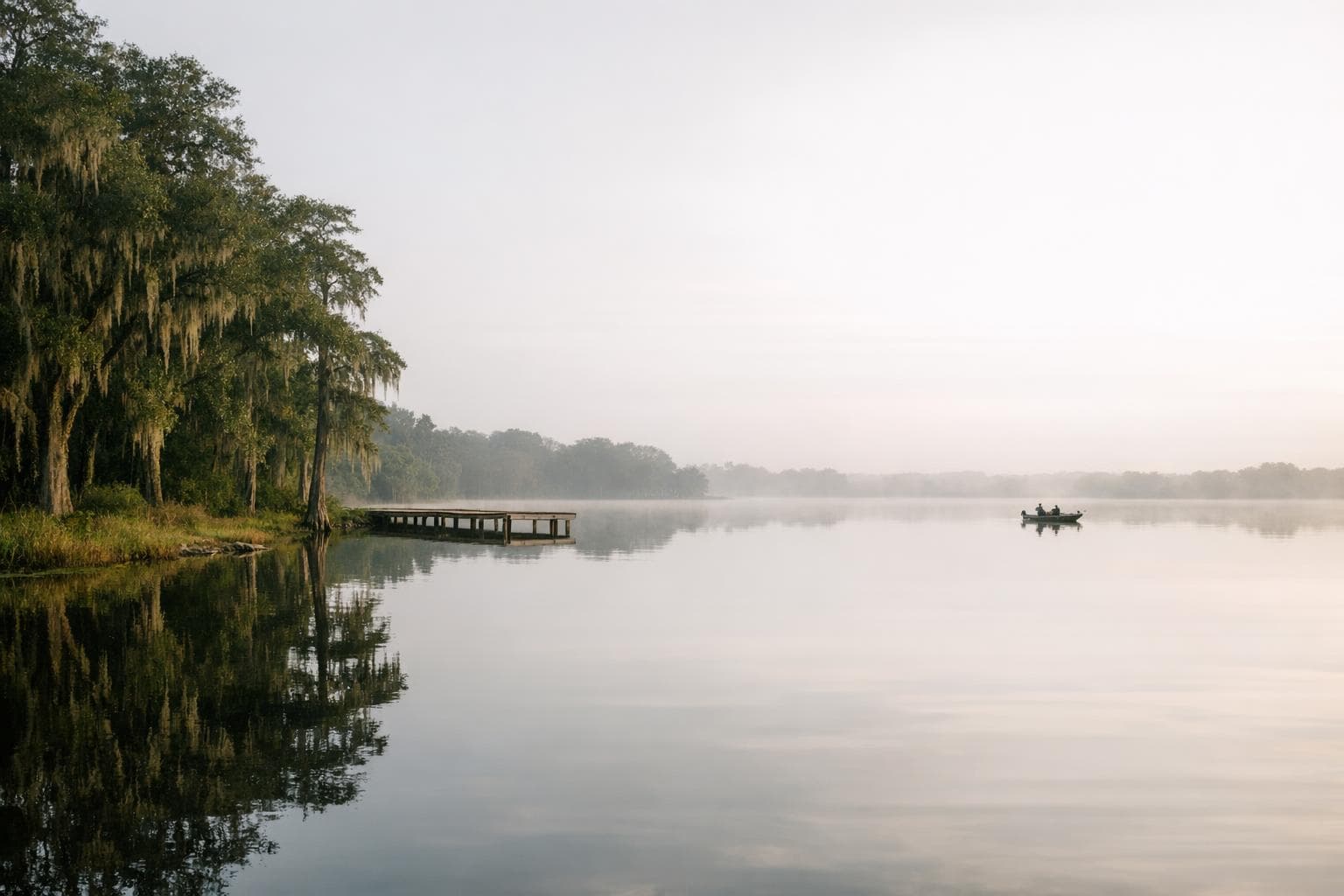
Dinner Lake covers twenty acres. That's small even by Polk County standards — smaller than a lot of the unnamed ponds people drive past without registering. But in May 2000, the final plan came in for the last phase of Dinner Lake Shore Estates, a private gated subdivision that would put 199 houses around a lake that, end to end, you could throw a rock most of the way across.
The math is the story. One hundred and ninety-nine houses. Twenty acres of water. Across three phases, the development would put roughly ten houses on the books for every acre of lake they were named after.
That ratio only works if you accept what the plan actually was: the lake was the amenity, not the address. The Ledger's coverage of the final phase made the arrangement plain — most of the lots sit in what had been pastureland, with only some of the deep lots in the first phase reaching to the lakefront. The other houses would look toward the lake, share an association with it, drive past it on the way in and out. They wouldn't sit on it.
This is how a 20-acre private lake becomes the engine for a 199-house subdivision. There aren't 199 waterfront lots on Dinner Lake. There couldn't be — the shoreline isn't long enough to hold them at any reasonable frontage. What there is, instead, is a name and a gate and the idea of the lake, multiplied across pasture acreage that wouldn't otherwise have carried a premium.
Winter Haven has plenty of subdivisions built around its bigger water. The Chain of Lakes carved the city's residential pattern decades earlier, and the lakefronts on Howard, Hartridge, Eloise, and the rest were largely spoken for by the second half of the twentieth century. Dinner Lake wasn't part of that chain. It was private, it was small, and it sat surrounded by pasture rather than platted neighborhoods. For a developer in 2000, that combination — a private lake, undeveloped land around it, a Winter Haven address — was the whole package. The lake didn't need to host the houses. It just needed to be there, behind a gate, attached to the name on the entrance sign.
Twenty acres is also small enough that the lake's condition is largely a function of what happens around it. A private lake doesn't get the same water-quality monitoring as the public chain. Its WBID — 1501D in the state's tracking system — exists, but the lake itself is essentially a closed neighborhood feature, governed by whoever owns the shoreline and the association that fronts it. When the plan was approved, the houses going in around the pasture would become, collectively, the watershed.
Dinner Lake Shore Estates was platted as private and gated from the start. That language matters less as marketing than as a description of how the lake itself would be reached. Public access to Dinner Lake doesn't exist in the way it exists for Howard or Shipp or Lulu. The lake sits behind the development that bears its name. You don't put a boat on it unless you live there.
What got built on Dinner Lake in the 2000s is one version of a pattern visible all over Polk County: small private lakes, formerly surrounded by pasture or grove, becoming the organizing feature of residential developments that use the water as identity more than as frontage. The lake isn't the neighborhood. The lake is what the neighborhood is called.
At build-out, the plan called for 199 houses across three phases around twenty acres of water.
Lake Agnes, Polk City: The Shore Where Polk City Started
A Boston developer stopped to rest on the shore of Lake Agnes in the summer of 1922, and the town of Polk City grew from where he sat
Read →
Mountain Lake, Lake Wales: The Winter Home That Led to Bok Tower
Bok Tower sits on Iron Mountain because a Philadelphia magazine editor first bought a winter-home lot on the 92-acre private lake next door, and hired the lake colony's landscape architect
Read →
Lake Whistler, Auburndale: The Dam on This Shore Belongs to the Lake Next Door
A high-hazard state dam completed in 1965 stands on 75-acre Lake Whistler's northeast shore, and the federal inventory lists its reservoir at 764 acres — Lake Arietta's number, not Whistler's
Read →
Lake Pierce, Lake Wales: The Five-Day Haul From Net to Railroad
Before it was a fish camp, the north shore of Lake Pierce was a commercial netting operation that hauled its catch out over log roads on a five-day round trip to the railroad — back when the lake was called Cat Fish Lake.
Read →