

May 22, 2026
Lake Minneola, Clermont: The Lake That Florida Tested First
In 2020, the clearest lake in the Clermont Chain became Florida's first test site for an Israeli-designed algicide — a $1.7 million experiment to see whether something nobody had tried here could knock cyanobacteria out of a protected lake
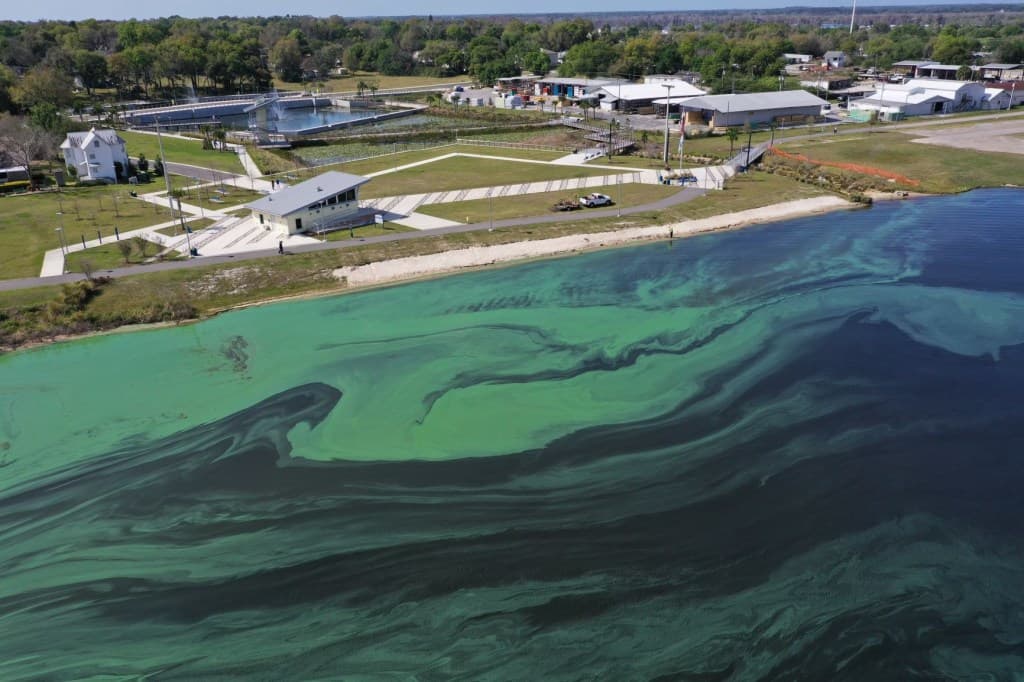
The water in Lake Minneola is usually clearer than the rest of the Clermont Chain. In the summer of 2020 the lake turned the wrong color, and the state agreed to try something on it that had never been tried in Florida.
The problem was cyanobacteria — blue-green algae, which produces toxins that can sicken people and kill dogs. Minneola had been struggling with it for years, despite carrying one of the highest protective designations the state hands out. The Clermont Chain of Lakes — Louisa, Minnehaha, Palatlakaha, Minneola, and the rest — was added to Florida's list of Outstanding Florida Waters in 1986. The label is supposed to mean a lake gets extra scrutiny and tighter discharge rules as the watershed around it fills in. South Lake County has been filling in fast.
By the late 2010s, blooms on Minneola had become routine enough that the Florida Department of Environmental Protection went looking for something new to try. What they found was a company called BlueGreen Water Technologies, based in Israel, with a proprietary hydrogen-peroxide-based algicide it claimed could selectively suppress cyanobacteria without scorching the rest of the ecosystem. Nobody in Florida had used it. The state decided Minneola would be the first.
The pilot was funded at roughly $1.7 million, run by the St. Johns River Water Management District in cooperation with DEP, and applied in stages across 2020 and into 2021. The Orlando Sentinel, reporting on the project that August, called the lake the state's guinea pig for a chemical treatment unproven in Florida. The treatment had been used in South Africa, China, and Israel. Minneola — almost 2,000 acres, ringed by Clermont's waterfront and swum by the triathletes who have made Clermont a training hub — was the test bed.
Lake Minneola sits at a low point in a chain that drains the old citrus ridge — the sandy spine where Clermont's groves once stretched in every direction, and where subdivisions, lawns, and stormwater systems have been steadily replacing them since the freezes of the 1980s pushed citrus south. The Palatlakaha River connects the chain together and eventually carries water north toward the Ocklawaha. Everything that runs off the ridge — fertilizer, septic seepage, stormwater — ends up moving through these lakes. Septic-to-sewer conversion reduces one of those loads at the source.
The final treatment application went down in June 2021. The St. Johns River Water Management District reported that the pilot had met its objectives for suppressing the bloom.
Hardee Lakes, Bowling Green: The Lake That Stayed Closed Until the Fish Grew
Lake 3 at Hardee Lakes Park was stocked with sunshine bass in 2001 and then kept shut to anglers while they grew, and when it finally opened one Saturday morning in October 2005 all eight spots were already taken
Read →
Lake Placid, Highlands County: The Town Melvil Dewey Renamed
The librarian who invented the Dewey Decimal System renamed a whole Florida town to plant a winter branch of his New York club — and the town still carries the name he picked
Read →
Peace River, Fort Meade: The Thirteen Miles Where the River Drains Into the Ground
Between Bartow and Fort Meade the Peace River loses water into holes in its own bed — on one day in June 2002 the USGS measured about 32 million gallons going into the ground — and Fort Meade is where the leaking stops
Read →
Lake Elbert, Winter Haven: The Hillside That Was Meant to Be America's Largest Modernist Neighborhood
Ten glass-walled houses opened on the grapefruit-grove crest above Lake Elbert's east shore in March 1957, and 10,000 people walked through them that first weekend — the opening installment of a modernist development that stopped at ten.
Read →