

November 18, 2026
Lake Istokpoga, Highlands County: The Osprey Patrol in the Cypress
In 1910 an egg collector wrote 75 osprey nests into his journal on Lake Istokpoga and in 1973 a biologist found nine - then Mike McMillian spent twenty-four years counting them back, and climbing the cypress to band the birds
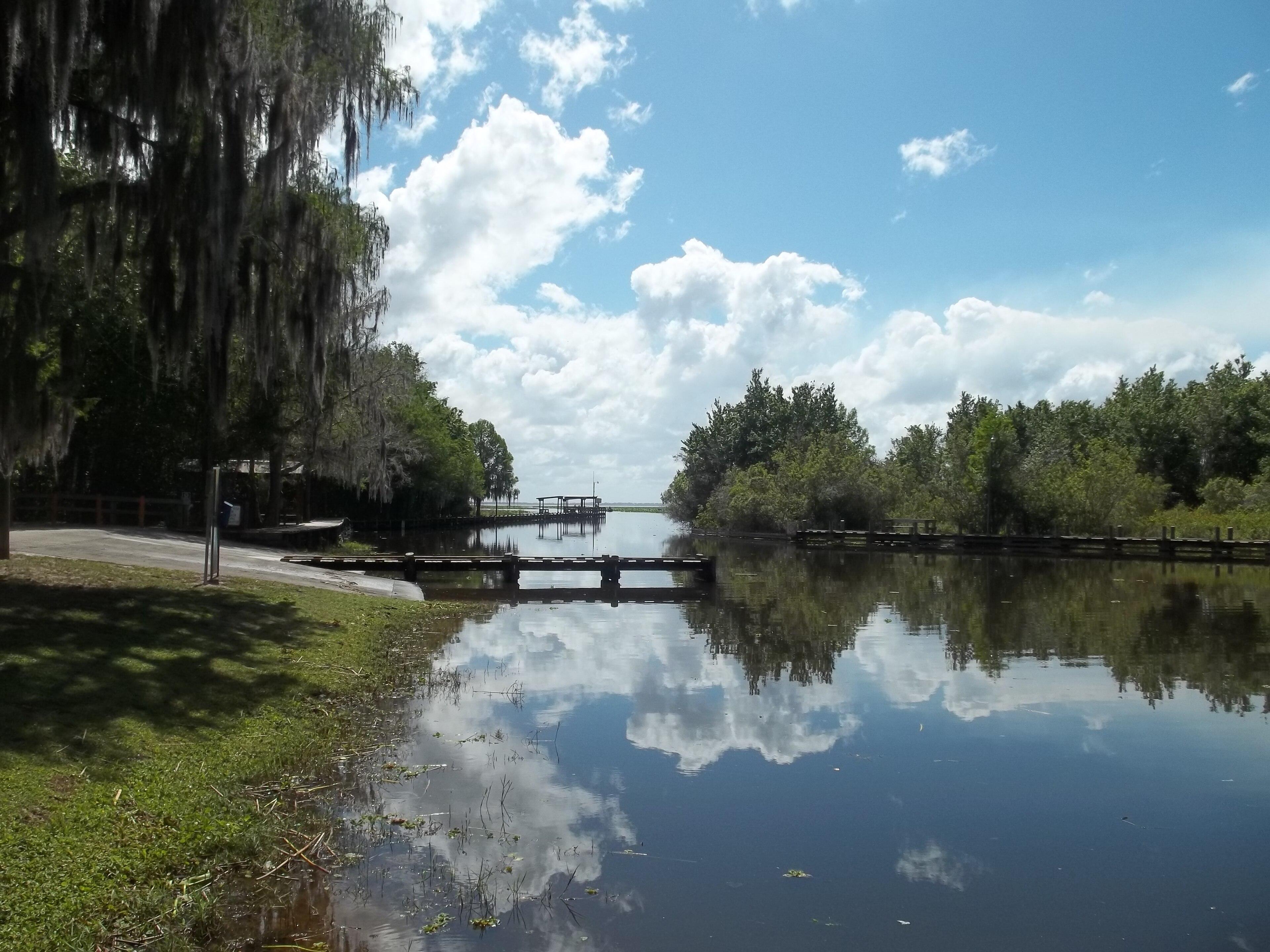
In 1910 a young man named D. J. Nicholson rowed down Istokpoga Creek — the channel now called the Istokpoga Canal — into the lake to record which birds lived along its shorelines and its two islands, and to collect eggs and specimens. Collectors like him were called oologists. In his notes he recorded 75 occupied osprey nests, counted between the tenth of March and the eighteenth of April.
Sixty-three years later Jim Layne, then director of Archbold Biological Station, went around the same shorelines with C. E. Winegarner on a single day in May 1973 and found nine occupied nests and twenty-two ospreys on the whole lake.
Mike McMillian heard that story and in 1989 took a boat around the lake and its two islands to see where the count stood. He wrote down 56 nests. The next year, 55. Counting nests was not enough, he decided: fifty-odd nests could still mean few young produced, as in the DDT years, and the number of nests could mislead. From 1991 through 2012 he censused every nest on the shoreline and the two islands eight to thirteen times a year between January and June, plotting each one on aerial photographs and recording how many young fledged from it. In 1995 he began color-banding nestlings with volunteer tree climbers and crews from Florida Power and Glades Electric, taking body measurements and blood samples while the birds were in hand; Brian Mealey of the Miami Museum of Science ran the blood for pesticides and mercury.
More than half of Istokpoga's shoreline, and virtually all the shoreline of both islands, is ringed with bald cypress. The upper branches are sparse enough to leave a nest an unencumbered site with a 360-degree view, and the heavily buttressed trunks stand in water that keeps raccoons off. The fishing underneath suits the bird's method: an osprey dives feetfirst and has to take fish near the surface or in shallow water, and because it hauls its catch home one at a time in its talons, a small fish is not worth the chase. Nests on Istokpoga turn up within ten to fifteen metres of one another, clustered along the southern, northeastern and eastern shores, the northeastern cluster sitting among houses.
Doug Stewart put the work in National Wildlife in October 2001. McMillian stood in a skiff alongside a bald cypress with one end of a climbing rope in his hands. On the other end, in rock-climbing gear, was Lourdes Rojas, going up to a nest ringed with fish skeletons to lift out two chicks. The pair had banded more than 500 ospreys over the previous decade. The first chick down was perhaps five weeks old and already weighed close to four pounds. Rojas told Stewart that an adult had thrown a fish at her the week before, which was a first. Along the lake's undeveloped, moss-draped cypress shores, Stewart wrote, one tree after another holds an osprey nest, sometimes two; the magazine put the lake's count at more than 700 ospreys and called it perhaps the densest concentration of nesting ospreys in the world.
In 1999 McMillian recorded 214 occupied nests in and around the lake. That same year he and Mark Martell of the University of Minnesota's Raptor Center fitted satellite transmitters on four adult female ospreys from Istokpoga, and all four traveled to four different countries in South America, Venezuela and Brazil among them. It had long been thought that ospreys south of Gainesville did not migrate at all, only dispersing around Florida in the non-breeding season. His 2013 paper in the Florida Field Naturalist carried the whole series: from 1995 to 2000 the nests visible by boat in March and April rose from 104 to 178, and by 2012 the lake held 200 nesting pairs along the water, more than 300 counting every nest associated with it, including the ones set back from shore on telephone poles, transmission towers and television antennas.
For the decline, that paper names the local use of pesticides in the 1950s, 1960s and early 1970s — aldrin and toxaphene on farms around the lake, DDT sprayed over Highlands County from 1966 to 1970 under a federal mosquito program. For the rise past anything Nicholson saw, the paper offers a hypothesis: hydrilla, introduced to Istokpoga in 1979, expanded the littoral zone and gave fish cover and nursery habitat, and an artificially high fish population could carry an artificially high number of ospreys.
He was still running nest checks in July 2016, by then an environmental specialist with Highlands County Parks and Natural Resources, and he told Archbold's newsletter that month, "To me, it's the prettiest lake in the County."
A person without a boat can reach the nests from Lake Istokpoga Park on the north shore, twenty-eight acres with a boat launch, a boardwalk and a pier; the foot trail runs east along the water's edge and then north along the boardwalk through the cypress margin. McMillian's own note to boaters, on the Friends of Istokpoga Lake Association's osprey page, was simpler: if you see a small Boston Whaler with someone raising a fifty-foot yellow pole, or hanging from ropes near an osprey nest, that is only the osprey patrol.
Sources
Every factual claim in this story was checked against the page it came from before the story was saved. These are those pages. Our standards are on the masthead.
- Michael A. McMillian, 'Long-term Trends in Osprey (Pandion haliaetus) Nesting Populations on Lake Istokpoga, Florida', Florida Field Naturalist 41(3), 2013 (full text of Florida Field Naturalist vol. 41, Internet Archive)
- Mike McMillian, 'Ospreys', Friends of Istokpoga Lake Association
- Doug Stewart, 'A Little Osprey-tality Goes a Long Way', National Wildlife, Oct. 1, 2001
- 'Osprey Ode', Archbold August 2016 News, Archbold Biological Station
- Lake Istokpoga Park, Florida Birding Trail
Saddlebag Lake, Lake Wales: The Five Months of Pumping It Took to Get the Water Out
Saddlebag Lake is a closed basin with no outlet, so when it rose into 300 homes in 2005 the only way out was three pumps and two miles of pipe to Lake Rosalie — paid for by the residents at $30,000 a month
Read →
Middle Lake Hamilton, Polk County: The One Passing Grade Came From Four Wedges of Twelve
Middle Lake Hamilton's only passing biological score, a 46 on September 3, 2020, came from four of the lake's twelve LVI wedges - two of which scored below the failing line - and ten months later the same assessor walked a different four and got 27
Read →
Lake Walk-in-the-Water, Lake Wales: The Lake That Lost All Its Hydrilla and Had to Be Replanted
Three 2004 hurricanes pulled every bit of submersed vegetation out of Lake Walk-in-the-Water and no one ever sprayed a drop — by FWC's account the hydrilla has not come back, and biologists have spent the years since hand-planting natives in its place
Read →
Lake Juliana, Auburndale: The County Park Permit Polk's Own Planners Turned Down
On June 6, 2012 the Polk County Planning Commission voted 5-1 to deny Polk County's own permit for a boat ramp on Lake Juliana — by the parks department's account the first county park permit ever rejected — and the appeal that reversed it turned on who owned the bottom of the lake.
Read →