November 28, 2026
Lake Kissimmee, Polk County: The Cow Camp That Has Been Keeping 1876 Since 1977
A ranger who answers to Mr. Chester has been keeping the year at 1876 on the Lake Kissimmee shore since the park opened in 1977, with fifty scrub cattle and six cracker ponies to make the point
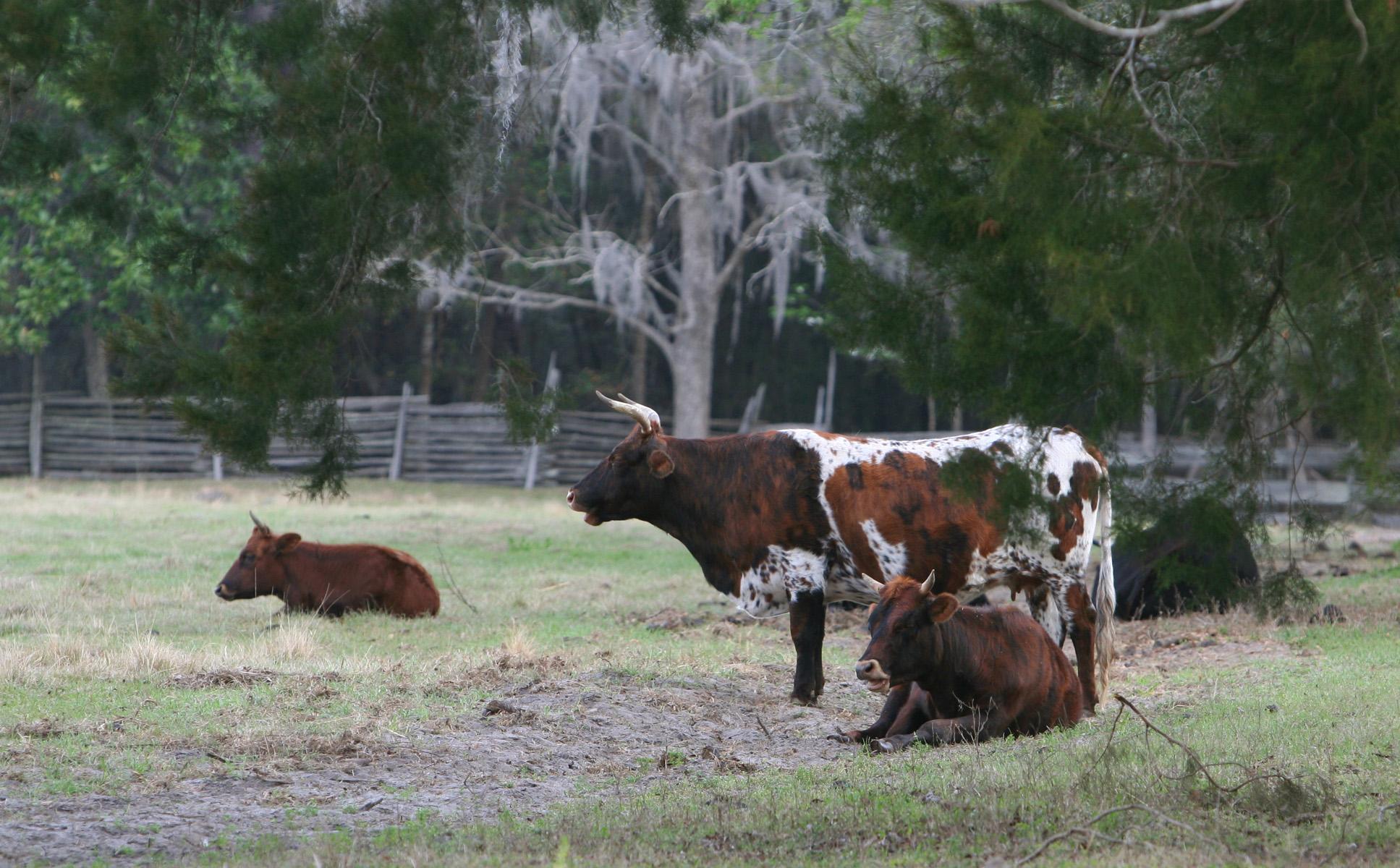
For the ranger who introduces himself as Mr. Chester, it is still 1876. He puts down a 12-foot cowhide whip to pour a cup of coffee brewing over the campfire, and he will offer to sell you a cow if you pay him in Spanish doubloons. The cows stand a few feet away in a corral fashioned from cypress logs, and their water trough is a hollowed cabbage palm trunk. Tom Palmer wrote that down for The Ledger in 2015, at the Cow Camp inside Lake Kissimmee State Park, east of Lake Wales.
Andy Noland, the park's manager, told Palmer the cow camp has existed in some form or another since the park opened in 1977. The state's approved unit management plan for the park carries the site in the Florida Master Site File as 8PO05301, Cow Camp, the site of a late 19th century cattle ranch, used now as a living history site interpreting the 1876 cattle industry and the Florida cow hunters. Everything built at the Cow Camp Interpretive Area, on the south side of the canal, comes to a corral and a small shelter.
The shelter is a chickee. James Coulter, writing in The 863 Magazine, counted what goes into one: a roof of nearly 2,000 cabbage palm leaves, good for three to five years before it needs patching, and no walls, which lets the cow hunter keep an eye on the cattle. The forest ranger Coulter met there, Mark Korushak, works the camp under the name Grazer, and tells visitors he is paid a dollar a day to watch another man's cows, that Florida is open range, and that the nearest town is Bartow — Lake Wales will not be founded for another 35 years. Palmer found a wagon parked inside the chickee carrying coffee, sugar, salt and flour, a Confederate army canteen hanging next to a rope-frame bunk, and an 1863 Sharps carbine within easy reach outside. The palm-woven roof over it withstood Hurricane Charley in 2004.
Fifty scrub cattle make up the park herd, the relatively scrawny descendants of the cattle Spanish explorers left behind in the 1500s, and six cracker ponies are kept for the roundups. The management plan describes cracker ponies as the small horses used to cow hunt on the range and through the woods, and puts 804 acres of the park in improved pasture, roughly a third of it grazed by the cattle and horses.
In the years following the Civil War there were twice as many cattle in Florida as people. The men who worked the range were called cow hunters — cowboy was taken as an insult — and they spent their lives on horseback rounding up cattle for the overland drive to Punta Rassa, near present-day Fort Myers, for shipment to Cuba. A corral like the one standing at the park held the cows gathered in preparation for a drive, which could take a month or two depending on the weather and the wetness of the terrain. The drives crossed open range dotted by cow camps a day's ride apart. Florida officials did not require ranches to be fenced until 1949.
The park lies at the headwaters of the Kissimmee River. G.W. Hendry, one of Fort Meade's pioneer settlers and a cattleman himself, wrote a description of Polk's natural features and agricultural potential in 1883. "The whole of Polk bordering the Kissimmee River is noted for its grazing of cattle," he wrote. The management plan lists what else the ground carried over the years — cattle ranching, timbering, farming and turpentining — and records that during the late 1800s the park and surrounding lands were used for Florida's pioneer cattle industry.
Most of the cattle in the Kissimmee Valley, Grazer tells visitors, belonged to Jacob Summerlin. Summerlin helped pioneer Florida's cattle trade with Cuba in 1859, and Cuba paid in Spanish doubloons worth roughly $15 a gold piece.
The Ledger put the number of visitors who make their way to the camp at 5,000 a year. The management plan records the program as an 1876 Cow Camp living history interpretation, provided weekends and holidays from October through May. Eliot Kleinberg recorded the reenactment opening for its season on October 1.
Sources
Every factual claim in this story was checked against the page it came from before the story was saved. These are those pages. Our standards are on the masthead.
- Preserving Florida's Cattle History: Lake Wales Cow Camp Transports Visitors Back to 1876 Florida — Tom Palmer, The Ledger, Jan. 27, 2015
- Lake Kissimmee State Park Approved Unit Management Plan, Florida Department of Environmental Protection, Division of Recreation and Parks (2014)
- Cow Camp: The Life Of A Cracker Cow Hunter — James Coulter, The 863 Magazine, Winter 2019-20
- Baron of Beef and King of Crackers — Cinnamon Bair, The Ledger, Jan. 15, 2006
- Peace River Days: The Cow Camp — Eliot Kleinberg, ekfla.com, Oct. 1
Lake Placid, Highlands County: The Town Melvil Dewey Renamed
The librarian who invented the Dewey Decimal System renamed a whole Florida town to plant a winter branch of his New York club — and the town still carries the name he picked
Read →
Lake Juliana, Auburndale: The County Park Permit Polk's Own Planners Turned Down
On June 6, 2012 the Polk County Planning Commission voted 5-1 to deny Polk County's own permit for a boat ramp on Lake Juliana — by the parks department's account the first county park permit ever rejected — and the appeal that reversed it turned on who owned the bottom of the lake.
Read →
Lake Tohopekaliga, Kissimmee: The Lake That Brought the Snail Kite Back
In 2004 the snail kite survey recorded no nesting at all on Lake Toho, and from 2005 through 2010 the same lake produced 41 percent of every successful snail kite nest documented in Florida
Read →
Lake Lowery, Polk County: The County Owns Shoreline It Can't Reach
Polk County owns lakefront land on Lake Lowery, left over after flood buyouts cleared the houses off it - and in July 2014 the parks director told the county's own lakes committee that a public ramp there was impractical because the only way in is a private road.
Read →