

November 28, 2026
The Wheel That Came Back Without Him
Robert Cleave flew out of Lakeland alone on September 2, 1941, and the only thing that ever came back was a numbered piece of his undercarriage — and the accounts do not agree on when, or on what happened to him
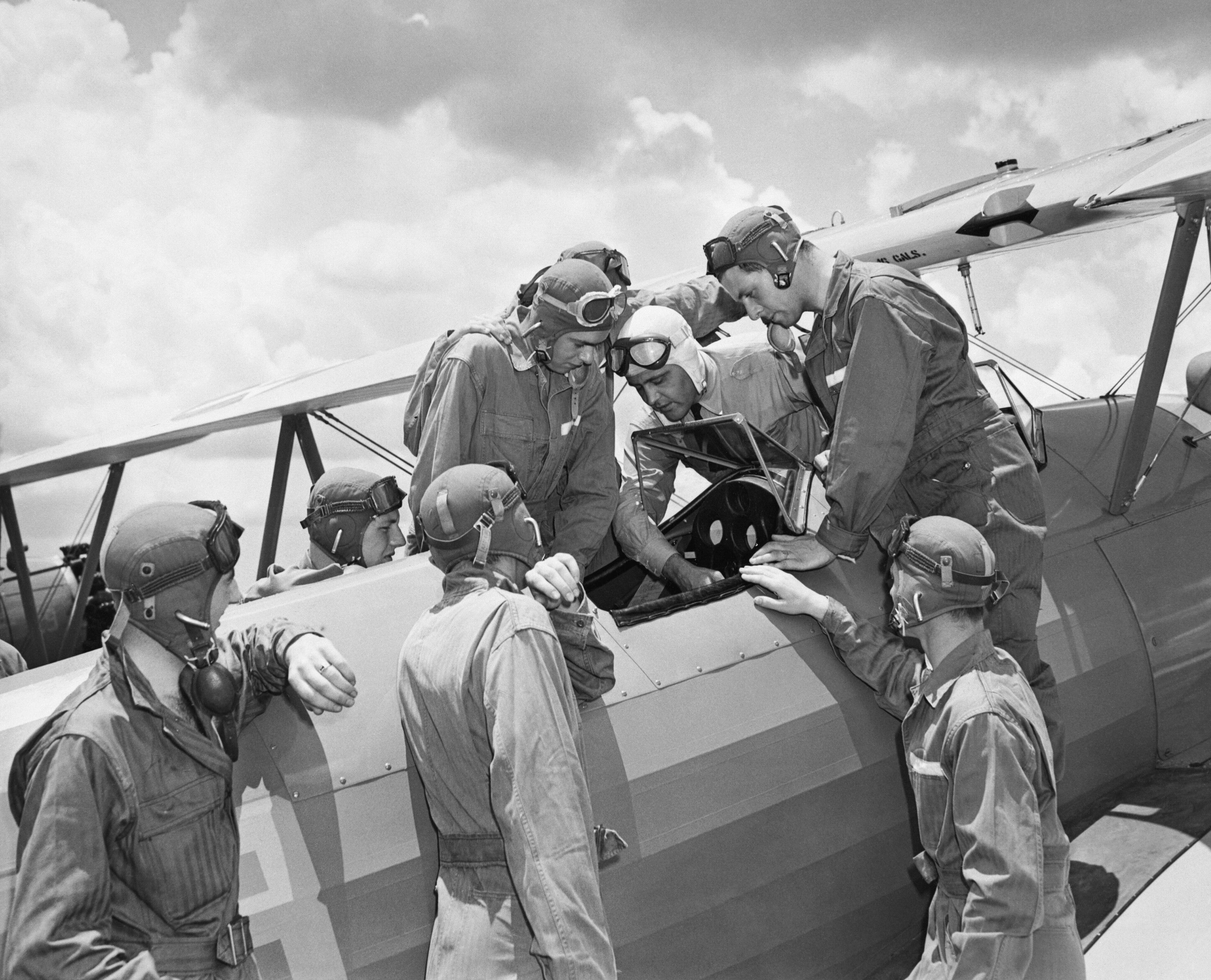
Robert Arthur Gordon Cleave took off alone from the flying field two miles north of Lakeland on September 2, 1941, and did not come back. He was twenty, the son of Arthur and Beatrice Annie Cleave of New Malden, Surrey, and the Royal Air Force had given him the service number 1312061. An extensive air and ground search failed to uncover any trace of Cleave or his aircraft.
The file the Air Ministry opened on him is at the National Archives in Kew under the reference AIR 81/8826, and its description runs to a single line: Leading Aircraftsman R A G Cleave, missing believed killed; aircraft accident, Stearman PT-3, Lincoln Flying School, Florida, USA, 2 September 1941. Lincoln Flying School was the field's old name. It had come down from Lincoln, Nebraska, in the spring of 1940, and Hal Darr and Al Lodwick bought it; Lodwick bought out Darr's interest the next year and renamed the place the Lodwick School of Aeronautics. It leased Lakeland Municipal Airport, where the Tiger Town baseball complex now stands.
The U.S. Army knew the school as the 60th Army Air Forces Flying Training Detachment. The cadet barracks and the mess hall stood between the hangars and Lake Parker. In the spring of 1941 the Army began allowing Royal Air Force cadets to train at American facilities, and the first contingent reached Lakeland that June for a ten-week course. Before the last of them left in October 1942, 1,327 British cadets had come through. They flew two-seater Stearman PT-17s and PT-13s, bright blue in the fuselage with yellow wings, lined up on the tarmac in line abreast. The course ran 60 to 65 hours of flight training, 85 to 140 hours of ground school, and 50 to 60 hours of physical and military drill. The aircraft carried no radio.
The cadets published their own yearbook. The August 1941 issue of Solo Land was put together by Classes 42-A and 42-B, the first two British classes at the school, and it listed every man in both, with his home town and what he had done for a living before the war. Class 42-A included William Hume, who on June 25, 1941 became the first British cadet to fly solo at Lakeland. Class 42-B included Cleave.
What happened on Cleave's last morning survives in a single recollection by another Lodwick trainee. That one account carries most of what follows. Fog blanketed the area after the first flights of the morning had departed in Stearmans, and the bad air held long past the fuel the airborne trainers were carrying. Emergency landings accounted for all of them but one, the aircraft flown by a British student on a solo flight. Air searches followed and turned up nothing.
A month later another hundred cadets came off a train. W C Wood, who had been a schoolboy in Glasgow, was one of exactly a hundred despatched on October 1, 1941, and they reached Lakeland the next day, each man allotted a bed in one of two long two-storey wooden buildings that faced each other across a grass square. Of the hundred who arrived on October 1, sixty or fewer would still be there on November 4. The washouts went back to Canada to be bomb-aimers and air gunners and fitters.
Then a piece of Cleave's aeroplane came back, and the two accounts of it do not agree. The Lakeland Public Library's catalogue record for that August issue of Solo Land says a piece of the landing gear from Cleave's aircraft was discovered floating in the Gulf of Mexico four months later. The trainee's recollection has word reaching Lodwick more than four years later that an aeroplane wheel had been found floating in the northern Gulf, and that the serial number and the maintenance records identified it as coming from the missing Stearman. Both versions have the undercarriage. Neither has the cadet.
The same trainee account carries what happened in August 1945. While the school was being shut down, a military transport plane landed at the field and its pilot asked to relay a message to the flight director, a man called Doc Holman. The pilot had been flying freed Allied prisoners from Germany to England, and one of them told him he had been captured while undertaking flying training in Lakeland: fog had blocked his return to base, when the fog cleared he found himself over water, and the gunners of a surfaced submarine shot his unarmed Stearman down. The submarine's crew pulled him out of the sea and he was taken to Germany and imprisoned. The account itself notes that German U-boats made their last forays into the Gulf between May and December 1943, which fits no cadet lost in September 1941.
In 2003 the Lakeland Ledger quoted Billy Henderson, whose father worked at Lodwick and brought cadets home to the house, saying that one of them was shot down in the Gulf by a German submarine while on a training flight, was rescued, and met his father again after the war, and that his father kidded him about it. Henderson's cadet had already gone on to advanced training, which Cleave never reached.
Twenty-three Royal Air Force cadets lie together in the British Plot at Oak Ridge Cemetery in Arcadia, on U.S. 17, about an hour's drive south of Bartow, beneath a sign saying they died while in training at U.S. flying training fields in South Florida. Twenty-one of them came from Riddle Field at Clewiston, and it is not certain how many, if any, had done their primary training at Lakeland first. Cleave has no grave.
A historic marker went up at the old field on May 12, 1994, dedicated in front of about a hundred former members of the 60th and the women who had worked there. The file at Kew has covering dates that run from 1941 to 1945.
Sources
Every factual claim in this story was checked against the page it came from before the story was saved. These are those pages. Our standards are on the masthead.
- Solo Land, August 1941 — item record, Lodwick School of Aeronautics Cadet Publications, Lakeland Public Library Digital Special Collections
- Robert Arthur Gordon Cleave — CASPIR, Canadian Warplane Heritage Museum personnel record
- AIR 81/8826 — Leading Aircraftsman R A G Cleave: missing believed killed, The National Archives (Kew) catalogue record
- 'Lodwick Marker Dedication' and 'History of the Lodwick School of Aeronautics,' Polk County Historical Quarterly (1994), page 7
- Gary White, 'Flight Cadets Attended Lakeland School of Aeronautics,' The Ledger, February 5, 2011
- US Flying Schools — Ted Church, Tail End Charlie (includes a Lodwick trainee's account)
- W C Wood, 'Only Birds and Fools Fly' — Training
- British Pilots Training in the USA, Part II — CFPNA (P. Laverdet)
- Only Birds and Fools Fly — introduction, by W C Wood AFC AFM
- Bill Rufty and Daneesha Davis, '23 Royal Air Force Cadets in Arcadia Cemetery Remembered,' The Ledger, May 26, 2003
The Towers That Broadcast Gulf to Ocean
The chief engineer who built WGTO told a reporter in August 1955 that the GTO stood for Gulf to Ocean, or else Gainesville to Okeechobee; the license left Polk County in 1989 or 1990 depending on which account you read, and a Lake Alfred road still carries the call letters
Read →
To the Generation Who Open and Possess These Relics
Bartow sealed a greeting to the future inside the Summerlin Institute cornerstone on May 12, 1887, and when the stone was opened during the 1930 demolition everything inside it was gone
Read →
The Night the Lake Came Over the Levee
The night before the storm came ashore, weather officials told Florida it would not hit
Read →
The Trooper Who Never Reached Cuba
Two Tenth Cavalry troopers were arrested in downtown Lakeland in May 1898 for a killing no two accounts describe the same way, and one of them never got out of Bartow
Read →