

October 12, 2026
Lake May Holds Almost as Much Muck as Water
In November 2005 a crew pushed an aluminum pole into the bottom of Lake May at 167 places. Under 8 to 10 feet of water they found another 6 to 10 feet of muck — 302.4 acre-feet of it, against 316.0 acre-feet of lake.
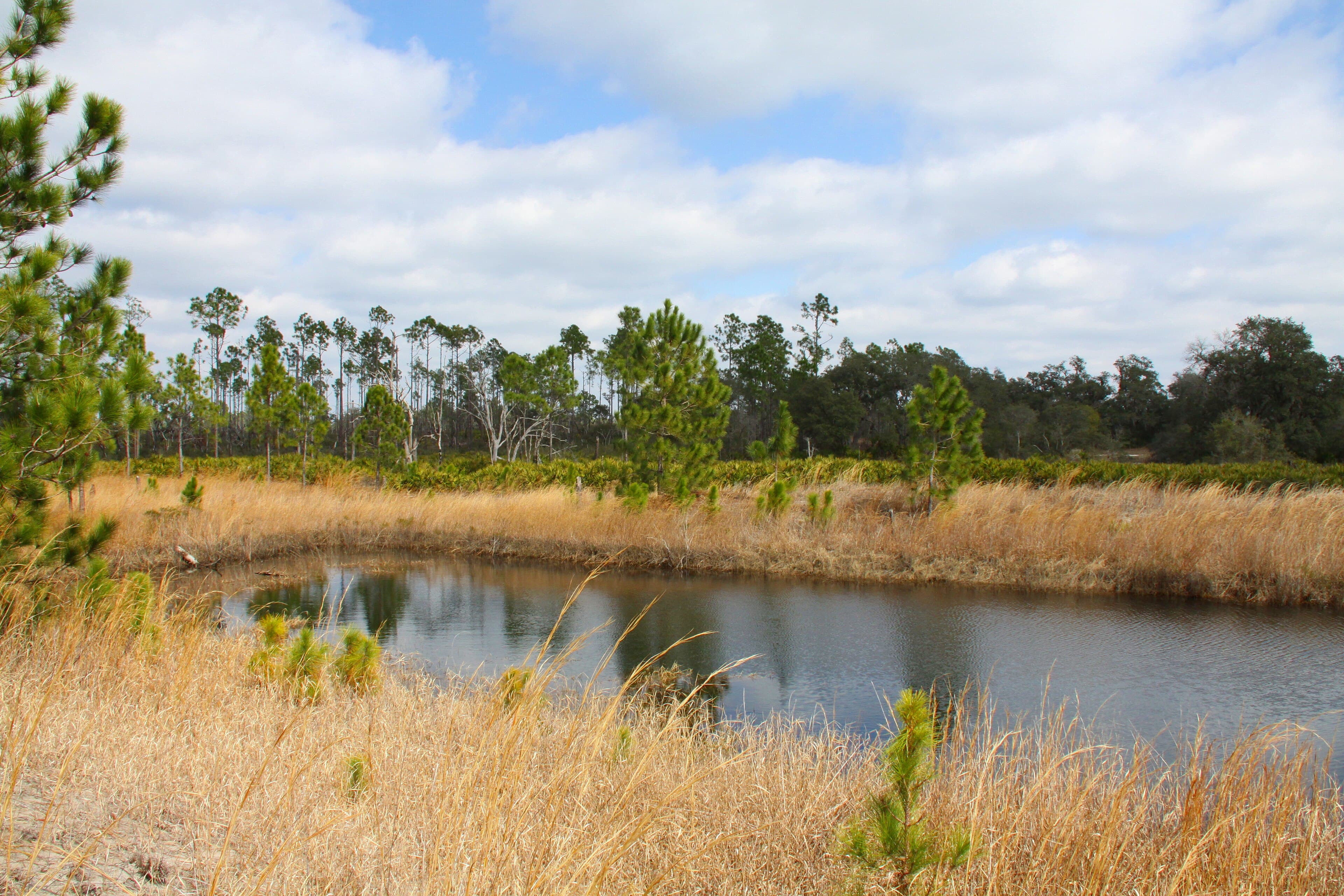
On November 16 and 17, 2005, field personnel from Environmental Research & Design worked their way around Lake May in Winter Haven and stopped at 167 separate locations. At each one they took two measurements, and each site was fixed by longitude and latitude with a portable GPS device.
The first measurement was the water depth. They lowered a 20 cm diameter Secchi disk on a graduated line until it met resistance from the surficial sediment layer, and recorded the depth on the line. Through the central portions of the lake that came to approximately 8-10 ft.
Then they put a 1.5-inch diameter graduated aluminum pole over the side and forced it down into the sediments until it reached firm bottom material, typically sand or clay. That is the depth to the firm lake bottom. The difference between the two numbers is the depth of unconsolidated sediment — the muck.
Through most of Lake May that difference runs approximately 6-10 ft. In one isolated pocket along the northwest side, next to the inflow from Lake Howard, the muck extends as deep as 18 ft. In the residential canals along the west side of the lake it is thinner, approximately 1-4 ft.
Added up, the organic sediments sitting above the firm bottom of Lake May come to approximately 302.4 ac-ft, or 487,872 cubic yards. Table 2-1 of the study puts the lake itself at a surface area of 50.54 ac and a volume of 316.0 ac-ft, measured at a water surface elevation of 131.79 ft. Approximately 50% of the lake bottom carries organic muck 7 ft deep or more. Spread evenly across the entire lake bottom, the muck would be approximately 5.98 ft deep.
Nobody had measured it before. The most recent bathymetry available for Lake May was a study conducted by USGS during March 1977, and it provided water depths only; it did not attempt to quantify existing muck accumulations.
Over the preceding decade, alum stormwater treatment systems, wetland treatment systems and wet detention ponds had been constructed to control nonpoint source inputs entering the Winter Haven Chain-of-Lakes. Environmental Research & Design framed the problem those projects left open: continued nutrient release from the accumulated sediments may negate the water quality improvements the projects could otherwise achieve. The study set out to determine whether all or portions of the accumulated organic sediments in Lakes May, Shipp and Lulu must be removed to achieve the desired water quality in them.
The study also estimated what would be left if the muck came out. With the organic muck removed, Lake May would become a relatively deep lake, extending to depths of approximately 18-19 ft in central portions.
Sources
Every factual claim in this story was checked against the page it came from before the story was saved. These are those pages. Our standards are on the masthead.
Lake Marion, Haines City: The Island House Built in the Shape of a Celtic Cross
In 1887 an Irish carpenter who had come south for his lungs started cutting cypress on a 23-acre island in Lake Marion, and built a house in the shape of a Celtic cross — his family has held the island ever since
Read →
Lake Otis, Winter Haven: The Two Parking Spaces That Unlocked the Hydrilla Money
Homeowners on a private Winter Haven lake raised about $40,000 to kill their hydrilla and needed $90,000 — so they built a public boat ramp instead, because a state rule only funds weed control on water the public can launch on
Read →
Peace River, Fort Meade: The Thirteen Miles Where the River Drains Into the Ground
Between Bartow and Fort Meade the Peace River loses water into holes in its own bed — on one day in June 2002 the USGS measured about 32 million gallons going into the ground — and Fort Meade is where the leaking stops
Read →
Lake Elbert, Winter Haven: The Hillside That Was Meant to Be America's Largest Modernist Neighborhood
Ten glass-walled houses opened on the grapefruit-grove crest above Lake Elbert's east shore in March 1957, and 10,000 people walked through them that first weekend — the opening installment of a modernist development that stopped at ten.
Read →