

July 14, 2026
Moon Lake, New Port Richey: The Four Miles of Roses in the Pine Flats
In the 1930s a Clearwater hotel man ringed a Pasco County lake with 35,000 rose bushes and four miles of blooms, and drew Rex Beach and a Vanderbilt to a dude ranch in the pine flats
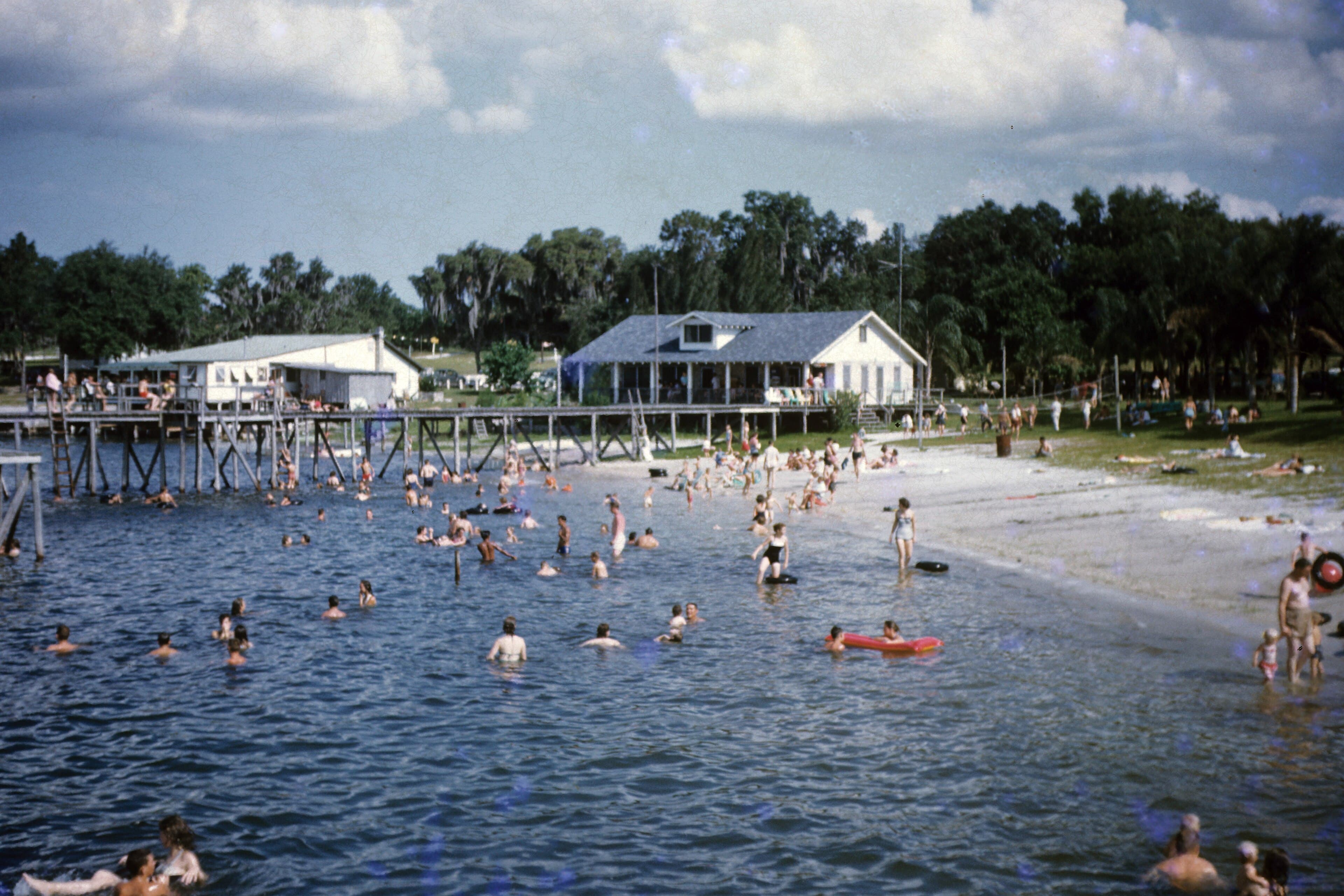
Between 1934 and 1936, someone bedded 35,000 rose bushes around a lake northeast of New Port Richey — enough to ring the water with four miles of blooms. Alongside them went 11,000 palms, 70,000 amaryllis, 5,000 azaleas, and rare fruit trees and lilies planted in the lagoons to keep something flowering year-round. All of it went into a stretch of Pasco County pine flats that had been a hunting preserve.
The man behind it was Ed Haley, who owned the Fort Harrison Hotel in Clearwater. His Moon Lake Company began developing the property in 1933 — a tract described in the historical marker as a 9,000-acre sportsman's paradise. Haley built the ranch out between 1933 and 1937, and by the time it opened, the grounds around the lodge held a public garden, walkways, a rodeo ring, and a lakeside dance floor big enough to compete with the other Florida garden attractions of the era.
A working dude ranch with rodeo and hunting, wrapped in an ornamental garden of tens of thousands of flowering plants, was the draw. Garden attractions dotted the state in the 1930s, and Moon Lake was planted on that scale.
Rex Beach, the novelist and screenwriter whose adventure stories were turned into films, stayed at Moon Lake. So did Cornelius Vanderbilt Jr. At one point the Florida Legislature held an informal parley on the grounds — lawmakers gathering at a rose-ringed dude ranch in the Pasco backcountry to talk business away from the capital.
The property carried a nationally known reputation as a game preserve. Accounts put its origins as a hunting operation as early as 1929, before Haley formalized the resort, and describe it as one of the more expansive hunting preserves of its time. Haley added the garden, the lodge, the rodeo ring, and the dance floor between 1933 and 1937.
None of the roses are there now. The name survives in the ground: Moon Lake is an unincorporated community and census place in Pasco County, with a population of about 4,800 as of the 2020 census, and Moon Lake Road runs through it. The neighborhood that grew up on the old ranch land is called Moon Lake Estates.
In September 2018, Pasco County closed Moon Lake Park after water levels rose fast enough to alarm homeowners around the shore. That same year, a fifteen-foot-wide sinkhole opened in the Moon Lake area along Pearl Drive, roughly ten feet deep in the backyard of two mobile homes, and four homes evacuated voluntarily. The Southwest Florida Water Management District has published minimum and guidance levels for the lake.
In February 2019, neighbors organized a second Moon Lake cleanup, working through an area that had struggled with illegal dumping and code violations.
The historical marker in New Port Richey stands where the dude ranch stood. It records a 9,000-acre sportsman's paradise, development begun in 1933 by Ed Haley's Moon Lake Company.
Lake John, Lakeland: The Lake a Dragline Left Behind
The 99-acre lake behind the ballfields at Curtis Peterson Park in Lakeland wasn't shaped by any river — it's water sitting in ground a phosphate dragline emptied out in the 1950s
Read →
Lake May Holds Almost as Much Muck as Water
In November 2005 a crew pushed an aluminum pole into the bottom of Lake May at 167 places. Under 8 to 10 feet of water they found another 6 to 10 feet of muck — 302.4 acre-feet of it, against 316.0 acre-feet of lake.
Read →
The Legal Floor Under Lake Wailes Has Never Been Met, and the District Proposes Lowering It to 102.1 Feet
Lake Wailes has not met the minimum level the water district set for it in 2015, and the draft reevaluation going to the Governing Board on October 27 would replace 104.8 feet with 102.1
Read →
Lake Pierce, Lake Wales: The Five-Day Haul From Net to Railroad
Before it was a fish camp, the north shore of Lake Pierce was a commercial netting operation that hauled its catch out over log roads on a five-day round trip to the railroad — back when the lake was called Cat Fish Lake.
Read →