

November 25, 2026
Lake Wire, Lakeland: The Telegraph Crews Named It, and the Railroad Came Looking for the Wire
In May 1867 a telegraph crew pushing a line toward Cuba skirted a 22-acre pond in northern Polk County and left it named Lake Wire, and sixteen years later that same wire was one of the reasons a railroad put its base camp on the shore
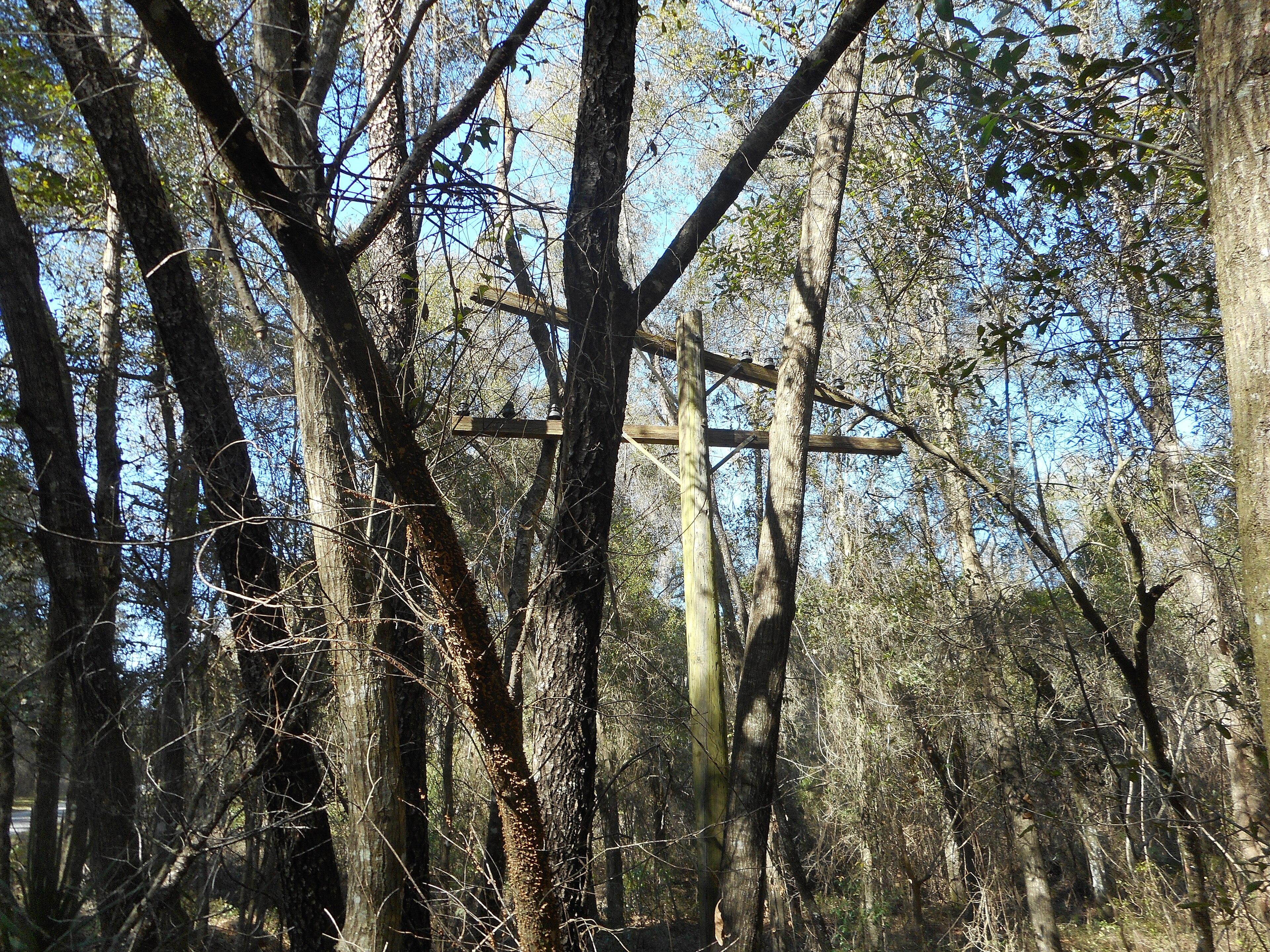
In May 1867 the pole gangs reached northern Polk County. The historian Canter Brown Jr.'s account has them wading waist deep and cutting their way through over 250 miles of thinly settled country, the line skirting Lake Wire that month, incidentally giving its name to that body of water, with the crews in Bartow within a few days. The Ledger reported in 2012 that the 22-acre lake was once known as Israel's Dish, reportedly after a cowboy of that name who camped there and left behind a dish that others used as a drinking cup.
In early 1866 Florida gave the International Ocean Telegraph Co. exclusive rights for 20 years to a Florida-to-Cuba cable, and the charter also covered stretching cross-state telegraph wires from the mainland to the state's islands, keys, sandbanks and reefs. Its engineer, W. H. Heiss, determined after months of investigating routes that the terminus would be the old U.S. Army facilities at Punta Rassa, with the run from there to Lake City going straight through the Peace River Valley. Work commenced April 20, 1867 from a headquarters at Gainesville. The wire reached Punta Rassa in late May 1867, and by August underwater cable reached Key West and Havana.
Accounts differ on the detail. Brown has the line skirting the lake, and the story map "Lovely Lakes of Lakeland" says the wires were stored near it; The Ledger, citing a report by the Polk County Historical and Genealogical Library, says the wire had to be routed around it. The month and the company are not in dispute.
The line workers cleared a trail as they went, and in the frontier historian James W. Covington's account that trail gradually developed into a road which became known as Wire Road.
In the summer of 1883 Henry B. Plant's South Florida Railroad was pushing a line between Kissimmee and Tampa fast enough to meet a state-imposed deadline of January 25, 1884. In his Origins of Lakeland series, Brown writes that Lake Wire afforded a nearly ideal situation for a work camp, because it provided access to the International Ocean Telegraph line, the Wire Road, and the old Fort Sullivan military road that connected Tampa with the Kissimmee and Orlando regions. Claude D. Clough was still a boy then, and in 1915 he told the Evening Telegram what he had seen: "About June 1883 gangs of laborers were seen in the woods cutting trees and opening up a right of way for the projected railroad."
Rail superintendent Herbert Drane built a crew camp at the lake, and by Jim Robison's account in the Orlando Sentinel that camp became Lakeland. The local historian LaFrancine Burton records that a crew of black railroad workers set up a camp on the southern shore of Lake Wire in 1883, some of them eventually moving a quarter of a mile south, into the ground bounded by Lake Beulah and Lake Hunter. Around December of that year L. M. Ballard moved his store and the Medulla post office to Lake Wire's south side, and in June 1884 he founded the town's first newspaper, the Lakeland News, which described its home as the new town on Lake Wire.
Rosalie Martin, writing for Lakeland Advertiser readers in 1919, had the name itself settled on the shore: Dr. J. L. DeRieux walked down to Lake Wire shore one evening with R. Trammell and the Rev. P. R. McCrary, and the three of them decided while there that the town should be named Lakeland. On January 1, 1885, Lakeland's 34 adult white men voted on incorporation, 22 in favor and 12 against.
On May 19, 2007 The Ledger printed a letter from John Brock of Lakeland, who wrote that an inventor from Massachusetts had strung wire through the trees all the way around a small mid-Florida lake and sent the message "What hath God wrought!" to an assistant in a nearby tent. The lake, Brock wrote, was Lake Wire, and he asked whether Lakeland might mark it with a monument or a sign. Samuel Morse, born in Charlestown, Massachusetts, opened his line on May 24, 1844, by the Senate Historical Office's account, with the wire stretching 38 miles between Washington and the railroad depot in Baltimore, and the words were not his. He invited Annie Ellsworth, the daughter of the patent commissioner, to compose the first message, and she chose the biblical phrase.
The park on the water is Lake Wire Shore & Park, at 20 Lake Wire Drive.
Sources
Every factual claim in this story was checked against the page it came from before the story was saved. These are those pages. Our standards are on the masthead.
- Jim Robison, 'Florida Wired for Telegraph After Civil War,' Orlando Sentinel, April 24, 2005
- LuAnn Mims, 'Lovely Lakes of Lakeland' story map (ArcGIS StoryMaps item data)
- Jennifer Fickley-Baker, 'A Day in Lake Wire Shore & Park,' The Ledger, May 31, 2012
- 'Lake Wire,' Polk County Water Atlas (USF)
- Canter Brown, Jr., 'Origins of Lakeland Series, Parts V and VI' (2019), ArcGIS StoryMaps item data
- Kimberly C. Moore, 'Confederate vets, former slaves among area's early settlers,' News Chief, May 5, 2018
- Canter Brown, Jr., 'Origins of Lakeland Series, Parts VII and VIII' (2019), ArcGIS StoryMaps item data
- 'The Ledger celebrates 100 years of covering Lakeland and Polk County,' The Ledger, August 22, 2024
- John Brock, letter, 'Lake Wire's Heritage,' The Ledger, May 19, 2007
- U.S. Senate Historical Office, 'What Hath God Wrought: Morse's Telegraph in the Capitol'
- 'Samuel Morse,' Lemelson-MIT Program
Lake Otis, Winter Haven: The Two Parking Spaces That Unlocked the Hydrilla Money
Homeowners on a private Winter Haven lake raised about $40,000 to kill their hydrilla and needed $90,000 — so they built a public boat ramp instead, because a state rule only funds weed control on water the public can launch on
Read →
Lake Istokpoga, Highlands County: The Osprey Patrol in the Cypress
In 1910 an egg collector wrote 75 osprey nests into his journal on Lake Istokpoga and in 1973 a biologist found nine - then Mike McMillian spent twenty-four years counting them back, and climbing the cypress to band the birds
Read →
Middle Lake Hamilton, Polk County: The One Passing Grade Came From Four Wedges of Twelve
Middle Lake Hamilton's only passing biological score, a 46 on September 3, 2020, came from four of the lake's twelve LVI wedges - two of which scored below the failing line - and ten months later the same assessor walked a different four and got 27
Read →
Saddle Creek at Structure P-11, Bartow: The Flow Record That Came Back
The USGS gauge below Lake Hancock published its last daily flow on October 7, 2014 and its next one on September 22, 2021 - and in between, the District had to calculate the lake's outflow instead of reading it
Read →