

April 19, 2026
Lake Arietta, Auburndale: The Street Named for What the Loggers Left
The street name on your waterfront lot is older than anything built there. Here's what Lighter Log Lane actually remembers — and what happened to the forest that gave it its name.
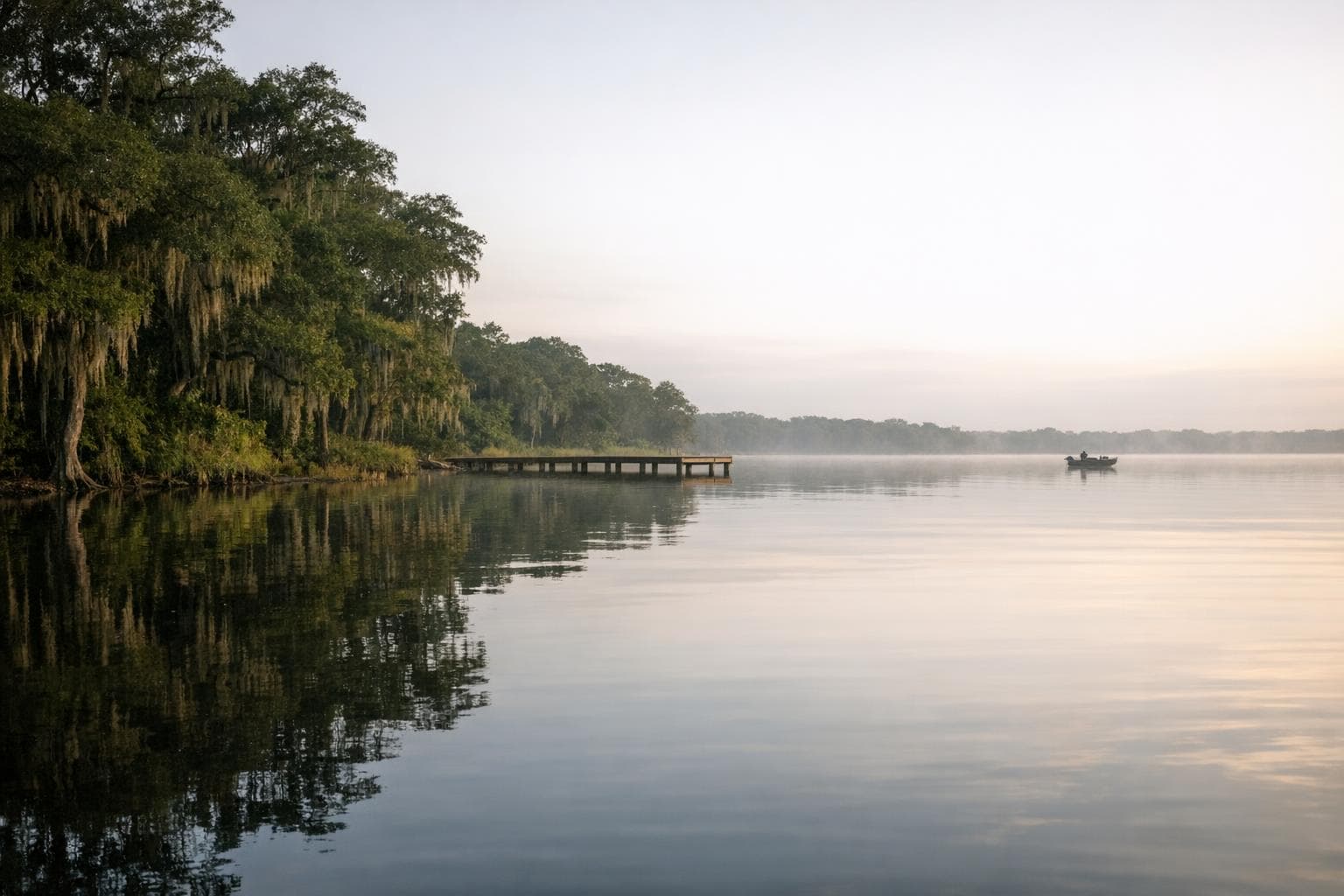
Lighter Log Lane runs along the shore of Lake Arietta in Auburndale, a residential street of waterfront homes in Polk County. The name refers to a material: lighter wood, the resin-soaked heartwood of dead longleaf pine, pulled out of the ground here by the thousands of stumps after the turpentine camps and the loggers were finished with the forest.
Lighter wood — also called fat lighter, fatwood, lighter knot, or rich lighter — is what remains of a longleaf pine after the tree dies or is cut. The sapwood rots away within a few years. The heartwood does not. It keeps taking on resin over decades until it is dense, dark, and so saturated with pitch that it will not decay. Pull a lighter wood stump from the ground a century after the tree was cut and it will still light in the rain.
The name means gives light, not catches fire easily, though it does both. Settlers across the Southeast split off thin pieces to start a hearth, a lamp, or a cook fire in any weather. Before petroleum, that was the reliable flame.
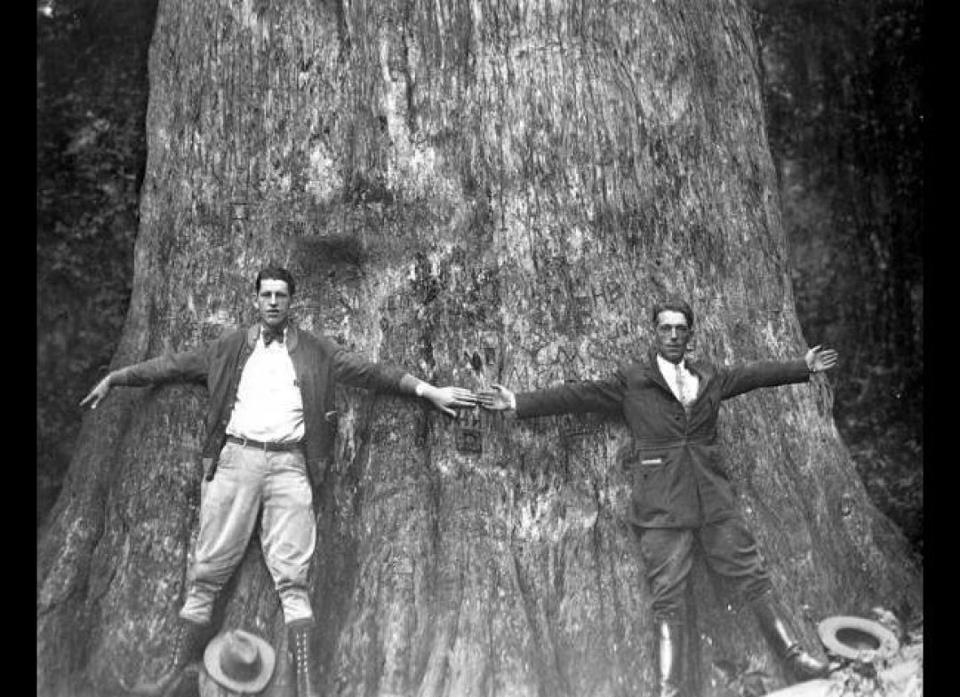 Two men standing at base of old-growth longleaf pine tree, early 1900s, showing scale of pre-logging timber
Old-growth longleaf pine, early 1900s. The trees took a hundred years or more to mature and could live five hundred.
Two men standing at base of old-growth longleaf pine tree, early 1900s, showing scale of pre-logging timber
Old-growth longleaf pine, early 1900s. The trees took a hundred years or more to mature and could live five hundred.
The land around Lake Arietta was longleaf pine forest — old growth, the trees needing a century or more to reach maturity. What made those trees valuable was the resin. Processed into turpentine, tar, pitch, and rosin, it was one of the most commercially valuable substances in the world before petroleum. It waterproofed wooden ships, preserved rope rigging, and went into paint, soap, medicine, lamp oil, and printing ink. The products were collectively called naval stores, and for two centuries the American Southeast supplied most of the world's demand.
The work was methodical. Tree chippers cut a V-shaped notch into the base of a longleaf pine — the wound was called a catface — and fixed a metal gutter and clay cup below it to catch the flowing resin. Every few weeks they cut a new face higher on the trunk, driving the wound upward as resin continued to flow. Over six to ten years the tree was bled out. Then it was sold to loggers.
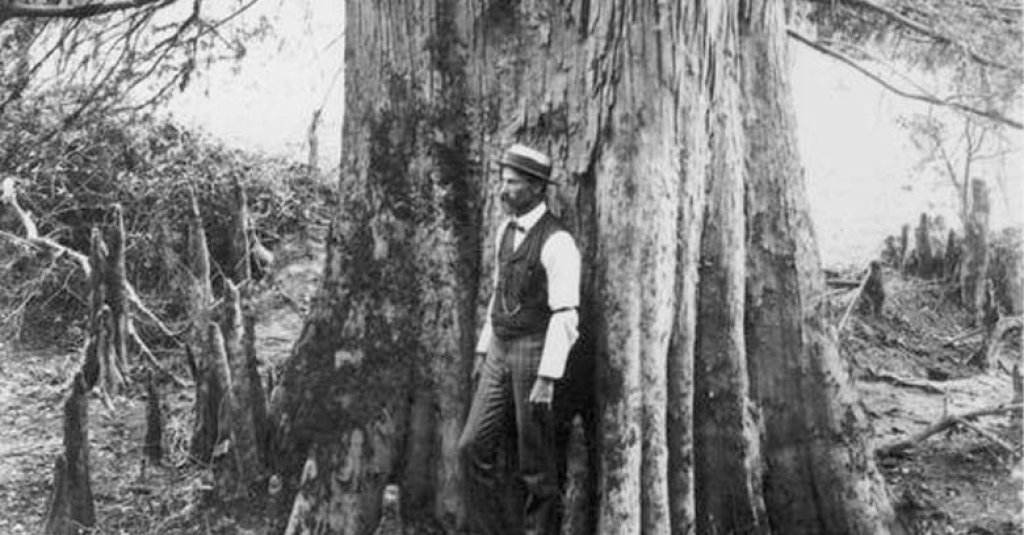 Man standing between massive cypress trees in cleared Florida forest, late 1800s early 1900s logging era
Florida timber, late 1800s. After the turpentiners were done, the loggers moved in.
Man standing between massive cypress trees in cleared Florida forest, late 1800s early 1900s logging era
Florida timber, late 1800s. After the turpentiners were done, the loggers moved in.
The industry reached Florida by the 1870s. By 1909 the state was among the nation's leading producers of naval stores. The camps that processed the resin were company towns in the full sense — housing, stores, schools, and enforcement controlled by the operator. Workers were paid in company scrip redeemable only at the company store, which kept prices high and wages functionally worthless. Many were never able to leave.
In Polk County, the turpentine camp of Nalaka operated from 1919 until 1928 across thousands of acres, staffed under the debt peonage system that bound workers through manufactured debt. Camps like it ran across central Florida in the same years. In 1923, after a young North Dakota man was beaten to death at a camp in Dixie County, the Florida Legislature abolished the leasing of convicts to private industry. The turpentine camps began closing. By 1950 the industry was effectively gone.
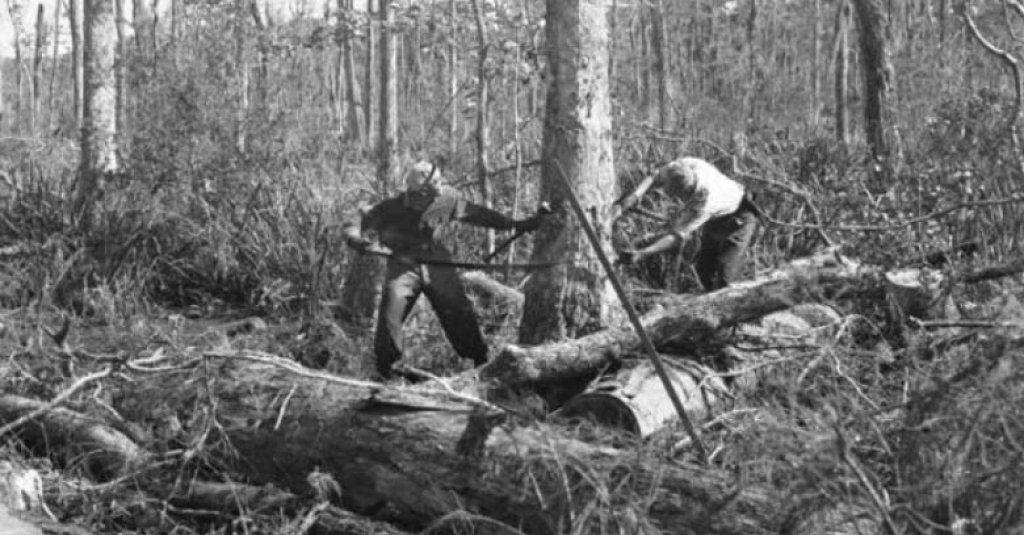 Workers sawing felled timber in Florida flatwoods forest, early 1900s longleaf pine logging
Central Florida timber work, early 1900s.
Workers sawing felled timber in Florida flatwoods forest, early 1900s longleaf pine logging
Central Florida timber work, early 1900s.
What the turpentiners and loggers left behind was stumps — thousands of them across the central Florida flatwoods, each holding decades of accumulated resin. Farmers dug them out of their fields and sold them as lighter wood for generations. Some are still being pulled from the ground.
The longleaf forest itself did not come back. Across the Southeast it has been reduced to less than three to five percent of its original range. What grew back here was faster-growing slash pine. The open-canopy pine savannas that had defined this region for millennia, with their wiregrass understories and gopher tortoise colonies, went with the old trees.
Lake Arietta predates all of it. So do Lake Ariana and the dozens of others ringing Auburndale. But the pine stands that once ran to Arietta's edge were cleared, the stumps pulled or left to sink into the soil, and the land was eventually sold, subdivided, and built on.
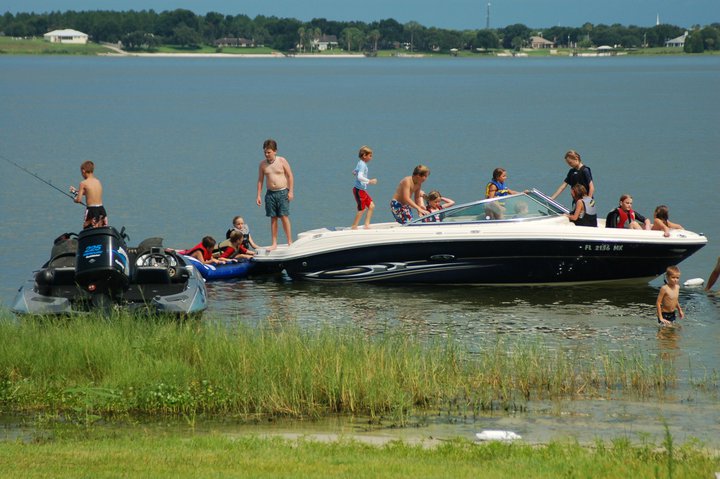 Lake Arietta shoreline and open water, Auburndale, Polk County, Florida
Lake Arietta, Auburndale, in the Peace River–Saddle Creek Watershed.
Lake Arietta shoreline and open water, Auburndale, Polk County, Florida
Lake Arietta, Auburndale, in the Peace River–Saddle Creek Watershed.
Lake Arietta today is 739 acres of private freshwater in the Peace River–Saddle Creek Watershed. People fish it for bass from their docks and ski it on weekends. The lighter wood stumps that gave the street its name are somewhere underfoot, still holding their resin, a hundred years after the pines that made them were cut.
Presented by

Own waterfront in Auburndale?
Lake history is interesting. Shoreline conditions are practical. Horizon Marine builds docks, seawalls, and shoreline protection on Auburndale's lakes — and gives a straight answer on what your property actually needs.
Moon Lake, New Port Richey: The Four Miles of Roses in the Pine Flats
In the 1930s a Clearwater hotel man ringed a Pasco County lake with 35,000 rose bushes and four miles of blooms, and drew Rex Beach and a Vanderbilt to a dude ranch in the pine flats
Read →
Edward Medard Reservoir, Plant City: The Mine That Became the Park
The 770-acre lake east of Brandon where a quarter-million people a year come to fish and camp was, in the 1960s, an open phosphate pit
Read →
Lake Bonny, Lakeland: The Nine Inches That Kept the Pumps Off
When Hurricane Milton pushed Lake Bonny into east Lakeland's neighborhoods in October 2024, the city couldn't legally start pumping until the water had already reached people's homes
Read →
Lake Padgett, Land O' Lakes: The Sinkhole That Was Measured From the Inside
On July 14, 2017, a sinkhole opened in the Lake Padgett Estates subdivision, swallowed two homes and a boat, and grew to 260 feet across — and a USF researcher climbed in with a 3D scanner to study it
Read →
Building on Lake Arietta or another Auburndale lake?
Free waterfront assessment · License #SCC131154313